
A customer once asked us to quote a granite replacement for a cast iron surface plate that had been sitting in their shop for eleven years. When we asked why, the answer wasn’t accuracy — the plate still checked out fine. It was that the shop had moved to a corner near a loading dock, and the plate had picked up a scatter of small dings and burrs from parts being set down carelessly. On cast iron, a burr raises a ridge you can feel with a fingernail and has to be stoned down. On granite, the same impact just leaves a small chip, and the surrounding surface stays flat. That’s a real difference, and it’s not the one most comparison articles talk about.
Most “granite vs cast iron” pages you’ll find are written by granite sellers, so they read like granite wins everything. It doesn’t. Both materials are still in production for good reasons, and the right choice depends on what you’re doing with the plate, not which one sounds more advanced.
What actually differs between the two materials
Granite doesn’t have internal stress to release. Cast iron is a poured, cooled metal casting, and even after stress-relieving and aging, it can move slightly over years as residual stresses redistribute — more so if it’s been through a temperature swing or an impact. Granite is a natural stone that was under geological stress for millions of years before it was quarried; once it’s cut and lapped, there’s nothing left inside it to relax. If you need a reference surface that holds its calibration over a long service life without periodic re-flattening, this is the single biggest reason granite is specified for metrology work.
Cast iron can be repaired by hand scraping. Granite can’t. If a cast iron plate wears or gets damaged, a skilled scraper can bring it back into tolerance in the shop. A damaged granite plate goes back to a lapping facility, or gets scrapped. If you’re in a facility without easy access to a granite re-lapping service, and you expect the plate to take a beating, that repairability is worth real money over the plate’s life.
Granite doesn’t rust. This sounds minor until you’ve run a plate in a humid coastal shop or a food-and-beverage cleanroom with washdown cycles. Cast iron needs oiling and careful humidity control to avoid surface rust, which — if it happens — changes the surface locally and has to be addressed before it affects a measurement. Granite is inert to that entirely.
Cast iron has better damping and higher stiffness-to-weight for a given size. For very large machine tool beds and bases, cast iron’s vibration damping characteristics and the ability to cast in ribs and cavities to manage weight are genuine engineering advantages that solid granite doesn’t have in the same way. This is why cast iron still dominates in machine tool structures even though granite has taken over most metrology surface plates.
Cast iron can be tapped and drilled directly. Threaded holes go straight into iron with a tap. Granite needs threaded inserts bonded or mechanically fixed in place, which has to be planned into the design — you can’t just drill and tap a hole into a finished granite component the way a machine shop would into iron.
Granite has lower thermal conductivity. This cuts both ways. It means granite is less prone to distorting from a localized heat source (a motor mounted nearby, a hand resting on one spot), because heat doesn’t conduct through it and create a local gradient as readily. But it also means that if the whole plate needs to come to a new ambient temperature — after shipping, or overnight HVAC setback — it takes longer to soak through evenly. Cast iron equalizes faster, for better or worse.
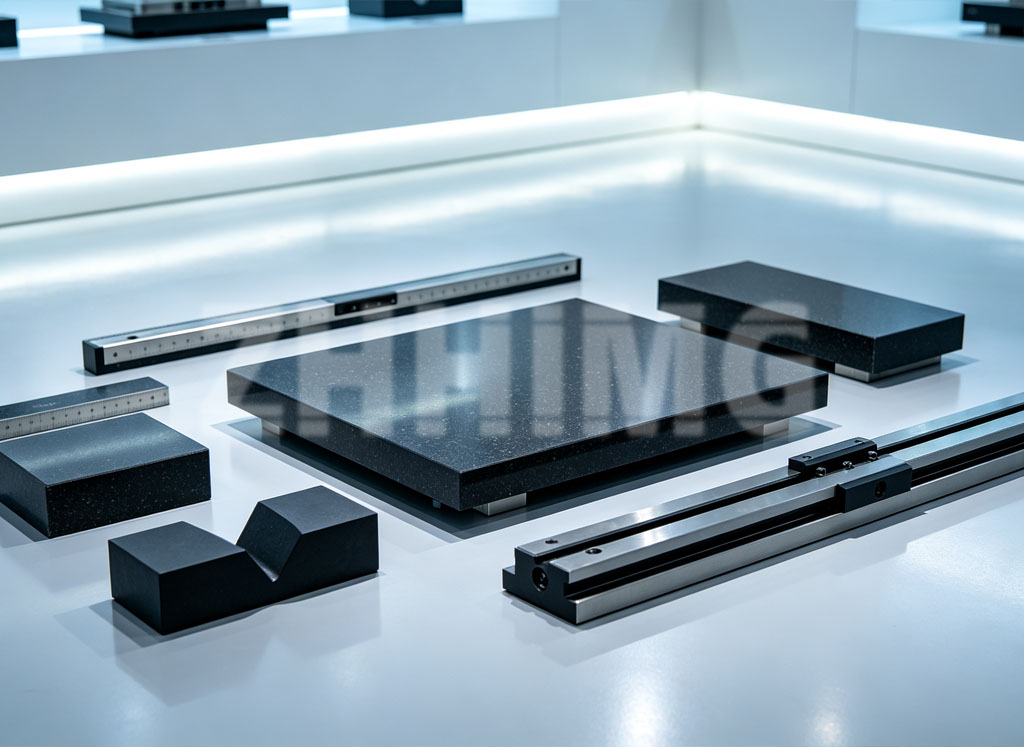
Where granite is the clear choice
If you’re building or specifying equipment where the base needs to stay dimensionally stable for the life of the machine — CMMs, optical inspection stations, semiconductor handling stages, laser measurement platforms — granite is the standard answer for a reason. No creep, no rust, and it can be ground with air-bearing surfaces and straightedge references built into the same monolithic block, which keeps everything on one stable reference rather than bolting stable and unstable materials together.
It’s also the better call anywhere the plate will see corrosive media, coolant splash, or humidity swings that would put cast iron at risk, and anywhere non-magnetic properties matter — near sensitive electronics or magnetic measurement equipment, granite’s non-magnetic nature is not optional.
Where cast iron is still the better call — and we’ll tell you that
If your shop does rough machine work near the plate and dings are inevitable, cast iron’s repairability by scraping will save you money over a granite plate’s service life, because you fix it yourself instead of shipping it out.
If you need threaded mounting points machined directly into the working surface without pre-planned inserts, cast iron is simpler.
If the application is a large machine tool bed or column where damping and cast-in structural ribs matter more than long-term dimensional stability of a reference surface, cast iron is doing a different job than a metrology plate does, and granite isn’t a drop-in substitute.
And frankly — if your tolerance requirement is loose enough that a Grade B cast iron plate meets it, and the plate will live in a stable indoor environment away from moisture and impact, paying the premium for granite buys you very little. We’d rather tell a customer that up front than quote them a plate they don’t need.
The question we ask before quoting either one
Before we recommend granite, we ask what’s actually damaging plates in the customer’s shop today — impact, corrosion, drift over time, or nothing at all and they’re just replacing on a schedule. The answer usually points straight at the right material, and sometimes it points at cast iron, or at nothing changing at all.
If your granite plate is going into an assembly with threaded fixtures, mixed materials, or specific thermal exposure, that’s worth discussing at the drawing stage, not after the block is cut. Send us your tolerance requirement, the environment the plate or component will live in, and any mounting or interface details you already have, and we’ll tell you honestly whether granite is the right call for your application — and if it isn’t, what is.
Post time: Sep-15-2026