
Choosing the base material for precision equipment is one of the most important decisions in machine design. The base supports every critical component, affects measurement stability, and determines how the machine performs over time.
There is no single “best” material for every application. Granite, ceramic, mineral casting, and precision metal each have different strengths. The right choice depends on accuracy requirements, thermal stability, vibration control, load capacity, environment, and budget.
Why Base Material Matters
Precision machines do not only depend on sensors, motors, or software. If the base structure is unstable, even high-end components cannot deliver consistent results.
A good precision base should:
- Maintain flatness and geometry under load
- Resist vibration during motion
- Remain stable under temperature changes
- Support long-term measurement repeatability
- Allow reliable assembly of air bearings, guides, and sensors
- Perform consistently in cleanrooms, laboratories, or industrial environments
Quick Comparison Table
| Material | Key Strengths | Typical Applications |
|---|
| Material | Key Strengths | Typical Applications |
|---|---|---|
| Granite | High dimensional stability, low thermal expansion, good damping, non-magnetic | Surface plates, machine bases, air bearing slides, CMM frames, semiconductor equipment |
| Ceramic | High hardness, wear resistance, thermal stability, lightweight potential | Precision gauges, metrology components, automation parts, optical and inspection systems |
| Mineral Casting | Good vibration damping, design flexibility, corrosion resistance | Machine tool bases, inspection frames, industrial automation structures |
| Precision Metal | High strength, machinability, load capacity, structural rigidity | Structural frames, CNC components, castings, high-load assemblies |
Granite: The Benchmark for Dimensional Stability
Granite is widely used in metrology and ultra-precision equipment because it offers excellent long-term stability.
High-quality black granite provides:
- Stable flatness over time
- Low thermal expansion
- Good vibration damping
- Non-magnetic properties
- Strong resistance to corrosion and wear
- Reliable performance in temperature-controlled environments
Granite bases are commonly used in coordinate measuring machines, optical inspection equipment, semiconductor manufacturing equipment, laser systems, PCB drilling machines, and precision motion platforms.
For applications where nanometer-level stability matters, granite remains one of the most trusted materials.
Ceramic: High Hardness and Precision Performance
Ceramic materials are often chosen when hardness, wear resistance, and thermal stability are critical.
Precision ceramic components can maintain tight tolerances in demanding environments. They are suitable for:
- Precision measuring tools
- Automation guides and fixtures
- Optical inspection components
- Semiconductor-related precision parts
- Environments requiring high surface quality
Ceramic is not always a direct replacement for granite or mineral casting. Instead, it is often selected when specific mechanical, thermal, or wear-resistant properties are required.
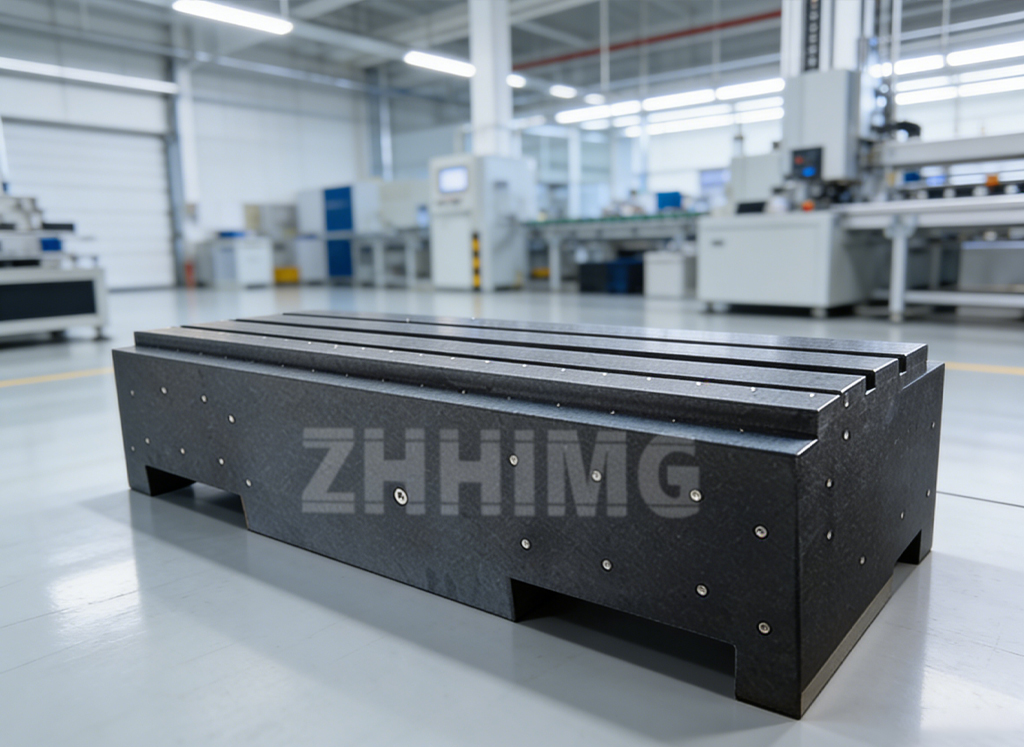
Mineral Casting: Strong Damping and Design Flexibility
Mineral casting, also known as polymer concrete or epoxy granite, is widely used in machine tool and inspection equipment structures.
Its main advantages include:
- Good vibration absorption
- Ability to form complex shapes
- Good corrosion resistance
- Reduced need for heavy post-machining in some designs
- Stable performance in industrial environments
Mineral casting is often used for machine bases, inspection frames, and automation structures where vibration control and geometric stability are important.
Precision Metal: Strength and Structural Reliability
Precision metal components, including CNC machined parts and castings, remain essential in industrial equipment.
Metal structures offer:
- High mechanical strength
- Excellent load-bearing capacity
- Mature machining and assembly processes
- Wide material selection
- Strong suitability for complex mechanical systems
For heavy-load equipment, moving structures, or systems requiring high rigidity, precision metal solutions are often necessary. Metal bases can also be combined with granite, ceramic, or mineral casting components to balance strength and precision.
How to Choose the Right Material
Ask these questions before making a decision:
-
What accuracy level is required?
Metrology and semiconductor equipment usually need higher dimensional stability. -
Will temperature change during operation?
Materials with low thermal expansion help maintain precision. -
Is vibration control critical?
Granite and mineral casting often perform well in vibration-sensitive applications. -
What is the load condition?
Heavy-load structures may require metal or reinforced designs. -
What is the operating environment?
Cleanrooms, laboratories, and industrial workshops have different requirements. -
Are there assembly or integration needs?
Air bearings, linear guides, sensors, and optical components may influence material selection. -
What is the expected service life?
Long-term stability matters more than initial cost for precision equipment.
Why ZHHIMG® Can Support Multi-Material Projects
ZHHIMG® manufactures precision granite, precision ceramic, precision metal, mineral casting, precision glass, UHPC precision components, and carbon fiber precision beams.
This multi-material capability allows engineers to compare options and select the most suitable solution instead of being limited to a single material type.
ZHHIMG® production is supported by:
- ISO 9001, ISO 45001, ISO 14001, and CE certifications
- Large-scale machining capacity for heavy and long components
- Temperature-controlled and humidity-controlled workshop environments
- Advanced inspection equipment from internationally recognized brands
- Experience serving semiconductor, metrology, automation, optical inspection, and precision manufacturing industries
Final Recommendation
If your priority is long-term dimensional stability and metrology-grade precision, granite is often the first choice.
If you need high hardness and wear resistance, ceramic may be more suitable.
If vibration damping and complex structures are important, mineral casting deserves consideration.
If strength, load capacity, and machinability are critical, precision metal solutions remain essential.
If you need high hardness and wear resistance, ceramic may be more suitable.
If vibration damping and complex structures are important, mineral casting deserves consideration.
If strength, load capacity, and machinability are critical, precision metal solutions remain essential.
For custom precision components, the best approach is to share your drawings, accuracy requirements, operating environment, and assembly details. This allows the manufacturer to recommend the most suitable material and processing plan.
If you need a quotation or technical review, you can contact ZHHIMG® through the website at http://www.zhhimg.com.
Post time: Nov-09-2026