
When sourcing precision bases for Coordinate Measuring Machines (CMM), semiconductor equipment, or optical inspection systems, the foundation of your machine dictates its ultimate accuracy. A common and costly mistake in the industry is the substitution of true precision granite with cheaper marble. While they may look similar to the untrained eye, their physical properties are fundamentally different.
At ZHHIMG, our core commitment to customers is simple: no cheating, no concealment, no misleading. In this guide, we break down the critical differences between granite and marble, helping you protect your precision manufacturing investments.
The Density Test: Why 3100kg/m³ Matters
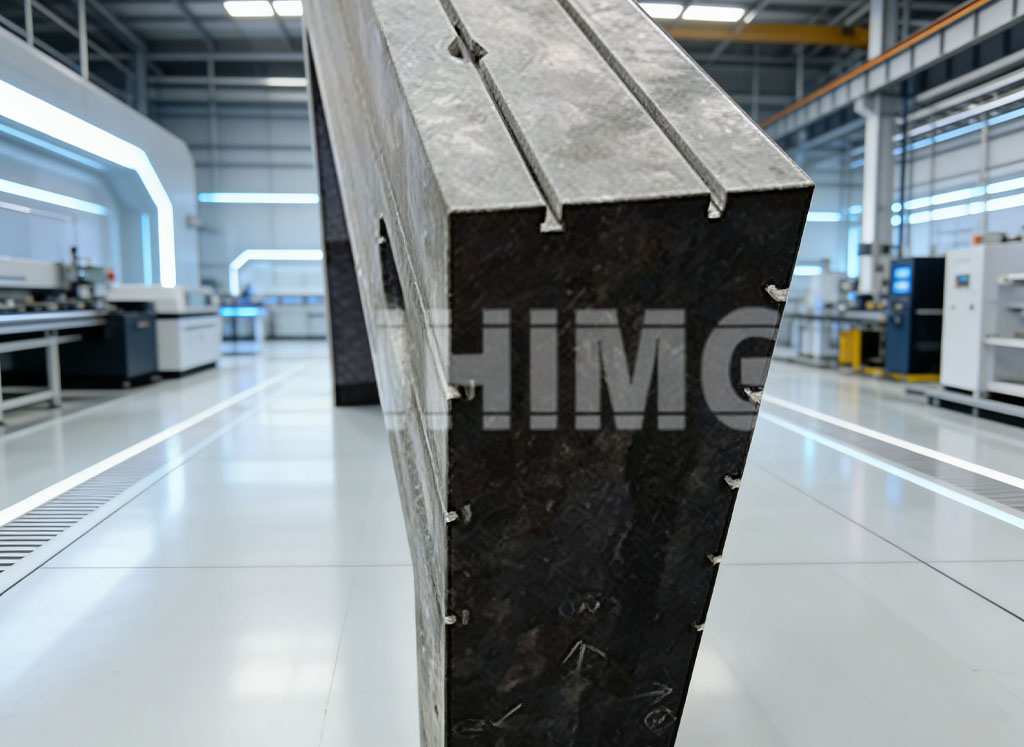
The most significant difference between precision granite and marble is density. True precision black granite, like the ZHHIMG® material we use, has a high density of approximately 3100kg/m³. This dense structure provides superior vibration damping and long-term dimensional stability.
Marble, on the other hand, is significantly less dense and more porous. Over time, lower-density materials are prone to micro-deformations caused by temperature fluctuations and mechanical stress. If a supplier cannot provide verifiable density data for their surface plates or machine bases, it is a major red flag.
Moisture Absorption and Dimensional Stability
Precision environments demand materials that do not react to their surroundings. High-density granite has extremely low moisture absorption. This means it will not swell, warp, or lose its flatness in varying humidity levels.
Marble’s porous nature makes it highly susceptible to moisture absorption. In environments where coolant mist or humidity is present, marble bases can absorb moisture, leading to localized swelling and catastrophic loss of precision. Re-calibrating a warped marble base is often impossible, resulting in expensive replacements.
Vibration Damping in Ultra-Precision Machining
For applications like femtosecond laser processing or nano-level metrology, vibration is the enemy. The natural crystalline structure of our ZHHIMG® black granite acts as a natural dampener, absorbing high-frequency vibrations generated by linear motors and spindles.
Marble lacks this uniform internal structure. Vibrations can travel through marble bases, causing chatter marks on machined parts or blurred readings on optical sensors.
How to Protect Your Procurement Process
To avoid falling victim to counterfeit materials, we recommend implementing these three checks during your sourcing process:
- Request Material Certifications: Ask for specific gravity and density test reports. True precision granite should consistently show a density near 3100kg/m³.
- Verify Manufacturing Standards: Ensure the manufacturer adheres to strict international metrology standards such as DIN 876, GGG-P-463C, or JIS B 7513.
- Demand Transparency: A reliable manufacturer will openly discuss their material sourcing and quality control processes. At ZHHIMG, we proudly hold ISO9001, ISO14001, and ISO45001 certifications, alongside over 20 international patents, because we believe total transparency is the only way to build trust.
The ZHHIMG Guarantee
The precision business can’t be too demanding. We have seen too many companies suffer from downtime and scrapped parts due to compromised foundations. That is why we strictly use only premium ZHHIMG® black granite for all our precision components, air bearings, and measuring rulers.
Don’t let a cheap base ruin your expensive equipment. If you are currently evaluating suppliers for granite surface plates, precision components, or custom machine bases, we invite you to review our material specifications.
Ready to verify the difference? Visit the ZHHIMG website to explore our precision granite product line or contact our engineering team today for a detailed material comparison and a custom quote.
Post time: Jul-21-2026