
In the ultra-precision manufacturing sector, the foundation of any equipment dictates its ultimate accuracy. When sourcing bases for CMMs, semiconductor lithography machines, or laser systems, engineers often face a critical material choice. While premium black granite is the industry standard, some manufacturers quietly substitute it with cheaper marble to cut costs. This practice introduces severe thermal and structural risks that can compromise multi-million-dollar equipment.
The Physics of Thermal Stability
Precision machining generates heat, and factory environments experience daily temperature fluctuations. Granite and marble react to these changes very differently. Premium black granite possesses a density of approximately 3100kg/m³. This high density translates to exceptional thermal inertia, meaning the material absorbs and dissipates heat slowly and uniformly.
Marble, by contrast, has a lower density and a significantly higher coefficient of thermal expansion. Even a minor temperature shift of a few degrees can cause a marble base to expand or warp microscopically. In applications requiring nanometer-level flatness, this microscopic deformation is catastrophic. It leads to calibration drift, forcing operators to halt production and recalibrate equipment constantly.
Vibration Damping and Structural Integrity
Beyond thermal stability, vibration damping is crucial for processes like fly-cutting or optical inspection. The dense, interlocking crystalline structure of high-grade black granite provides natural damping characteristics that steel and marble cannot match. It absorbs high-frequency micro-vibrations from motors and external sources, ensuring the cutting tool or sensor remains perfectly still.
Lower-density marble lacks this rigid internal structure. Over time, it is also more susceptible to micro-fractures and wear, especially when subjected to the constant movement of linear motors or air bearings. A compromised base eventually leads to uneven wear on guideways and premature failure of precision components.
The True Cost of Cutting Corners
Choosing a cheaper marble base might save a fraction of the initial capital expenditure, but the hidden costs quickly multiply. Downtime for recalibration, scrapped parts due to dimensional inaccuracies, and accelerated wear on moving axes far outweigh the initial savings. In the precision business, compromising on the foundation is never a viable cost-saving strategy.
Uncompromising Material Standards
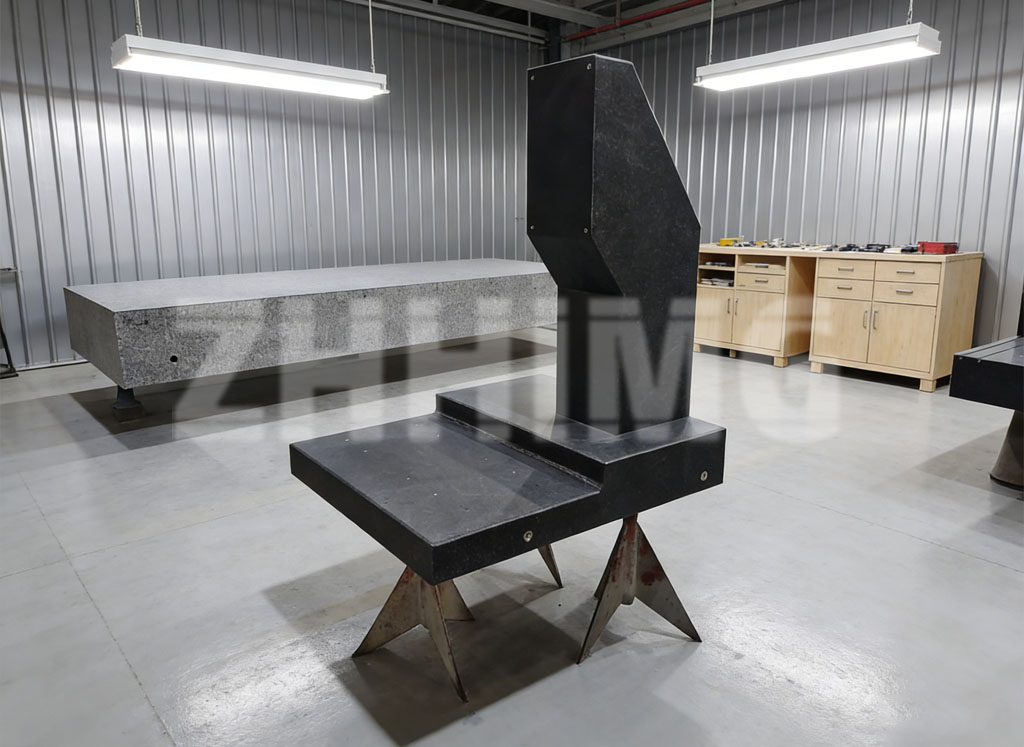
At ZHHIMG, we recognize that ultra-precision equipment demands uncompromising foundations. We strictly adhere to a policy of using only premium black granite with a verified density of ≈3100kg/m³ for all our precision bases and air bearing components. We firmly reject the industry practice of substituting inferior marble, ensuring our clients never face hidden thermal or structural failures.
Our commitment to material integrity is backed by our status as the only manufacturer globally holding ISO 9001, ISO 14001, ISO 45001, and CE certifications. We operate a 10,000m² climate-controlled cleanroom and utilize ultra-large grinding machines capable of achieving nanometer-level flatness. Our master craftsmen, with over 30 years of experience, guarantee that every base meets the exacting standards required by global leaders like GE, Samsung, and Bosch.
Struggling with thermal stability or calibration drift in your precision equipment?
Post time: Jul-23-2026