
In many industrial applications, granite and marble are sometimes considered similar materials because both are natural stones with smooth surfaces and attractive appearances. However, when it comes to ultra-precision manufacturing and metrology applications, the difference between granite and marble becomes extremely important.
For applications such as precision machine bases, granite surface plates, CMM foundations, semiconductor equipment structures, and high-accuracy measurement systems, material selection directly affects long-term accuracy, stability, and reliability.
Although some low-cost suppliers use marble as an alternative to precision granite because of its lower price, these two materials have significant differences in physical properties. In industries where measurement accuracy reaches the micron or even nanometer level, choosing the correct material is not a cost decision—it is an engineering decision.
Why Material Selection Matters in Precision Manufacturing
Modern precision industries depend on stable mechanical structures.
Equipment manufacturers in fields such as:
- semiconductor manufacturing
- optical inspection
- precision automation
- coordinate measuring machines (CMM)
- laser processing
- scientific research equipment
require mechanical components that can maintain their accuracy over long periods.
A precision structure must resist:
- thermal deformation
- vibration
- environmental changes
- long-term material movement
Even extremely small changes in the supporting structure can influence the final performance of the entire machine.
For this reason, materials used for precision applications must provide not only strength but also stability and predictable physical behavior.
Granite and Marble: Similar Appearance, Different Performance
From a visual perspective, granite and marble may look similar. Both are natural stones and can be polished to achieve a smooth surface.
However, their internal structures are different.
Granite is an igneous rock formed through the cooling of magma. It typically contains hard minerals such as quartz and feldspar, creating a dense and stable structure.
Marble is a metamorphic rock mainly composed of calcite. It is widely used in architectural decoration because of its appearance and workability, but its physical characteristics make it less suitable for demanding precision applications.
In ultra-precision manufacturing, appearance is not the determining factor. Engineers focus on:
- density
- hardness
- thermal stability
- vibration damping capability
- long-term dimensional stability
Density and Structural Stability: A Critical Difference
One of the most important differences between precision granite and marble is density.
High-quality precision granite generally has a higher density and more stable mineral structure.
For example, ZHHIMG® black granite used for precision applications has a density of approximately:
3100 kg/m³
This high density contributes to:
- improved rigidity
- better vibration damping
- stronger structural stability
A stable material foundation helps precision equipment maintain consistent performance during operation.
By contrast, many marble materials have lower density and different mineral structures, which may result in less predictable performance when used for high-precision mechanical applications.
Thermal Stability and Long-Term Accuracy
Temperature variation is one of the biggest challenges in precision manufacturing.
When materials expand or contract due to temperature changes, the accuracy of machine structures can be affected.
Precision granite is widely used because of its excellent thermal stability.
In applications such as:
- granite surface plates
- precision machine bases
- semiconductor equipment foundations
maintaining geometric stability is essential.
A material that changes less under environmental conditions helps engineers reduce error compensation and improve long-term reliability.
This is especially important for equipment operating inside controlled environments, including temperature-controlled measurement rooms and semiconductor manufacturing facilities.
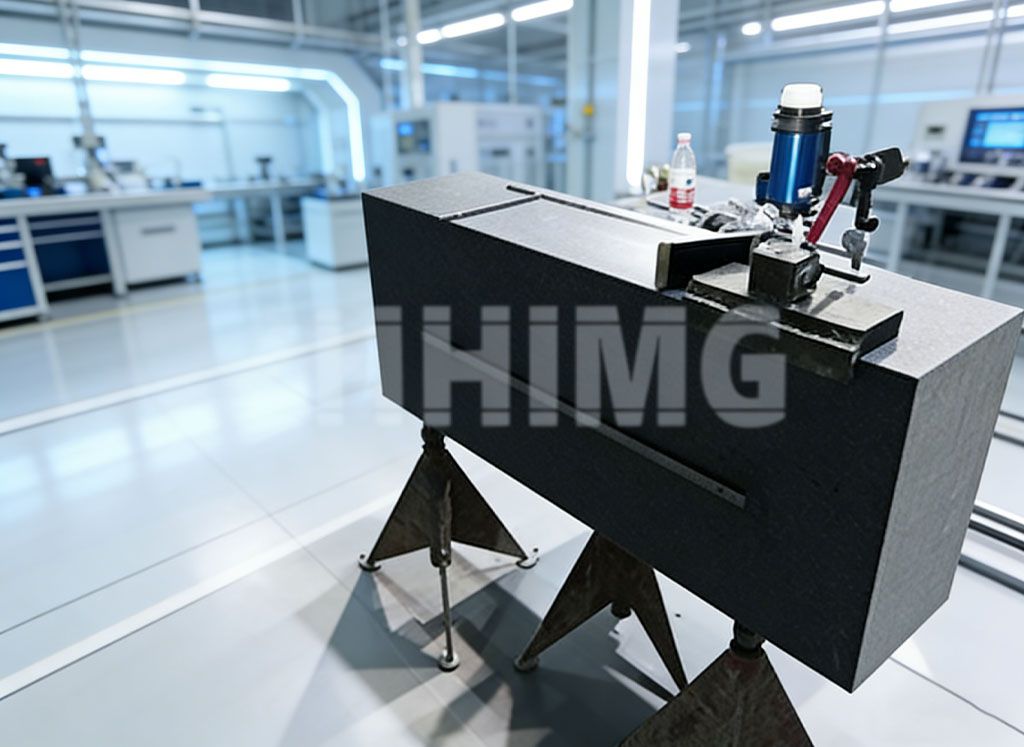
Vibration Damping: Why Granite Is Preferred for Precision Equipment
Precision equipment is highly sensitive to vibration.
External vibration from:
- motors
- factory environments
- mechanical movement
- nearby equipment
can affect measurement results and positioning accuracy.
Natural granite has excellent vibration damping characteristics due to its internal structure.
This makes granite suitable for:
- precision measuring platforms
- optical equipment bases
- semiconductor inspection systems
- high-precision automation equipment
A stable foundation allows sensors, motion systems, and measurement devices to perform closer to their designed accuracy.
This is one of the main reasons why precision granite has become a standard material in many advanced manufacturing industries.
Why Some Suppliers Choose Marble and Why It Can Be a Problem
In the global market, some suppliers choose marble instead of true precision granite because marble is generally easier to source and less expensive.
For general industrial or decorative applications, marble can be an excellent material.
However, using marble as a substitute for precision granite in ultra-precision applications can create potential risks:
- reduced long-term stability
- lower vibration control capability
- inconsistent accuracy performance
- shorter service reliability
For customers purchasing precision components, it is important to understand that not all natural stone products are designed for precision manufacturing.
A polished stone surface does not automatically mean it is a precision material.
The Importance of Professional Granite Processing
Even with high-quality granite, achieving precision performance requires advanced manufacturing technology.
A professional precision granite manufacturer must control the complete process, including:
- raw material selection
- granite aging treatment
- precision machining
- surface grinding
- flatness measurement
- final inspection
The final accuracy of a granite component depends not only on the stone itself but also on manufacturing experience and measurement capability.
Precision granite is not simply cut and polished—it is engineered.
ZHHIMG® Precision Granite Solutions
ZHHIMG® focuses on manufacturing high-performance precision granite components for industries requiring exceptional stability and accuracy.
The company selects premium black granite materials and applies strict manufacturing and measurement processes to produce:
- granite machine bases
- granite components
- granite surface plates
- granite measuring tools
- granite air bearings
With large-scale manufacturing capability, advanced grinding equipment, and professional metrology systems, ZHHIMG® provides precision granite solutions for semiconductor equipment, automation systems, measurement technology, and advanced industrial applications.
Choosing the Right Material for Future Precision
As industries continue moving toward higher accuracy and smaller tolerances, the importance of material selection will continue increasing.
The difference between granite and marble is not only about appearance or price. It is about whether the material can provide the stability required for modern precision engineering.
For ultra-precision applications, the foundation determines the performance.
Choosing the right material at the beginning can help equipment manufacturers achieve better accuracy, longer service life, and more reliable operation.
Post time: Jul-27-2026