
When selecting a structural material for an ultra-precision machine, the choice isn’t just about stiffness. It’s about thermal stability, vibration damping, long-term dimensional integrity, and total cost of ownership. Three materials dominate the conversation: natural granite, engineered ceramics, and mineral casting. Each has its place. But understanding where each excels—and where it falls short—is the difference between a machine that holds tenths of a micron and one that drifts out of spec within a year.
The Thermal Stability Question
Thermal drift is the silent killer of precision. A machine base that expands or contracts even a few microns per meter per degree Celsius can render a $500,000 CMM useless for high-tolerance work.
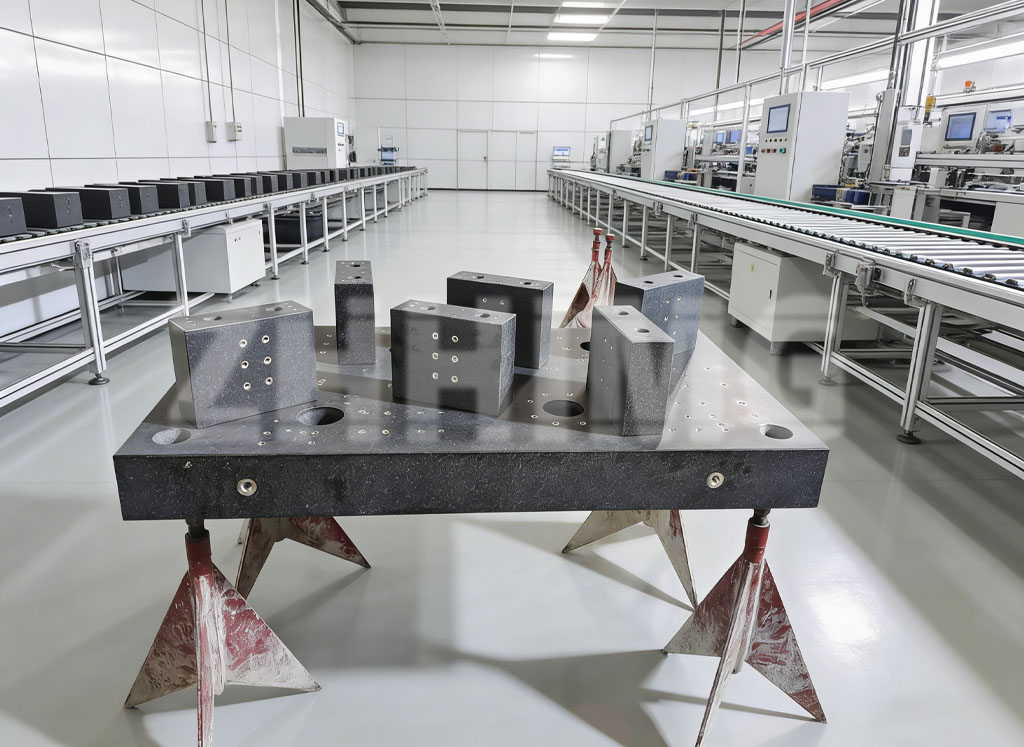
Natural granite offers one of the lowest and most predictable coefficients of thermal expansion (CTE) among structural materials—typically in the range of 4.6 to 9 × 10⁻⁶/°C. Its thermal inertia is exceptional: granite is a “slow” material that reacts minimally to ambient temperature changes,making it the gold standard for coordinate measuring machines and metrology platforms。At ZHHIMG®, our ZHHIMG® black granite achieves a density of ≈3100 kg/m³—higher than most European and American black granites—which further enhances its thermal mass and stability.
Engineered ceramics, particularly silicon carbide (SiC) and aluminum oxide (Al₂O₃), offer even lower CTE values (3–5 × 10⁻⁶/°C) and superior thermal conductivity (10–30 W/mK versus granite’s 1–3 W/mK). This means ceramics can dissipate heat more rapidly, but they are significantly harder to machine and more expensive to produce in large structural sizes.
Mineral casting (sometimes called polymer concrete or epoxy granite) has a CTE of approximately 8–12 × 10⁻⁶/°C—higher than natural granite and less predictable due to the epoxy resin content. However, mineral casting offers high thermal inertia, resisting rapid temperature fluctuations and providing a stable environment for high-duty-cycle CNC operations where motors generate significant heat。
The Damping Factor
Vibration is the enemy of surface finish and measurement accuracy. In high-speed CNC milling, it causes chatter. In semiconductor inspection, even microscopic oscillations can lead to measurement errors.Natural granite dissipates vibrations 5–10 times more effectively than cast iron。Its crystalline structure provides inherent damping that reduces machine chatter and directly improves surface finish and tool life. Mineral casting, however, takes damping a step further. The epoxy resin matrix in mineral casting absorbs vibration even more effectively than a purely crystalline stone structure. Some sources report damping ratios 5 to 10 times higher than natural granite, depending on the resin-to-aggregate ratio。
Ceramics, by contrast, have relatively poor damping—typically only 0.01–0.02 damping ratio, compared to granite’s 0.03–0.05 and mineral casting’s 0.04–0.08.
The practical takeaway: If your application involves high-speed reciprocating masses—like a linear motor-driven PCB drill or semiconductor bonder—mineral casting may be the superior choice for reducing settling time。If you’re building ultra-precision laboratory equipment, CMMs, or optical measurement platforms where dimensional stability over years matters more than damping during cutting, solid granite remains the preferred material.
Manufacturing and Design Flexibility
This is where the three materials diverge most significantly.
Granite is quarried and then ground to shape. While it achieves the highest possible flatness—ZHHIMG® processes granite to nanometer-level flatness—it is difficult to incorporate complex internal features. Adding threaded inserts or coolant channels requires labor-intensive drilling and bonding. Our capability to process single pieces up to 20 meters in length, 4000mm in width, and 1000mm in thickness—using four ultra-large Nantec grinding machines, each costing over $500,000 USD—demonstrates the scale achievable with natural granite.
Mineral casting is a casting process. This allows for “integrated design”: threaded inserts, pipes, and cable ducts can be cast directly into the structure. Designers can create hollow structures or ribbed reinforcements that are impossible to machine out of solid stone. By casting multiple parts into one monolithic base, you reduce the number of bolted joints—further improving overall machine rigidity.
Ceramics offer the highest hardness (Mohs 8–9.5) and wear resistance, but production requires specialized diamond grinding and high-temperature sintering above 1200°C. Structural ceramic components are typically limited in size and significantly more expensive.
The Verdict
There’s no one-size-fits-all answer. Serious equipment manufacturers tend to use all three materials, matched to the application rather than picking one as a blanket standard:
- Choose natural granite for metrology platforms, CMM bases, air-bearing surfaces, and optical benches where microns of drift over a decade is the thing you’re trying to prevent.
- Choose mineral casting for machine tool frames and structural bases that need to be cast into complex shapes and absorb cutting vibration.
- Choose ceramics for applications requiring extreme hardness, wear resistance, or rapid thermal distribution in compact form factors.
At ZHHIMG®, we manufacture all three—precision granite, precision ceramic, and mineral casting components—because we don’t believe in a one-size-fits-all solution. Our ZHHIMG® black granite, with its 3100 kg/m³ density and superior physical properties, remains the benchmark for applications where absolute stability is non-negotiable. But we also recognize that mineral casting and ceramics have their place in the precision ecosystem. The key is knowing which material solves your specific problem.
Post time: Jul-08-2026