
When sourcing granite bases for ultra-precision machinery, most project purchasers tend to focus merely on upfront procurement prices. It is easy to overlook that cost calculations should cover the whole service cycle, rather than one-time expenditure. Spliced granite structures appear attractive due to competitive initial quotations, yet numerous manufacturers encounter unexpected operational troubles after years of continuous production. These concealed problems gradually trigger extra expenditure that far exceeds the initial savings on purchasing, which deserves sufficient attention from engineers, laboratory managers and procurement teams across high-tech industries.
The core hidden trouble of spliced granite platforms originates from the bonding interface between separate stone blocks. Even if advanced adhesive materials are adopted during assembly, working environments with cyclic temperature fluctuation, minor vibration and constant load will slowly change the physical status of bonding layers. Slow creep of glue materials, uneven stress release and tiny displacement along splicing seams cannot be eliminated completely. Such subtle deformation cannot be detected in short-term factory acceptance inspection, but will emerge steadily under long-duration industrial operation. Once micro-shifts occur on joint surfaces, the overall flatness and angular benchmark accuracy of the granite base will drift continuously.
Constant precision deviation further generates a series of cascading long-term costs for enterprises. First of all, frequent re-calibration becomes inevitable. Production lines equipped with spliced bases need repeated precision verification, which leads to regular equipment shutdown and reduces effective production time. Second, unstable measurement benchmarks raise rejection rates of precision workpieces. For semiconductor testing equipment, laser processing platforms and coordinate measuring instruments, tiny benchmark errors will be amplified in final detection results, bringing about scrapped parts and material waste. Moreover, sustained accuracy attenuation shortens the service cycle of whole sets of equipment. Many factories have to arrange premature overhaul or complete platform replacement, creating considerable capital losses. 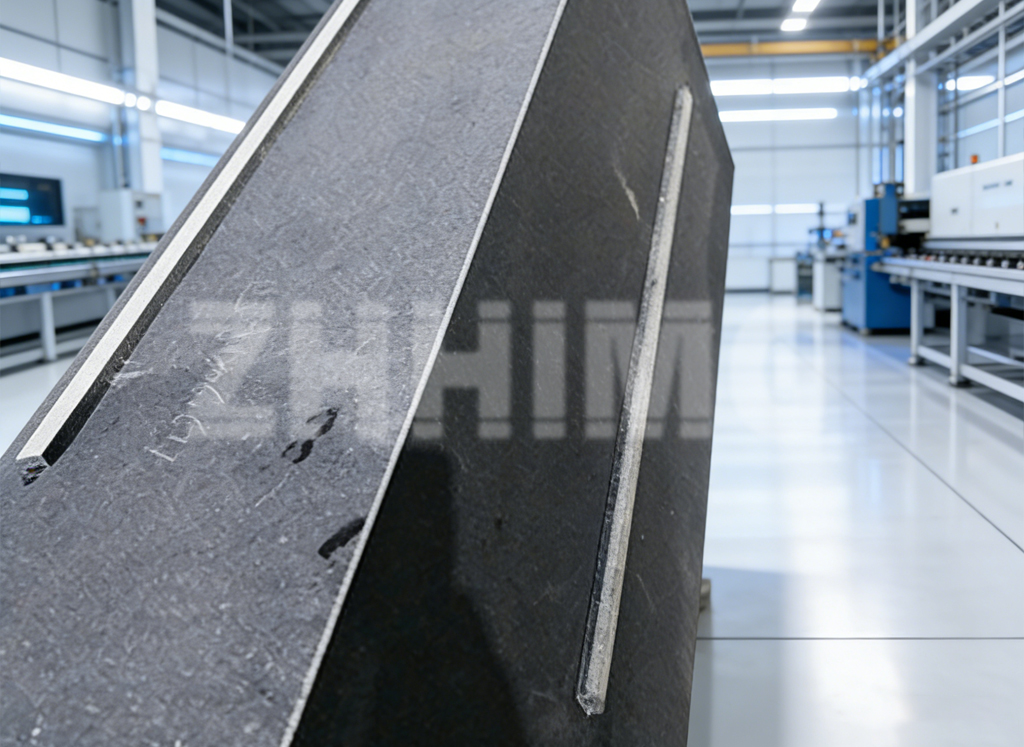
High-end manufacturing sectors including semiconductor inspection, new energy testing, optical metrology and precision CNC equipment put forward stringent requirements for long-term geometric stability. Such application scenarios are not suitable for spliced granite structures. ZHHIMG recommends monolithic ultra-stable granite bases for clients engaged in AOI equipment, X-Ray detectors, femtosecond laser devices and linear motor platforms. Adopting high-density black granite with density close to 3100kg/m³, monolithic stone components avoid all risks related to splicing seams. Unlike many suppliers that cut costs by applying inferior marble or widely promoting spliced schemes, ZHHIMG adheres to strict raw material standards and objectively reminds partners of the lifecycle defects of spliced solutions.
Stable dimensional performance of monolithic granite bases relies on systematic manufacturing and testing conditions. Located in Jinan with convenient logistics linking Qingdao Port, ZHHIMG runs two production plants and an independent raw stone storage yard. The 10,000 m² constant temperature and humidity workshop is built with shock absorption infrastructure to avoid external vibration interference during processing. We deploy ultra-large grinding equipment and rely on experienced grinding technicians with decades of manual processing experience. Every finished base undergoes strict testing using Mahr, Mitutoyo, WYLER and Renishaw inspection instruments. All measuring tools hold official calibration certification, ensuring each monolithic granite component delivers consistent precision for decades.
As the only player in this industry holding ISO9001, ISO14001, ISO45001 and CE certifications simultaneously, ZHHIMG maintains technical communication with global metrology institutions and top universities. We serve many world-renowned enterprises covering semiconductor, precision automation and new energy industries. Guided by the principle “No cheating, No concealment, No misleading”, our team provides clients with objective selection suggestions instead of simply pushing low-cost products.
For companies investing in ultra-precision production infrastructure, short-term budget savings should never be the primary judging standard. Comparing monolithic granite base and spliced alternatives from the perspective of full-lifecycle cost helps enterprises avoid long-term operational traps. If you need stable granite structural components to support long-running high-precision production lines, contact ZHHIMG for professional technical consultation and customized solutions.
Post time: Jul-30-2026