
During the operation of ultra-precision equipment, vibration stands as one of the most troublesome interferences affecting micron and nanometer-level accuracy. Self-excited vibration generated by high-speed start-stop and reciprocating reversing of internal moving axes, as well as external ground vibration from factory fans, air compressors and surrounding machine tools, will transmit to optical and inspection modules along the base, causing measurement deviation and optical path offset, and directly lowering product yield. Many equipment manufacturers invest heavily in vibration isolation platforms during structural design. Relying on the inherent high damping property of the material itself, granite structural components weaken vibration transmission from the source and become a core part of vibration reduction schemes for precision equipment.
Damping refers to the capacity of a material to dissipate vibrational energy. Metal materials such as cast iron and steel feature low damping. Once vibration occurs, energy decays slowly and resonance tends to persist. Tiny vibrations continuously propagate and amplify along the machine bed, requiring additional complex vibration isolation pads and air springs for suppression. In contrast, premium black granite is dense crystalline rock with tightly interlocked crystals. When vibration enters the stone matrix, micro-friction between crystal interfaces rapidly absorbs vibrational energy and converts kinetic energy into heat for dissipation, preventing continuous vibration propagation. This is the core principle of granite’s natural high damping. It can block vibration transfer within the complete machine structure without installing excessive extra vibration-damping accessories.
ZHHIMG adopts black granite raw material with a density of approximately 3100 kg/m³. It boasts a uniform and dense crystalline structure without the loose and porous defects found in ordinary marble. Raw blanks undergo sufficient aging treatment to release inherent internal stress and avoid internal fissures in the stone. If pores or microcracks exist inside the stone, vibration will reflect at these defects and amplify disturbances instead. Our granite components are integrally machined from single blanks instead of adopting splicing and bonding solutions. Spliced joints serve as weak channels for vibration transmission; vibration easily passes through adhesive layers to upper modules and greatly weakens vibration reduction performance. Integrally formed granite components feature continuous and intact internal structures with stable vibration transmission paths. The damping performance can evenly cover the whole base, beams and gantries.
Machining processes further unleash the vibration reduction potential brought by high damping. All finishing and manual lapping procedures are completed in a constant-temperature & constant-humidity workshop equipped with vibration isolation trenches and thickened ultra-hard floors. External vibration interference is avoided throughout machining, and no processing-induced microcracks are formed inside finished products. The crystals on reference surfaces processed by senior lapping craftsmen remain intact. When XY linear motor stages, coordinate measuring machines and ultrafast laser equipment operate, impact vibration from moving modules decays rapidly after entering the granite matrix, reducing upward vibration transfer to probes, optical lenses and inspection sensors.
This vibration reduction advantage is especially prominent in scenarios extremely sensitive to micro-vibration. For semiconductor AOI inspection, X-Ray imaging, femtosecond laser machining and perovskite coating equipment, optical imaging systems often only tolerate nanometer-scale vibration. Even faint continuous vibration will blur images and drift laser spots. Granite components achieve dual vibration suppression: on one hand, they absorb internal vibration generated by the equipment’s own motion; on the other hand, they isolate external vibration transmitted from the factory floor. Cross-structural vibration transfer is minimized to keep optical assemblies and inspection probes mounted on granite bases stable. 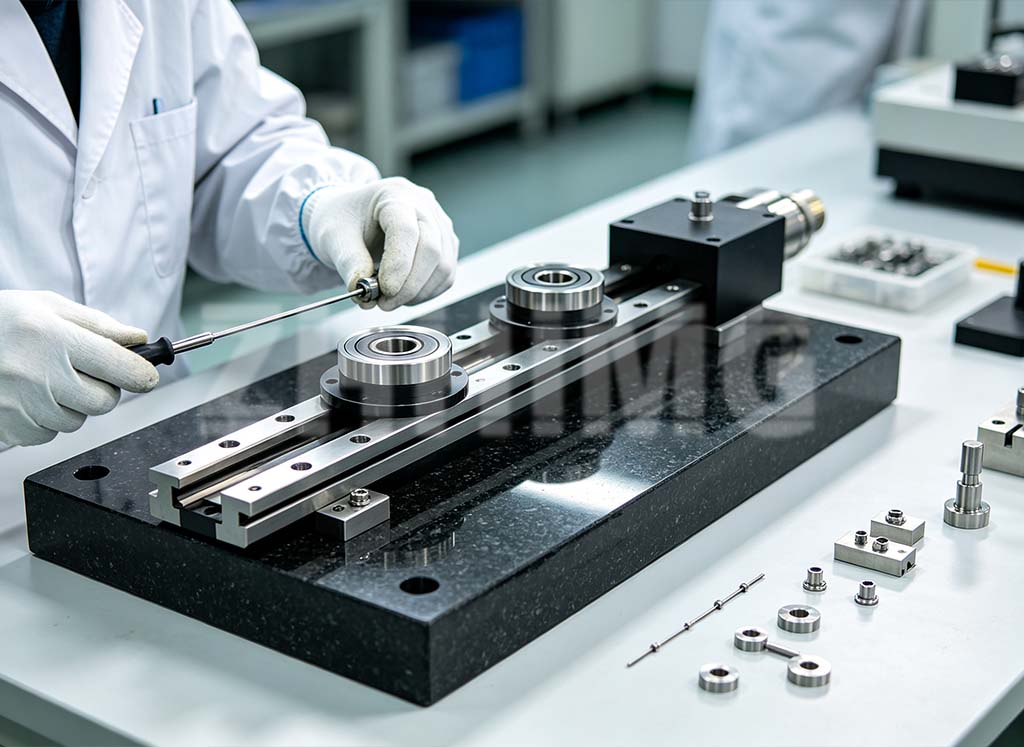
One key distinction should be clarified: high damping does not equal full vibration isolation. Granite dissipates vibrational energy via its material properties. For low-frequency strong impact vibration, cooperation with foundation vibration isolation schemes is still required. Nevertheless, compared with metal beds, granite can significantly lower vibration transmissibility and reduce resonance risks under identical working conditions. It simplifies the design of the whole machine’s vibration reduction system and cuts investment in supporting vibration-damping components.
Some low-cost stone products on the market use porous marble with weak crystal bonding and poor damping characteristics. The stone surface tends to sand and peel under long-term vibration, and vibration reduction capacity keeps declining. ZHHIMG firmly rejects such inferior raw materials used for cutting corners. All finished components are inspected with international metrology instruments including German Mahr dial gauges, UK Renishaw laser interferometers and Swiss Wyler electronic levels. Indicators comply with multiple global precision standards such as DIN, ASME and JIS. From metrology institute laboratories and university research platforms to leading enterprises in the semiconductor, new energy and laser industries, a large number of precision equipment rely on the high damping characteristics of granite components to control vibration transmission and guarantee long-term stable high-precision operation.
Post time: Sep-10-2026