
During long-term batch production, precision automation equipment, inspection instruments and processing platforms need to maintain stable repeat positioning performance. Many machines meet precision requirements at the initial commissioning stage, yet suffer positioning drift and increased dispersion of measured data after tens of thousands of reciprocating movements. Apart from insufficient performance of motion modules, inadequate rigidity of the machine base is another easily overlooked root cause. As the load-bearing geometric benchmark of the whole equipment, a base with low rigidity will produce tiny deformation under continuous alternating loads. Accumulated deformation will damage the repeat operation accuracy of the equipment. ZHHIMG high-rigidity granite machine bases adopt dense stone blanks and integrated machining processes to resist load-induced deformation and ensure stable repeated operation of equipment.
Rigidity refers to the ability of a material to resist deformation under external force. Though metal castings and welded frames can gain higher rigidity by thickening structures, their weight rises sharply and residual stress remains. They tend to deform under long-term cyclic loads. Premium granite features a high elastic modulus and inherently excellent rigidity. When subjected to alternating loads from sliding tables and tooling, its deformation is minimal. ZHHIMG selects high-density black granite raw blocks and carries out sufficient stress relief aging to eliminate internal residual stress generated during quarrying and mechanical machining. The base will not undergo plastic deformation under sustained reciprocating loads. The geometric benchmark of the whole machine remains consistent in every motion cycle to guarantee stable repeated operation.
During continuous reciprocating operation of equipment, dynamic loads generated by moving parts keep transferring to the base. If the base lacks rigidity, every start, stop, acceleration and deceleration will trigger minor elastic deformation of the base. Such deformation is directly transmitted to guide rails, linear scales and optical probes mounted on the base, causing benchmark position deviation in each operation and continuous deterioration of equipment repeatability. ZHHIMG granite machine bases feature continuous integral structures without splicing gaps and uniform rigidity distribution, which effectively suppress benchmark deformation induced by dynamic loads. Even when the equipment runs nonstop for extended cycles, the geometric benchmark of the base will not drift with the increase of operation times, significantly reducing data fluctuation in mass production.
The value of high-rigidity bases also lies in vibration suppression. Dynamic excitation force generated by high-speed movement acts on the base. A sufficiently rigid granite base can restrain structural resonance and prevent vibration amplification. Vibration decays rapidly, creating a more stable working environment for guide rails and optical assemblies. Compared with metal frames, granite combines high rigidity and high damping. It can not only withstand load deformation but also dissipate vibration energy quickly. This dual protection for repeated operation accuracy is particularly critical in scenarios with strict repeatability requirements, such as semiconductor inspection, optical scanning and precision laser machining. 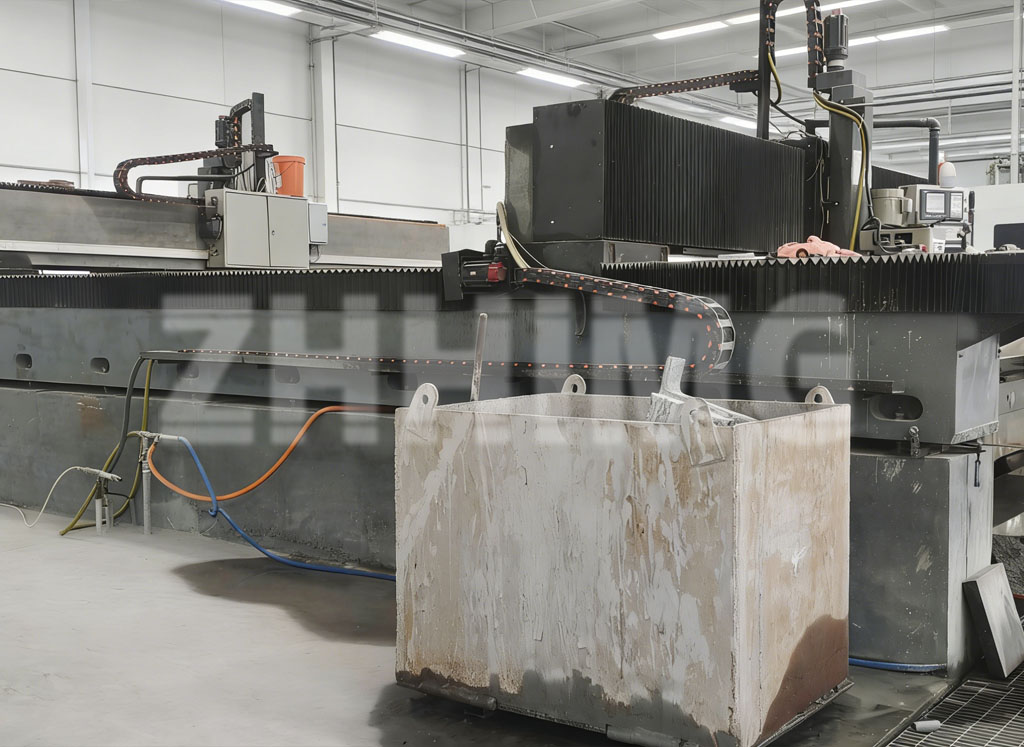
At the custom design phase, ZHHIMG engineers optimize base wall thickness, reinforcing structure and support point layout according to the overall load distribution, motion acceleration and equipment cycle frequency. For equipment with high-frequency reciprocating motion, stress-bearing areas are strengthened to avoid local stress concentration. Finished bases are ultra-precision ground in a constant-temperature and constant-humidity workshop and inspected for multi-dimensional geometric tolerances. After delivery, paired with proper installation and leveling schemes, the high-rigidity granite base can continuously bear high-frequency cyclic operation without benchmark deformation caused by long-term force loading.
Of course, high rigidity does not mean zero deformation. Deformation may still occur if loads exceed the design range or uneven settlement appears on the on-site foundation. Therefore, during preliminary communication, it is necessary to clarify the maximum dynamic load, cyclic working conditions and site foundation conditions of the equipment. The ZHHIMG team designs the base structure accordingly to match the rigidity with actual working conditions of the equipment.
Relying on the high elastic modulus of the substrate, complete stress relief aging and integrated structural design, high-rigidity granite machine bases resist deformation caused by dynamic alternating loads and reduce vibration interference. They can maintain stable geometric benchmarks of the whole machine for a long time, continuously guarantee repeat positioning and inspection accuracy, and greatly improve the reliability of long-term continuous operation of precision equipment.
Post time: Sep-15-2026