Most precision‑grade equipment adopts support blocks for load‑bearing and leveling. When selecting components, many engineers focus primarily on load capacity, flatness and leveling performance, yet overlook hidden risks triggered by temperature variations. Diurnal workshop temperature swings, continuous heat generation from operating equipment, seasonal changes and air‑conditioning airflow disturbances all cause thermal expansion and contraction of supporting components. Poor thermal stability of support blocks leads to minor height deviations, which further result in tilted equipment datums, plane offset, measurement distortion, inspection misjudgement and deviated motion trajectories. Featuring outstanding thermophysical properties, granite triangular support blocks mitigate deformation disturbances induced by temperature fluctuations and serve as a critical part of the support system for high‑precision equipment.
How Temperature Variations Compromise Equipment Precision via Support Blocks
Precision equipment sits fully atop support blocks, which form the bottom‑level datum for the whole machine. Even tiny dimensional changes in blocks will transfer deformation upward to worktables, optical lenses, motion modules and other core assemblies.
Steel and cast‑iron blocks feature high thermal‑expansion coefficients. Several‑degree temperature shifts can trigger micron‑level dimensional changes. Uneven heating among multiple support blocks causes inconsistent height variation and leads to tilting or twisting of the machine frame. Such deformation is dynamic: after re‑leveling, deviations reappear once temperature changes again. Frequent recalibration consumes substantial production time.
For production‑line equipment running 24/7, day‑night temperature differences in workshops are unavoidable. Metal blocks expand and contract continuously with temperature, making long‑term stable equipment performance difficult to achieve.
Core Values of Thermal‑stable Granite Triangular Support Blocks
Densely interwoven mineral crystals inside granite deliver a far lower thermal‑expansion coefficient than steel or cast iron. Height and thickness variation remains minimal under changing temperatures. Combined with evenly distributed loading of the three‑point triangular support structure, granite minimizes thermally induced deformation from the base support.
-
Reduce temperature‑driven height drift and cut re‑leveling frequency
When workshop temperature fluctuates, granite triangular blocks barely change in height, maintaining long‑term height consistency across support points. Once leveled, equipment will not tilt noticeably due to diurnal temperature differences. Frequent horizontal recalibration is avoided, improving equipment uptime for semiconductor inspection, machine‑vision systems, coordinate‑measuring machines and lithium‑battery inspection devices requiring continuous stable operation.
-
Mitigate differential deformation caused by local heat sources
Motors, light sources and modules on certain equipment generate persistent heat that transfers down to bottom supports. Local heating makes metal blocks bulge and causes slight frame twisting. Granite’s low thermal expansion and moderate thermal conductivity suppress abrupt height shifts from single‑point heating and reduce frame warping to preserve relative positioning of worktables and optical modules.
-
Maintain geometric relationships of complete equipment via three‑point structure and thermal stability
Compared with four‑point support layouts, triangular three‑point supports release stress more effectively and avoid built‑in stress inside machine frames. Under temperature variation, granite blocks deform uniformly and synchronously without abnormal height change of individual blocks. Frame twisting is prevented, protecting worktable flatness and motion straightness from disturbances originating in bottom supports.
-
Consistent long‑term performance without ageing‑related deformation
Besides high thermal expansion, rubber and composite blocks suffer ageing, creep and permanent compression deformation under prolonged heat exposure. Granite is free from ageing. Its material properties and thermal‑stability performance do not degrade under repeated temperature cycles, lowering maintenance costs for block replacement and secondary calibration. 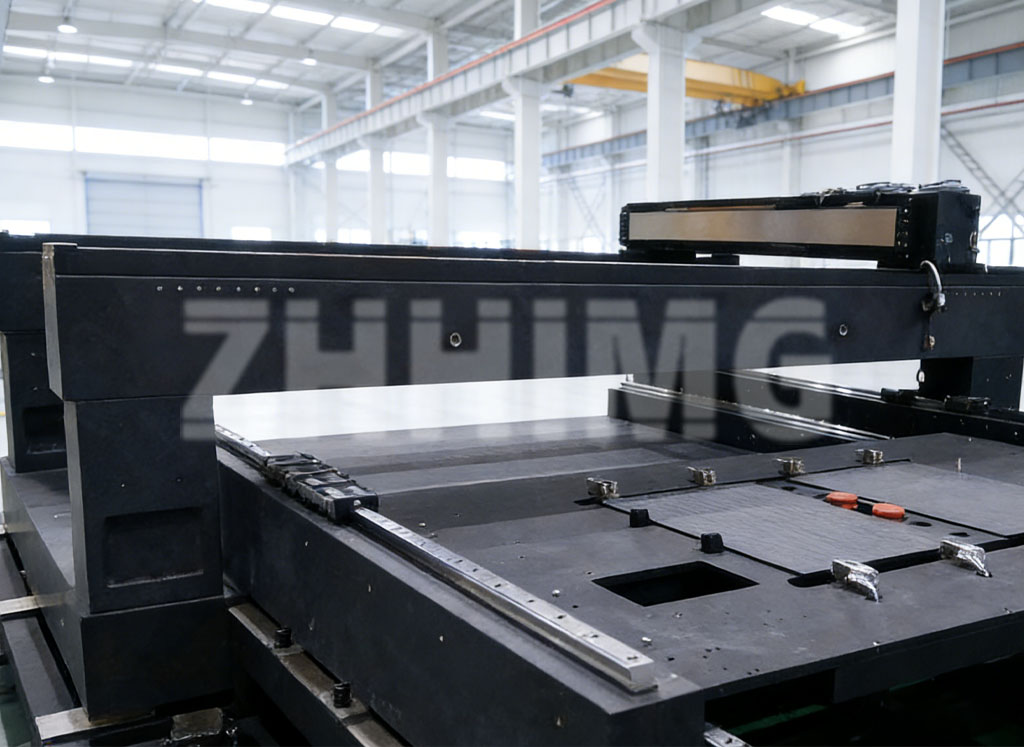
Common Pitfalls to Avoid under Practical Working Conditions
Although granite boasts excellent thermal stability, it is not completely immune to temperature effects. Key design and installation notes should be followed in field applications.
- Keep blocks away from high‑power heat sources. Continuous high‑temperature baking still triggers deformation caused by excessive local temperature gradients.
- Even with granite triangular support blocks, temperature control for high‑precision workshops is recommended to maximise precision gains.
- Thoroughly clean contact surfaces during installation. Residues and debris trapped underneath will introduce artificial horizontal errors even if the blocks themselves meet precision requirements.
- Granite triangular blocks mainly suppress thermal deformation. They cannot fully isolate vibration and shock. Vibration‑isolating assemblies may be deployed jointly for high‑vibration scenarios.
ZHHIMG Capabilities for Granite Triangular Support Blocks
ZHHIMG granite triangular support blocks are manufactured from high‑density black granite raw material processed through multi‑cycle stress‑ageing to eliminate residual internal stress and prevent deformation from subsequent stress release. Strict controls are implemented for working‑surface flatness, parallelism and finish. Custom non‑standard dimensions are available according to equipment load and installation space. Geometric tolerances are verified within a constant‑temperature, vibration‑isolated metrology laboratory, and test reports meet acceptance standards for international projects.
Beyond triangular support blocks, ZHHIMG supplies granite bases, gantry frames and support blocks. Our product portfolio also covers mineral castings, precision ceramics, carbon‑fiber and other ultra‑precision components. We deliver one‑stop solutions including material‑selection consulting, custom machining and inspection & delivery for optical‑inspection equipment, coordinate‑measuring machines, semiconductor instruments and new‑energy lithium‑battery machinery.
Temperature‑induced precision errors are often subtle and hard to diagnose. Thermally stable granite triangular support blocks reduce temperature‑related disturbances starting from the foundational support layer. They help high‑end equipment generate consistent and reliable data, cut downtime for calibration and boost overall production‑line efficiency.
Post time:
Aug-05-2026
