
In the field of CNC precision machining, many equipment manufacturers weigh up cast iron and granite bases. A common question raised by engineers: how much improvement in machining accuracy can be achieved by replacing traditional cast iron bases with granite ones? There is no fixed figure for accuracy gain. It depends on ambient temperature fluctuation, cutting heat, vibration and workpiece dimensions. However, the fundamental performance advantages of granite bases remove several core bottlenecks limiting CNC accuracy.
Cast iron bases have inherent drawbacks. Metals feature high thermal expansion coefficients. Heat generated by continuous spindle cutting and day-night temperature shifts in workshops cause base expansion and contraction, resulting in machine origin drift. Besides, cast iron readily transmits vibration. Tiny tremors from cutting travel to the tool tip and leave marks on finished surfaces. Insufficient aging also leads to slow deformation over time. Accumulated errors usually confine the practical precision of conventional CNC within the micrometer range, making sub-micrometer machining hard to sustain.
After CNC machines adopt ZHHIMG precision granite bases, improvements start with thermal stability. The selected high-density black granite has an extremely low thermal expansion coefficient. Its dimensional change remains minimal under cutting heat and ambient temperature variations, greatly lowering positioning errors caused by thermal drift. Under identical temperature changes, thermal deformation of granite bases can drop by more than 70% compared with cast iron structures. Machine origin stays stable for long hours, cutting frequent offset adjustments and recalibration.
Vibration damping is another key upgrade. Granite has excellent inherent damping capacity, which quickly absorbs vibration from high-speed spindle rotation and tool cutting to suppress resonance. With vibration well controlled, tool tip motion follows the theoretical path more accurately, workpiece surface finish improves and contour accuracy rises. For precision machining of molds, optical parts and semiconductor components, the benefit from vibration reduction becomes especially noticeable.
That said, the magnitude of accuracy gain varies with working conditions. In ordinary workshops with unstable temperature, switching to granite bases normally boosts repeat positioning accuracy and contour accuracy by 30%~50%. In temperature-controlled workshops for ultra-precision CNC, stable accuracy improvement can exceed 60%, enabling consistent sub-micrometer machining. It should be noted that granite base serves as the foundational carrier for better precision. Final machining results still rely on high-quality guideways, linear motors, precision gratings and proper assembly. 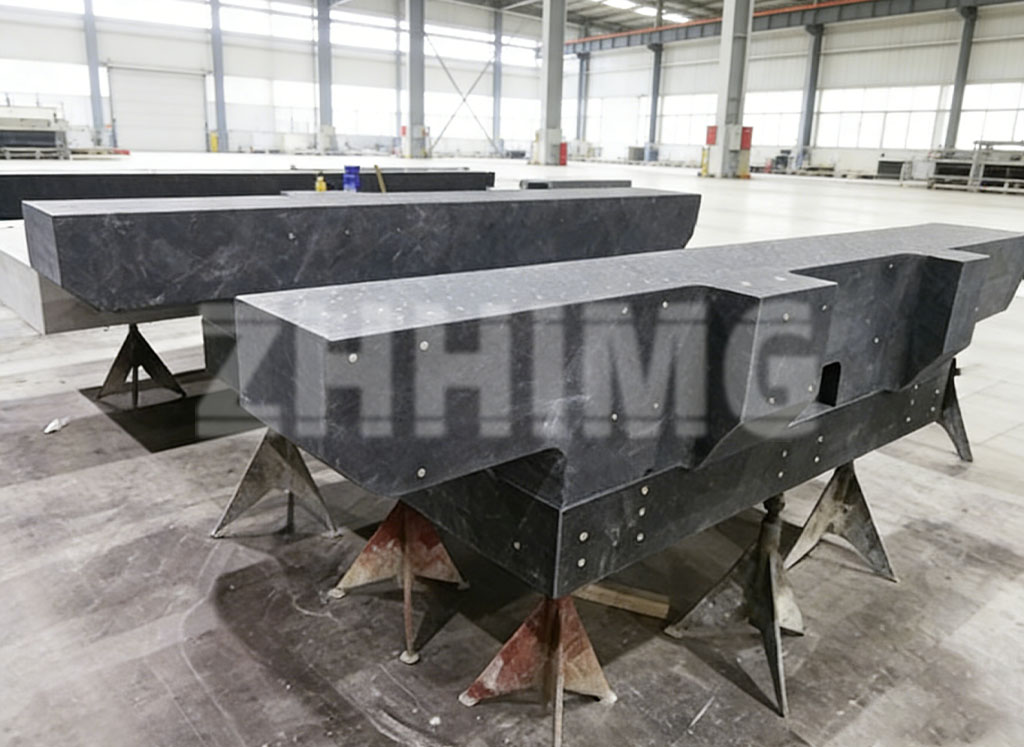
Beyond immediate accuracy gains, long-term stability is another highlight of granite bases. Fully aged granite has released internal stress. Unlike cast iron, it hardly creeps over time. The geometric shape of the base stays consistent even after years of operation. Precision degrades far slower than conventional metal beds, reducing maintenance and recalibration costs in later service stages.
Equipped with mature granite component manufacturing technology and complete international metrology inspection tools, ZHHIMG supplies custom integrated granite bases and gantry frames for various CNC machines, ranging from small precision engraving mills to large gantry CNC systems. More and more precision equipment manufacturers adopt granite base solutions. They leverage the natural physical advantages of the material to reduce thermal and vibration errors at source and unlock the full machining potential of CNC equipment.
Post time: Sep-18-2026