
Every measurement system fights an invisible opponent: heat. A one-degree shift in ambient temperature sounds trivial, but on a 1-meter steel base it can move dimensions by roughly 11.7 microns — enough to invalidate a CMM reading, throw off a laser interferometer calibration, or shift the reference plane under a semiconductor wafer stage. For engineers working at micron or sub-micron tolerances, this is not a rounding error. It’s the difference between a passed inspection and a rejected batch.
Why Metal Struggles Under Thermal Load
Steel and cast iron have long been the default choice for machine bases and measurement platforms, largely because they’re easy to machine and familiar to work with. But their coefficient of thermal expansion (CTE) — typically 10.8 to 12.5 µm/m·°C for steel — makes them poor candidates for environments where temperature isn’t perfectly controlled. Metal also conducts heat quickly, which means it responds to a warm hand, a nearby motor, or sunlight through a window almost immediately. That responsiveness is exactly the problem: a base that reacts fast to temperature also drifts fast, and drift is the enemy of repeatability.
There’s a second issue that’s less discussed: internal stress relief. Cast and welded metal structures continue to move slightly for years as internal stresses settle, even without thermal input. Combine that with thermal cycling and you get a base that’s never truly dimensionally “at rest.”
Granite: Density, Stability, and a Slower Thermal Response
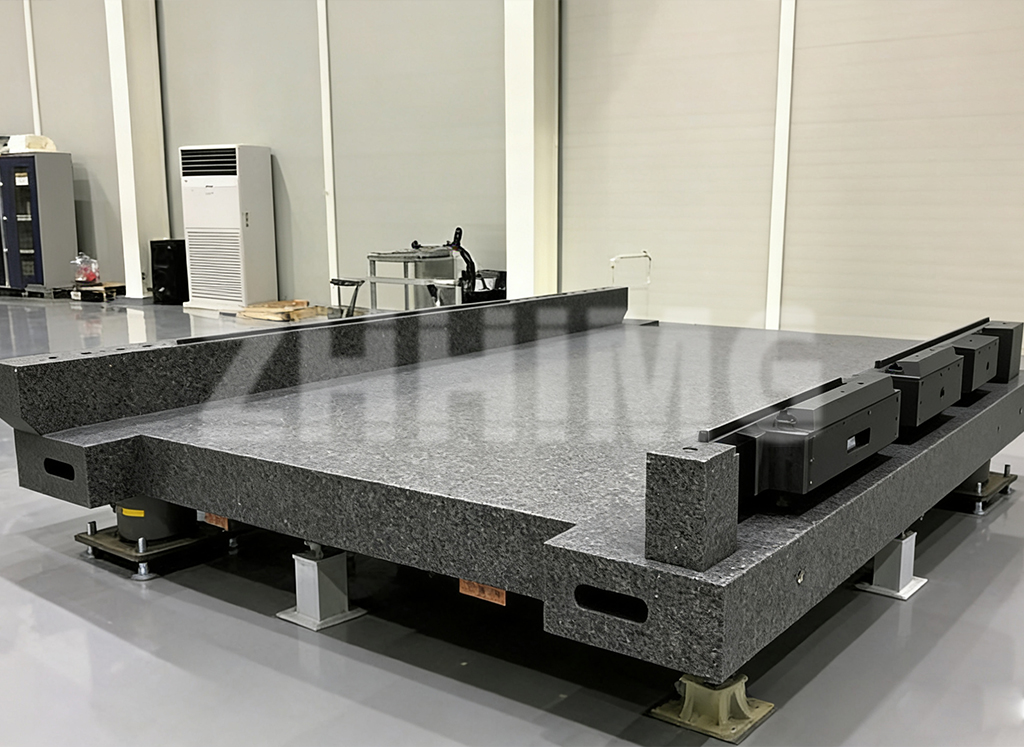
Granite behaves differently, and the physics explain why. A well-selected black granite has a CTE around 5–8 µm/m·°C, roughly half that of steel, and — more importantly — it has low thermal conductivity. Heat moves through granite slowly, so short-term ambient fluctuations don’t translate into immediate dimensional change. That thermal lag is often more valuable than the CTE number itself, because most real-world environments never hold a truly constant temperature.
Not all granite is equal, though, and this is where sourcing matters. Density is a reasonable proxy for internal uniformity and mineral consistency; higher-density stone with fewer micro-voids tends to hold flatness better over years of use. In our own production, we work with a granite selection around 3,100 kg/m³, denser than typical European or American black granite stock, specifically because that density correlates with better long-term stability. We’ve also seen firsthand why some lower-cost suppliers substitute marble or lower-grade stone — it’s softer to machine and cheaper to source, but it doesn’t hold up the same way under repeated thermal cycling or long-term load. It’s a distinction worth checking when qualifying a supplier, not just taking on faith.
Ceramic: Where Even Lower Expansion Is Required
For applications demanding tighter thermal stability than granite can offer — certain semiconductor alignment stages, high-precision optical systems, or measuring instruments operating across variable temperature ranges — technical ceramics move the needle further. Depending on composition, ceramic CTE can run below 3 µm/m·°C, with excellent stiffness-to-weight ratios and strong resistance to wear. The trade-off is cost and machining complexity, which is why ceramic components tend to appear in higher-value, tighter-tolerance applications rather than as a blanket replacement for granite.
Why Environmental Control Still Matters
Material selection solves part of the problem, not all of it. Even the most thermally stable base benefits from a controlled environment. Temperature-controlled metrology rooms, isolated foundations, and vibration-damping measures all reduce the variables a granite or ceramic base has to compensate for. In our facility, granite assembly for high-precision work is done in temperature- and humidity-controlled rooms with reinforced flooring and surrounding isolation trenches — not because the granite needs it to survive, but because holding nanometer-level flatness on a surface plate requires controlling every variable simultaneously, not just the material itself.
Practical Takeaways for Buyers
When specifying a granite or ceramic base for CMMs, optical comparators, semiconductor tooling, or linear motion platforms, a few questions are worth asking suppliers directly: What is the actual density of the stone, and can it be verified? Is flatness calibration traceable to a national metrology institute? Was the piece seasoned and stress-relieved before final grinding? These aren’t marketing details — they’re the difference between a base that holds tolerance for a decade and one that drifts within a year.
Thermal expansion will never be fully eliminated from a manufacturing or lab environment. The realistic goal is choosing a base material and a process that minimizes its impact, and understanding that granite, ceramics, and environmental control work together rather than any single factor doing the job alone. For anyone specifying precision bases or measuring tools, it’s worth treating material selection as an engineering decision, not a line-item cost comparison.
Post time: Aug-07-2026