
In metrology inspection, semiconductor equipment, ultra‑precision laser processing and other scenarios, granite surface plates serve as core physical benchmarks. Their long‑term dimensional stability directly determines measurement credibility and operational reliability of complete equipment. Many users obtain satisfactory test data at the initial commissioning stage. However, months or even one year after deployment, the plates gradually suffer degraded flatness, offset reference points and slow precision drift. Root‑cause analysis shows that inadequate aging treatment of stone material is a commonly overlooked yet prevalent industry trigger. Some manufacturers only focus on accuracy indicators upon delivery, ignoring long‑term deformation hazards induced by residual stress release inside granite blanks. This leads to continuous precision deviation after product delivery and brings implicit losses to downstream precision manufacturing. Targeting this industry pain point, ZHHIMG adopts full‑link measures including blank selection, stress relief, process control and verification testing, and establishes a complete solution to effectively prevent later‑stage precision drift caused by insufficient aging of granite surface plates.
Complex residual stress remains inside natural granite blanks throughout geological formation, mining and cutting processes. If blanks do not undergo sufficient natural aging cycles to fully release internal stress, ultra‑precision lapping can deliver high‑grade flatness only temporarily. As time elapses, latent internal stress releases slowly and triggers uncontrollable micro‑deformation of plates. Such deformation does not emerge immediately. It accumulates under cyclic ambient temperature changes and long‑term load, eventually manifesting as plate warpage, local point subsidence and deteriorated reference flatness, namely late‑stage precision drift. To shorten production cycles, some market suppliers skip lengthy natural aging and directly process freshly‑cut blanks. Though products pass outgoing accuracy inspection, deformation risks are transferred to end‑users. Aging defects can hardly be identified during incoming inspection; failures only surface after long‑time operation, resulting in extremely high costs for maintenance and factory re‑calibration.
To fundamentally avoid precision drift arising from insufficient aging, the first critical step lies in raw‑material screening and pre‑aging disposal. ZHHIMG maintains an independent stone yard for long‑term static natural aging of large incoming granite blocks, allowing sufficient time for preliminary internal stress release. Freshly‑mined or newly‑cut blanks are prohibited from direct production. Beyond evaluating density and mineral composition, stone screening prioritizes detection of micro‑cracks, bedding planes and heterogeneous interlayers, eliminating blanks with inherent stress defects. The high‑density black granite base material reaches around 3100 kg/m³ with compact and uniform grains. Its stress‑release amplitude is far lower than ordinary marble and variegated granite, which reduces latent deformation risks inherently. The firm firmly opposes the bad practice of substituting marble for precision granite.
Natural static aging alone cannot completely eliminate residual stress. ZHHIMG embeds stress‑relief procedures into the whole manufacturing workflow and adopts a stepped process route: raw‑block aging → rough‑machining stress removal → secondary aging → semi‑finishing → precision finishing in constant‑temperature environment. After initial static aging, raw blocks go through high‑stock‑removal rough milling to release surface stress generated by cutting, followed by another static aging cycle to dissipate machining stress from rough cutting before lapping. Many factories carry out ultra‑precision lapping right after rough processing. Machining stress is locked inside finished parts and gradually releases to cause precision drift in service. After stepped aging treatment, semi‑finishing and final ultra‑precision lapping are completed inside constant‑temperature‑humidity workshops. The 10 000 m² temperature‑humidity‑controlled workshop is equipped with heavy‑duty anti‑vibration concrete foundation and anti‑vibration trenches. Silent travelling cranes further minimize internal disturbances, ensuring all stress‑relief operations are performed under stable conditions.
Finished processing does not mean risk elimination. Simulated aging verification for finished products is vital for screening hidden aging‑related risks. ZHHIMG is not limited to one‑off outgoing accuracy inspection. Simulating real‑world working conditions of end‑users, it conducts temperature cycling and static load aging tests to continuously track flatness variation trends of plates. Equipped with premium metrology instruments including German Mahr dial gauges, Swiss WYLER electronic levels and British Renishaw laser interferometers, all test tools are traceable to national metrology systems. Long‑term accuracy variation data are fully recorded to identify and eliminate potential late‑drift risks in‑house. Technical teams are well‑versed in global mainstream metrology standards such as DIN, ASME, JIS and GB. Lapping technicians with over 30‑year experience assess long‑term stress‑release tendency rather than merely pursuing instantaneous high outgoing accuracy. 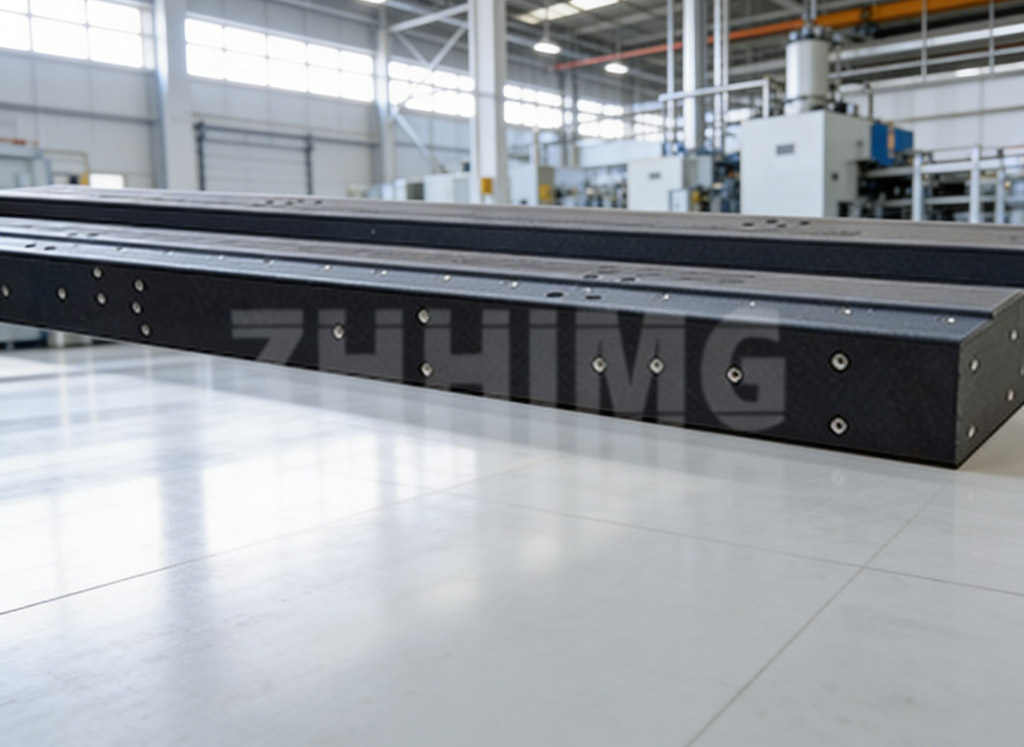
Industry‑university‑research collaboration further optimizes the prediction system for aging defects. ZHHIMG carries out joint tests with multiple international metrology institutes and top‑tier universities. It researches stress‑release patterns of granite and accumulates long‑term deformation databases for materials of diverse textures, thicknesses and dimensions. Correlations among blank size, machining allowance, aging cycle and late‑stage drift are summarized to guide production parameter setting. With more than 20 international patents and trademarks, together with complete ISO9001, ISO14001, ISO45001 and CE certifications, ZHHIMG honors its customer commitment: no cheating, no concealment, no misleading. Production cycles will not be compressed at the cost of adequate aging.
Benefiting from the complete aging‑risk prevention system, ZHHIMG granite surface plates, granite bases and air‑bearing components are widely deployed in semiconductors, coordinate measuring machines, industrial CT, perovskite equipment, new‑energy inspection and other fields, serving multiple Fortune Global 500 enterprises and scientific research institutions. Within ultra‑precision industries, outgoing accuracy is only a basic requirement, while long‑term accuracy retention capability defines true component quality. Following its quality policy “For precision‑oriented business, no pursuit of perfection is excessive”, ZHHIMG keeps optimizing aging‑control technologies. It helps end‑users avoid late‑stage precision drift induced by insufficient aging and cut comprehensive losses from equipment downtime, repeated re‑calibration and rework, supporting stable operation of global ultra‑precision industries.
Post time: Sep-07-2026