
1. Standardize Daily Operation to Avoid Artificial and Mechanical Hard Damage
Black granite mechanical beams possess high hardness and rigidity but feature natural brittleness with limited resistance to severe impact and hard collision. Most precision deviations in long-term service are not caused by material aging, but by accumulated minor damage from improper operation.
During daily operation and equipment debugging, heavy objects are strictly prohibited from directly striking or dragging the beam surface. Hard metal tools and rigid workpieces shall not contact the precision reference surface to avoid irreversible defects such as edge chipping, scratches and micro-cracks. All assembly and workpiece handling procedures must be operated gently with flexible cushioning protection. Meanwhile, partial long-term overload should be avoided to prevent accumulated internal structural stress, effectively eliminating micro-deformation and benchmark offset from the source.
2. Strict Environmental Control to Stabilize Precision Performance
Temperature, humidity, dust and corrosive gas are key environmental factors affecting the precision stability of granite beams. Ultra-precision granite components are extremely sensitive to ambient changes, making stable working conditions the foundation of long-term precision maintenance.
It is recommended to operate equipment in a constant-temperature, constant-humidity and dust-free workshop to prevent thermal expansion and contraction caused by drastic temperature changes and surface moisture residue under high humidity. In semiconductor and precision industrial workshops, acidic, alkaline and oil-based volatile contaminants must be isolated. These substances gradually erode the micro-pores of granite, damaging surface flatness and smoothness over time and causing potential precision errors. Maintaining clean ventilation and removing suspended dust can prevent abrasive particle accumulation and avoid surface wear during equipment vibration.
3. Professional Cleaning Standards to Prevent Precision Damage Caused by Improper Maintenance
Daily cleaning is the most fundamental yet error-prone maintenance step. Improper cleaning methods including strong acid or alkaline detergents, steel wool and abrasive rags will directly scratch the precision reference surface and corrode the stone layer, resulting in permanent matte surfaces, scratches and flatness deviations.
Standard cleaning follows the principles of neutrality, gentleness and zero residue. Daily dust removal adopts clean, dry microfiber dust-free cloth for gentle wiping. For slight oil stains and water marks, special neutral stone detergent is allowed, and the surface must be thoroughly dried immediately to prevent liquid penetration into micro-pores. Corrosive solvents such as vinegar, alcohol, ammonia water and industrial strong alkalis are strictly forbidden, as well as any hard polishing tools. Cleaning frequency can be adjusted according to workshop conditions: high-dust and high-oil workshops require daily cleaning, while standard precision workshops conduct thorough cleaning weekly to maintain a flawless reference surface.
4. Regular Sealing Protection for Long-term Anti-fouling and Moisture Resistance
Natural black granite contains tiny inherent micro-pores. In industrial environments, moisture, oil and dust easily penetrate these pores, causing internal contamination, surface darkening and gradual precision degradation, which are major hidden dangers affecting long-term service performance. Periodic professional sealing treatment is critical to extend component service life.
Penetrating stone sealants are preferred over film-forming materials. Penetrating sealants permeate deeply into micro-pores to form an invisible protective layer without changing surface flatness, smoothness or precision benchmarks, effectively blocking the penetration of moisture, oil and dust. Before construction, the beam surface must be completely clean and dry. The sealant shall be evenly and thinly coated. After full penetration, excess residue shall be wiped off, followed by 24–72 hours of standard curing with no moisture or contamination contact. Conventional industrial scenarios require sealing maintenance every 2–3 years, while high-humidity, high-oil and high-frequency working environments require treatment every 1–2 years to sustain stable anti-fouling and moisture-proof performance. 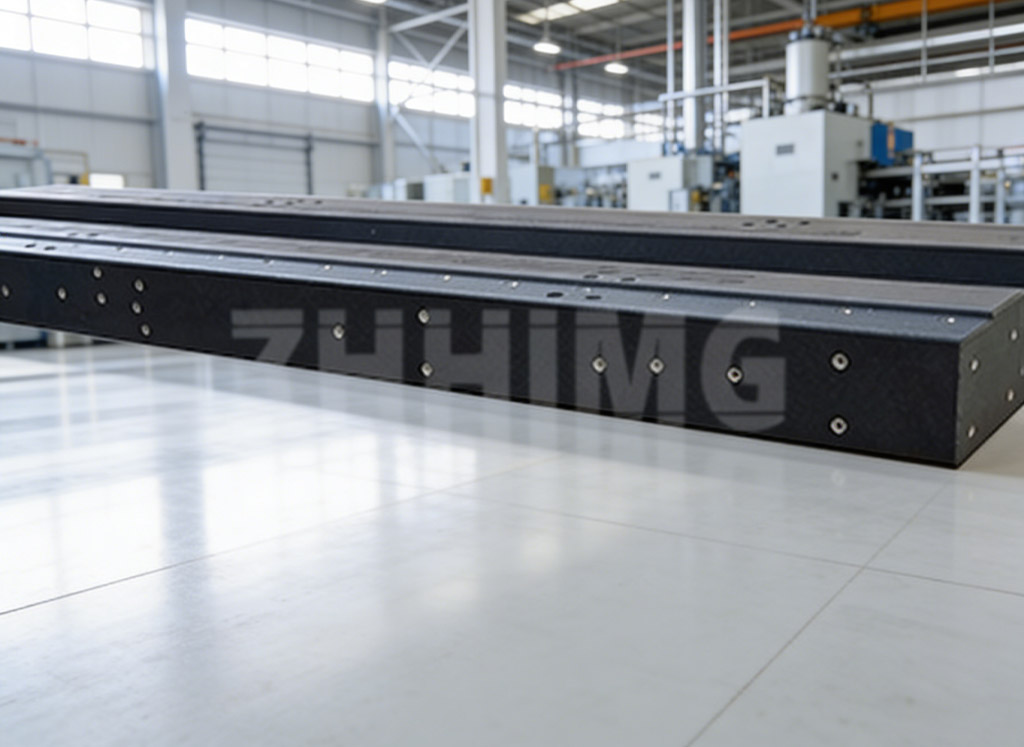
5. Periodic Precision Calibration to Predict Hidden Accuracy Offset
Compared with visible surface damage, invisible micro precision drift and latent deformation exert greater impact on ultra-precision equipment. Long-term high-speed operation, accumulated micro-vibration and subtle environmental changes may cause micron and sub-micron precision deviation, which cannot be identified visually but severely affect the yield of semiconductor inspection, laser processing and precision measurement.
Enterprises shall establish regular precision calibration mechanisms. Professional measuring instruments are used to comprehensively inspect flatness, straightness, levelness and geometric tolerance, with all test data recorded for comparative analysis. Slight precision deviation can be repaired through professional grinding and fine calibration in advance to prevent further deviation expansion, equipment shutdown or component scrapping. Meanwhile, it is necessary to check assembly joints and splicing positions regularly to eliminate hidden risks such as looseness and micro-displacement, ensuring consistent overall equipment precision.
6. Protection During Idle Periods and Transportation to Avoid Latent Losses
Protection during equipment shutdown, component handling and hoisting is often overlooked and constitutes a major cause of granite beam damage. When exposed to the air for a long time, idle granite beams easily accumulate stubborn dust and absorb moisture, resulting in surface darkening and micro-pore blockage.
During long-term shutdown, beams must be fully covered with dust-proof covers to isolate dust and humid air, with regular ventilation, inspection and cleaning. In transportation, hoisting and disassembly processes, flexible buffer wrapping is mandatory with precise force-bearing positioning. Unilateral stress, hard extrusion and collision must be avoided to prevent micro-cracks and latent structural damage, ensuring qualified precision after reinstallation.
Conclusion
The ultra-high precision and long service life of black granite mechanical beams depend not only on factory manufacturing quality but also on refined and standardized post-maintenance. Compared with carbon fiber and other composite materials, granite features zero aging, zero creep and permanent stability. With scientific maintenance, it can maintain consistent precision for decades. Standardized operation, stable environmental control, professional cleaning and sealing, periodic precision calibration and full-scenario protection together form a complete maintenance system for ultra-precision granite components.
As a benchmark enterprise in the ultra-precision industry, ZHHIMG adheres to the quality policy that “No precision pursuit is excessive in precision industry”. In addition to supplying high-precision black granite mechanical beams and precision bases worldwide, we provide complete maintenance guidelines and professional after-sales technical support. We help global customers maximize the performance advantages of precision stone components and ensure long-term stable, efficient and high-precision operation of high-end precision equipment.
Post time: Aug-07-2026