
A machine base decides how accurate your equipment can be. Motion stages, optics and measuring probes all sit on it. If the base moves, vibrates or expands, the machine loses accuracy, however good its other parts are.
Precision granite is the standard material for ultra-precision machine bases. It is used in semiconductor equipment, coordinate measuring machines (CMM), laser systems, AOI and optical inspection, industrial CT, linear motor stages and air bearing platforms. Not all granite bases perform the same, though. This guide covers the seven factors to check before you place an order.
1. Material: Real Black Granite or a Substitute?
Material quality comes first. Dense, fine-grained black granite gives better damping, stiffness and long-term stability than lower-grade stone. Some suppliers substitute cheaper marble or low-density stone because the two look similar after polishing.
Ask your supplier for:
- • The stone type and quarry origin
- • The density value (high-quality black granite is typically around 3,000 kg/m³ or higher; ZHHIMG® black granite is approximately 3,100 kg/m³)
- • Water absorption and compressive strength data
- • A material test report
Marble is softer, more porous and less stable, so it is not suitable for precision machine bases.
2. Flatness, Parallelism and Surface Finish
Define the accuracy you need before you request a quote. Typical requirements include:
- • Flatness of the working surface
- • Parallelism and perpendicularity between surfaces
- • Surface roughness, which matters especially for air bearing applications
- • Positional accuracy of holes, slots and inserts
Tighter tolerances need lapping, a finishing process that removes material in micron steps. Skilled lapping craftsmen and large grinding machines together determine what accuracy is achievable. Tolerances that are tighter than your application needs only add cost, so specify what you need.
3. Size and Weight Capability
Large equipment, such as gantry systems and long-travel measuring machines, needs bases that are long, wide and heavy. Check that your supplier can actually machine and handle your size, including:
- • Maximum length, width and thickness
- • Maximum weight of a single piece
- • Overhead crane capacity and large-format CNC and grinding equipment
A single-piece base is generally more stable than a bolted assembly. ZHHIMG® can machine single granite pieces up to 100 tons, up to 20 m long, 4,000 mm wide and 1,000 mm thick.
4. Structure, Inserts and Machining Features
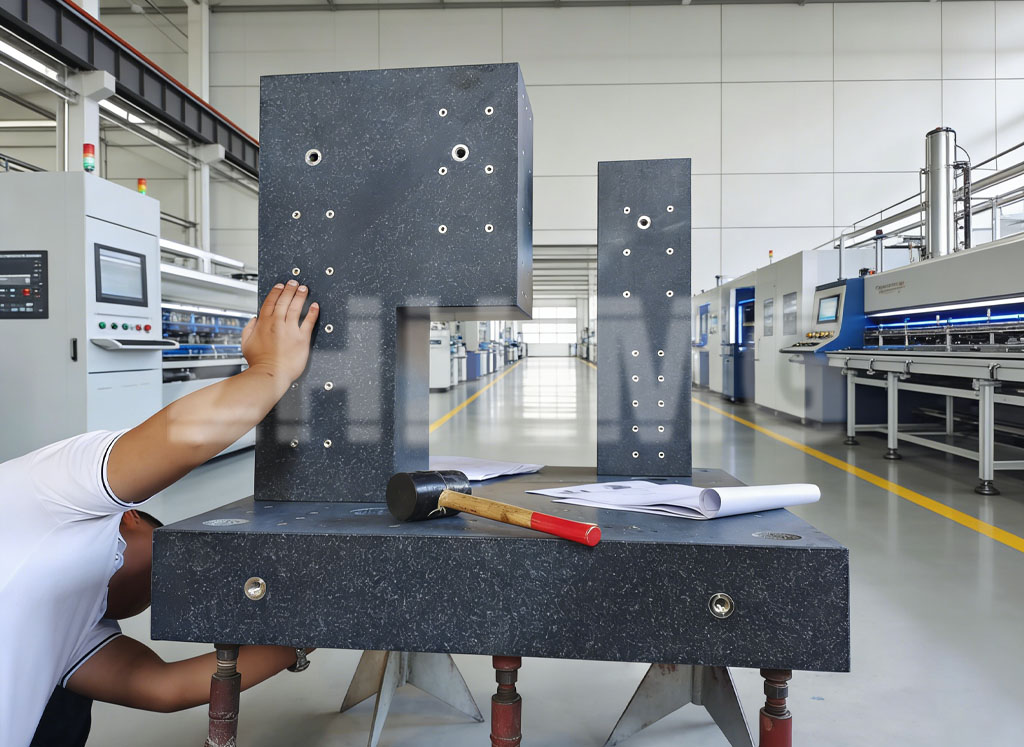
A machine base is more than a block. Real designs include:
- • Threaded inserts, T-slots and through holes
- • Precision-ground mounting surfaces for rails and linear motors
- • Cable channels, lightening pockets and internal cavities
- • Air bearing surfaces
Good design reduces weight and cost while keeping stiffness. Send your drawings early so the supplier’s engineers can review manufacturability and suggest improvements.
5. Measurement and Traceable Calibration
A supplier can only deliver the accuracy it can measure. Look for:
- • Calibrated instruments such as electronic levels, laser interferometers, indicators and roughness testers
- • Calibration certificates that are traceable to a national metrology institute
- • An inspection report supplied with every order
- • A temperature- and humidity-controlled inspection room with a vibration-isolated floor
ZHHIMG® measures with instruments from Mahr, Mitutoyo, WYLER and Renishaw. All of them carry calibration certificates traceable to national standards.
6. Assembly and Cleanliness Requirements
Semiconductor and optical equipment often needs the granite base assembled with other parts, such as rails, air bearings and frames, in a clean environment. Ask whether the supplier offers:
- • Granite assembly services
- • A temperature-controlled, dust-free assembly area
- • Combined granite, metal and ceramic components from one source
One source for several materials reduces coordination work and fit-up problems.
7. Quality System, Capacity and Communication
Finally, check the supplier’s systems and reliability:
- • Certifications such as ISO 9001, ISO 14001, ISO 45001 and CE (ask to see the certificates)
- • Production capacity and typical lead times
- • Export experience, packaging and shipping, including near-port logistics
- • Clear communication, with no hidden compromises on material or process
ZHHIMG® is based in Jinan, near the Qingdao port, which supports efficient export shipping.
Quick Checklist
| Factor | What to ask the supplier |
|---|---|
| Material | Stone type, density, test report |
| Accuracy | Flatness, parallelism, roughness you can achieve |
| Size | Maximum length, width, thickness, weight |
| Structure | Inserts, slots, cavities, air bearing surfaces |
| Measurement | Instruments, calibration traceability, report |
| Assembly | Clean-room assembly, multi-material support |
| Quality system | Certificates, capacity, lead time |
FAQ
Is granite better than steel or cast iron for machine bases?
Granite offers excellent vibration damping, low thermal expansion and no rust, and it does not hold residual stress the way welded steel can. Steel and cast iron are still used where impact strength or tensile load matters.
Why does density matter?
Higher density generally means better stiffness and damping and lower porosity, which improves long-term stability.
Can I get a custom base from my drawing?
Yes. Send your drawing (DWG, STEP or PDF) with tolerances, quantity and application, and our engineers will review it.
Get a Quote for Your Granite Machine Base
ZHHIMG® produces precision granite bases, components, assemblies, air bearings and measuring tools for customers worldwide. Send us your drawings and requirements for a fast technical review and quote.
Post time: Nov-25-2026