
Selecting a machine base material is not simply a choice between three different materials. It is a decision about how a machine will behave over time: under changing temperatures, vibration, load, assembly stress, and repeated measurement cycles.
For global engineering purchasers, quality managers, and laboratory technicians, the most important question is usually not “Which material is best?” It is: Which material best protects the accuracy, throughput, and serviceability required by this machine?
Precision granite, mineral casting, and engineering ceramics each have a well-established role in ultra-precision equipment. Their performance differs because their material structures, manufacturing methods, finishing processes, and practical size limits differ. A coordinate measuring machine, high-speed grinding machine, semiconductor inspection platform, and precision optical stage may all require stable bases, but the optimum material is rarely identical.
Begin With the Machine Function
A useful material-selection process starts with the machine’s precision budget. Determine where error is most likely to enter the system:
- Is the primary risk vibration from moving axes, grinding forces, or nearby equipment?
- Does the machine need a highly accurate reference surface for measurement or assembly?
- Will it operate in a controlled metrology room or on a production floor with changing ambient conditions?
- Are cable routes, cooling channels, threaded inserts, or embedded mounting features essential?
- What are the largest dimensions, transport limits, and installation requirements?
- Is the design fixed for a long production run, or likely to change between projects?
The answers often point clearly toward precision granite, mineral casting, or ceramics. In many successful systems, the final structure also uses more than one material—for example, a mineral-cast frame combined with precision granite guide surfaces or ceramic moving elements.
Precision Granite: Stable Reference Surfaces
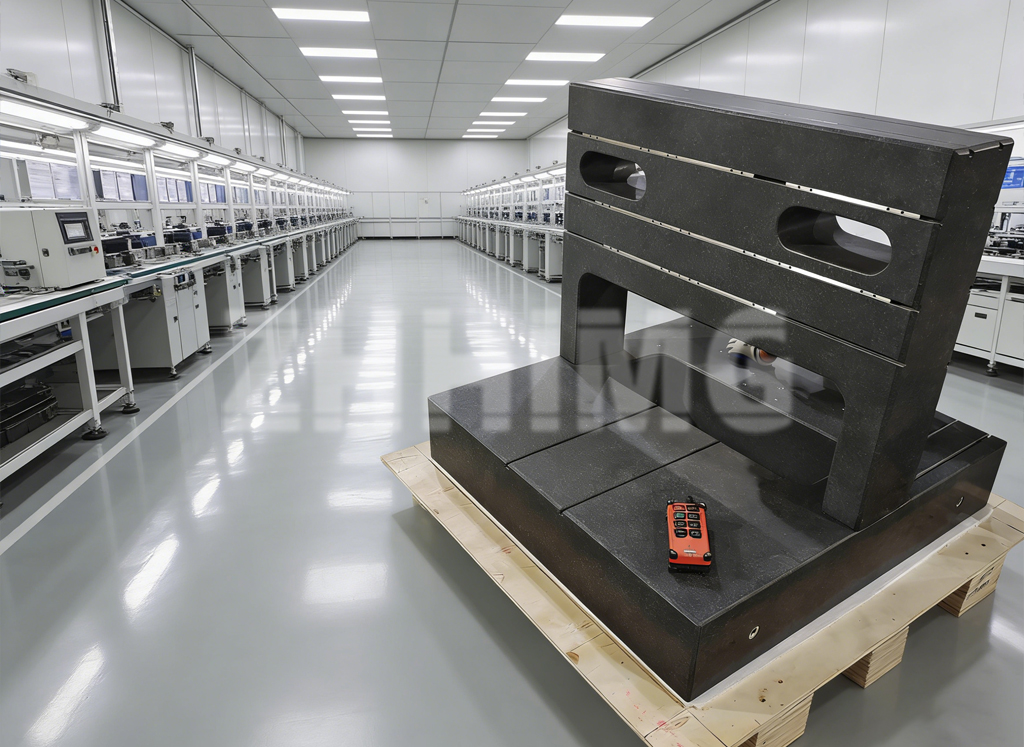
Precision granite is widely used for metrology equipment bases, granite surface plates, CMM structures, air-bearing systems, optical inspection machines, laser equipment, and precision assembly platforms. It is a natural stone material that is cut, machined, ground, and lapped rather than poured into a mold.
Its main engineering benefit is long-term geometric stability. A carefully selected, homogeneous granite with low porosity and suitable physical properties can provide stable reference faces after precision grinding and lapping. Granite is also non-magnetic, electrically insulating, corrosion resistant, and naturally capable of absorbing vibration.
These characteristics matter when the base itself is part of the measurement reference system. A granite machine base can carry precision rails, air bearings, optical components, or coordinate-measuring elements while maintaining a stable datum surface.
Granite does have design constraints. Complex internal cavities, curved enclosed passages, and highly integrated functional features generally require secondary machining, bonded inserts, or assembled components. The material is heavy, so lifting capacity, transport, and foundation conditions must be assessed early. Geometry also influences performance: rib design, support-point layout, hole patterns, and loading arrangement should be evaluated with the same care as the material itself.
In practical manufacturing, granite components are especially appropriate where large dimensions, stable precision surfaces, and direct lapped datums matter more than a highly integrated molded structure. For example, a large metrology platform may benefit from a granite base with ground mounting interfaces, precision holes, and assembled air-bearing or guideway modules.
Mineral Casting: Integration and Damping
Mineral casting, often called polymer concrete or epoxy granite, is an engineered composite made from graded mineral aggregates and a polymer binder. It is formed in molds and cured at relatively low temperatures. The process makes it particularly useful for machine structures with complex external geometry and integrated interfaces.
A mineral casting machine base can incorporate embedded inserts, conduits, cable passages, mounting plates, and other features during molding. This can reduce the number of secondary operations and simplify final assembly. It is one reason mineral casting is frequently considered for grinding machines, automation equipment, precision CNC systems, laser equipment, and other designs with high functional integration.
Vibration damping is another important advantage. Research on epoxy-granite foundations has reported substantially higher damping than cast-iron alternatives in a machining-center application, with the base design influencing stiffness and chatter behavior as well. Actual performance remains dependent on the aggregate formulation, binder system, geometry, inserts, curing process, machine layout, and support conditions.
Thermal behavior should be considered in context. Mineral casting typically has relatively low thermal conductivity, which can reduce rapid heat transfer through the structure. That can be useful for isolating local temperature changes, but it also means a machine may require time to reach thermal equilibrium. Precision surfaces, linear-guide interfaces, and critical mounting pads are often post-machined or fitted with accurately manufactured inserts.
Mineral casting is usually a strong candidate when damping, repeatable casting of a stable design, and embedded functional features outweigh the need for directly lapped natural-stone reference surfaces. The tooling investment should be included in the evaluation, especially for low-volume or frequently changing designs.
Ceramics: High Performance, Higher Constraint
Technical ceramics are used where stiffness, wear resistance, low mass, corrosion resistance, electrical insulation, or specialized thermal behavior are needed. Ceramic machine structures can be valuable in high-precision motion systems, semiconductor equipment, vacuum-compatible assemblies, precision measuring components, and selected optical or scientific instruments.
Compared with granite or mineral casting, ceramic components can offer very high stiffness-to-weight performance and excellent resistance to wear. This can be useful for moving beams, guide elements, precision stages, and components where reduced moving mass improves dynamic response.
The practical limitation is that ceramics are typically more costly and more difficult to manufacture at large structural sizes. Material brittleness also affects fastening design, impact resistance, handling, and local stress concentration around holes or inserts. Large ceramic machine bases are therefore less common than ceramic precision components or substructures.
For many equipment builders, ceramics make the most sense at the locations where their unique properties produce the greatest return: a lightweight moving member, a wear-critical guide component, an electrically insulating support, or a thermally sensitive precision element. Using ceramic throughout an entire large base may not be necessary or economical.
A Practical Selection Matrix
| Selection factor | Precision granite | Mineral casting | Technical ceramics |
|---|---|---|---|
| Precision reference surfaces | Excellent after grinding and lapping | Usually requires post-machining or inserts | Excellent when precision-finished |
| Vibration damping | High natural damping | High; formulation and design dependent | Generally lower than granite or mineral casting |
| Complex integrated features | Moderate; requires machining or assembly | Excellent; inserts and channels can be molded in | Limited and costly for complex large structures |
| Large machine-base capability | Strong | Strong with suitable molds and handling | More limited in practice |
| Corrosion resistance | Excellent | Generally good | Excellent |
| Wear resistance | Good for structural surfaces | Depends on surface treatment and inserts | Excellent |
| Cost at large scale | Often competitive for precision structures | Can be efficient for repeatable molded designs | Usually highest |
| Typical use | Metrology, CMM, optics, air bearings | CNC, grinding, automation, integrated frames | Motion parts, specialty precision components |
Use the Material as Part of the System
The best machine base is selected with the complete machine architecture in mind. Material properties alone cannot guarantee accuracy. Designers should also assess support-point configuration, isolation strategy, guideway mounting, heat sources, motor placement, cable management, machining loads, cleanroom requirements, and verification methods.
For high-precision projects, it is useful to involve the machine-base supplier during the drawing stage rather than after the design is frozen. Questions about insert locations, threaded holes, bonded assemblies, grinding access, transport dimensions, and measurement references can often be resolved before they become expensive production changes.
ZHHIMG® manufactures precision granite components, mineral-cast structures, and precision ceramic parts for metrology and advanced-equipment applications. In practice, the most reliable solution is often not a material preference, but a design decision based on the required datum stability, dynamic behavior, integration level, size, and lifecycle cost.
Post time: Aug-21-2026