
1. Raw material standard difference: mixed low-density stone vs. screened high-density pure black granite
Ordinary granite parts on the market mostly adopt mixed stone materials with inconsistent origins, mixed mineral grains and residual loose texture. Some manufacturers even use marble substitute materials to reduce costs. Such materials have low density, uneven internal structure, high water absorption and poor temperature resistance. Although they can be polished to meet basic flatness standards, they are prone to micro deformation and accuracy drift after long-term use.
All equipment-grade stable granite components strictly adopt high-density pure black granite with stable mineral phase and compact grain structure. The raw stone is screened layer by layer to eliminate loose veins, porous sections and soft impurity areas. The overall density is uniform and far exceeds ordinary stone materials, providing fundamental structural rigidity and long-term geometric stability for precision equipment.
2. Internal stress treatment difference: no aging treatment vs. multi-stage stress relief aging
Most ordinary granite products only undergo simple cutting and surface grinding without professional stress relief procedures. The stone retains massive internal stress formed during mining and processing. After installation and use, affected by workshop temperature difference and mechanical vibration, the residual stress is slowly released, resulting in invisible warping, flatness attenuation and unstable measurement data.
Equipment-grade granite components must complete standardized multi-stage aging treatment, including natural placement aging and simulated vibration aging. The long-cycle stress releasing process completely eliminates internal unbalanced stress, ensuring that the structural geometry remains unchanged for a long time even in continuous vibration and temperature-changing working environments.
3. Production environment difference: ordinary workshop processing vs. constant temperature and vibration-isolated precision workshop
Ordinary granite processing is completed in ordinary industrial workshops without constant temperature control and vibration isolation measures. Ground vibration, air flow fluctuation and temperature drift will cause subtle errors in the grinding process. These hidden errors cannot be seen visually, but will continuously affect the equipment operation accuracy in actual use.
Professional equipment-grade granite finishing, assembly and testing are all completed in a 10,000-square-meter professional constant-temperature and humidity dust-free workshop. The super-thick hard concrete floor and surrounding anti-vibration trenches effectively isolate external vibration interference. Equipped with silent traveling systems, the whole workshop maintains a stable precision environment, ensuring that the processing accuracy and test data of each component are true, effective and repeatable. 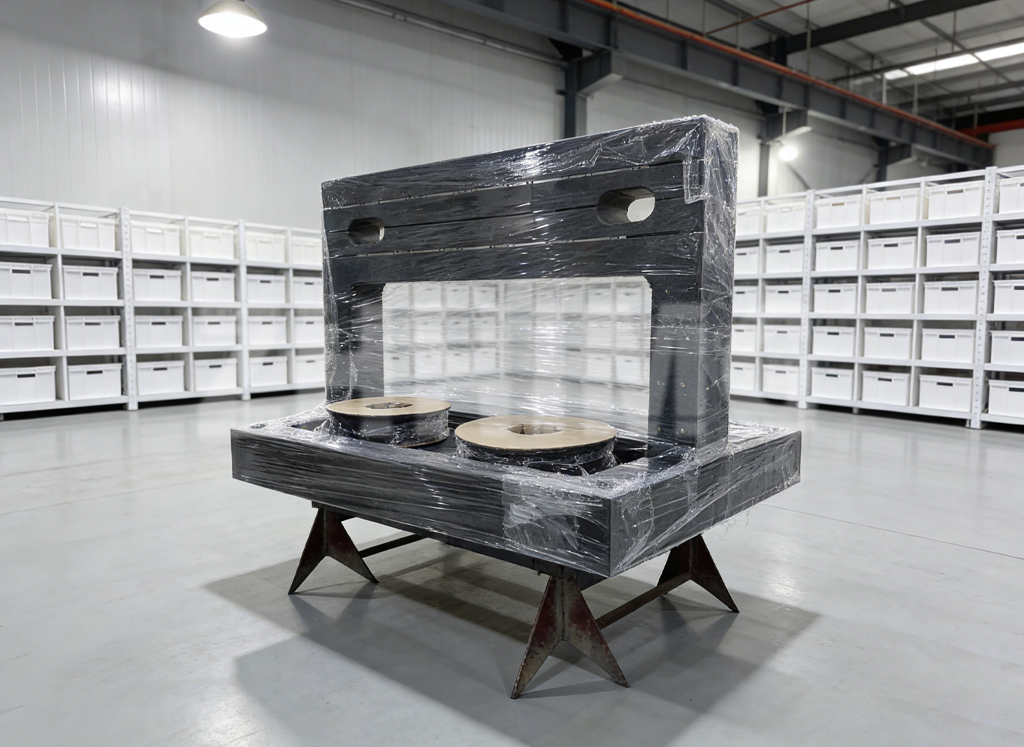
4. Testing standard difference: simple detection vs. full-standard traceable precision calibration
Ordinary granite manufacturers only use simple measuring tools for flatness inspection, lacking systematic precision testing items. The test data has no authoritative calibration source and cannot be traced, resulting in inconsistent product accuracy and unreliable batch stability.
Equipment-grade granite components adopt world-class testing equipment including German Mahr gauges, Japanese Mitutoyo precision testers, Swiss WYLER electronic levels and British Renishaw laser interferometers. All detection data is calibrated by national and provincial metrology institutions and fully complies with global mainstream standards such as DIN, ASME, JIS, GB and BS. Complete traceable testing systems ensure that every precision index of the product is true, stable and internationally recognized.
5. Technical craftsmanship difference: mechanical grinding only vs. manual nano-precision polishing + standard professional training
Ordinary granite processing relies entirely on mechanical grinding, lacking fine manual correction and experience-based error compensation. The process is single and cannot eliminate tiny structural defects caused by stone texture differences.
Professional equipment-grade granite manufacturing combines high-precision CNC equipment and decades of senior manual polishing experience. All technicians receive long-term standardized training on global metrology standards. Senior polishing masters can accurately control micron-level material removal, realizing nano-level flatness precision that pure mechanical processing cannot achieve, which greatly improves the stability and consistency of high-end precision components.
6. Factory qualification and R&D difference: uncertified small workshops vs. standardized international high-end manufacturers
Ordinary granite processing factories lack complete international management system certifications and independent intellectual property rights, with unstable process management and no standardized quality control system.
As a leading ultra-precision granite and precision component manufacturer with ISO9001, ISO14001, ISO45001 and CE full certifications, ZHHIMG holds more than 20 international patents and trademarks registered in Europe, America and Southeast Asia. The company has long-term in-depth cooperation with world-renowned universities and metrology institutions, continuously optimizing processing technology and testing methods. Standardized enterprise management, strict quality policies and customer-oriented zero-deception commitments ensure that all delivered products maintain consistent high-end equipment-grade precision performance.
7. Application performance difference: short-term flatness vs. long-term stable benchmark performance
Ordinary granite parts can only meet temporary flatness requirements and are only suitable for low-precision detection and ordinary mechanical support scenarios. They cannot adapt to high-precision fields such as semiconductors, laser ultra-precision processing and new energy testing.
Equipment-grade stable granite components are specially developed for ultra-precision industrial scenarios, widely used in CMM coordinate measuring machines, AOI optical inspection, XRAY detection, semiconductor equipment, linear motor platforms, precision laser equipment and new energy testing equipment. They maintain ultra-high stability, vibration resistance and precision retention for a long time, becoming the indispensable precision benchmark of modern ultra-precision industry.
Conclusion
The gap between ordinary granite parts and equipment-grade stable granite components is not reflected in surface flatness, but in raw material quality, stress treatment, production environment, testing traceability, technical craftsmanship and standardized factory strength. For high-end precision equipment manufacturing, only strictly screened, fully aged, precisely tested and professionally processed equipment-grade granite can ensure long-term stable operation of precision equipment.
As a world-class ultra-precision component manufacturer, ZHHIMG always adheres to strict precision manufacturing standards, eliminates inferior ordinary stone materials from the source, and provides global customers with truly high-stability, equipment-grade precision granite structural parts and measuring benchmarks.
Post time: Aug-10-2026