
Vibration stands as one of the dominant sources of error for ultra‑precision equipment. For granite structural components serving semiconductor production, laser processing, coordinate measurement and optical inspection systems, even tiny external vibration will translate into position deviation, blurred imaging or inconsistent measurement readings. While many buyers focus merely on final grinding accuracy and flatness of finished granite parts, material proportioning and intrinsic stone characteristics fundamentally determine the anti‑vibration capacity over the whole service life. Optimized material selection and proportion matching deliver far more durable vibration suppression than post‑processing or passive damping accessories alone.
Many market‑available granite components suffer performance bottlenecks rooted in raw‑material blending. Some manufacturers mix different batches of stone blocks or adopt low‑grade stone with heterogeneous mineral composition to cut costs. Uneven mineral grain size, random pore distribution and impurity inclusions create inconsistent internal rigidity. Under cyclic vibration excitation, local micro‑vibration resonance occurs inside the workpiece. Even if surface flatness meets drawing requirements after grinding, the component will amplify external vibration during real‑world operation, shortening service life and lowering equipment repeat accuracy.
Material proportioning for anti‑vibration granite structures focuses on mineral compactness, grain homogeneity and density consistency, rather than simple single‑index pursuit. High‑quality natural black granite features a stable mineral composition with closely packed crystalline grains. Strict raw‑stone screening eliminates layers containing loose mineral veins, porous zones and soft impurities. Block selection and batch matching ensure density stays within a narrow tolerance range across the whole component. This uniform internal texture helps dissipate vibration energy rapidly instead of storing and transmitting vibration waves throughout the granite base.
Material proportion control covers more than stone block selection. When designing large‑size granite beams, beds and air‑bearing bases, component geometry must match the inherent material properties. Experienced manufacturers carry out raw‑stone pre‑evaluation before cutting. According to grain orientation, density distribution and internal stress status of each selected block, engineers arrange cutting directions, rib layout and wall‑thickness proportion. Reasonable cooperation between material texture and structural geometry optimizes the material utilization ratio, suppresses modal resonance points, and greatly improves damping behaviour of large monolithic granite structures.
It is worth noting that good material proportioning cannot offset defects brought by inadequate stress release. Even well‑proportioned granite will retain internal stress generated during rock formation and cutting processes. Advanced production workflows combine material‑based proportion optimization with multi‑stage aging procedures. Natural aging together with simulated vibration aging releases residual stress step‑by‑step. This prevents local deformation and performance drift after long‑term exposure to continuous machine vibration, locking in the anti‑vibration performance designed at the material‑matching stage.
Accurate verification is essential to validate whether material proportion schemes achieve expected anti‑vibration effects. Simple flatness inspection cannot reflect damping performance. Professional manufacturers adopt laser interferometers and electronic level instruments to test vibration attenuation characteristics under simulated operating conditions. Testing references global metrology standards from Europe, North America and Asia. Each batch of raw stone undergoes sampling inspection for density, mineral homogeneity and damping factor before entering formal processing. Test records keep traceable for customers, supporting equipment installation and on‑site modal analysis. 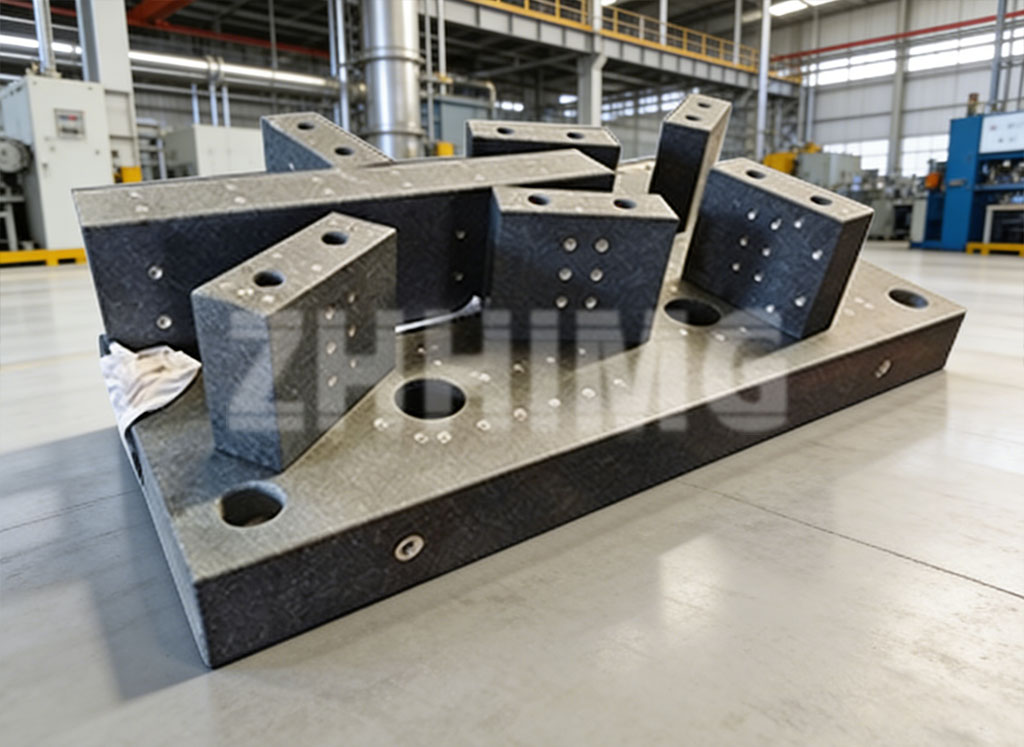
Material proportion optimisation brings tangible value for downstream equipment integrators. Well‑matched granite structural parts reduce dependence on external vibration isolators. For large travel linear motor platforms, high‑speed PCB drilling devices and perovskite coating equipment, improved internal damping shortens vibration settling time significantly. Equipment achieves stable status faster after motion stops. This directly boosts throughput and measurement consistency for high‑precision production and inspection processes.
Realising reliable material proportion control relies on comprehensive manufacturing capability. Stable raw‑material stockyards guarantee sufficient qualified stone reserves for batch matching. Large‑scale processing capacity supports customised cutting schemes according to material grain distribution. Constant‑temperature workshops with anti‑vibration infrastructure avoid introducing extra stress during machining. Supported by international certification systems and long‑term cooperation with metrology research institutes, manufacturers keep refining stone‑selection and proportion‑matching methodology. Professional teams with metrology background interpret test data and transfer material advantages into end‑product anti‑vibration performance.
As an experienced supplier of ultra‑precision structural components, ZHHIMG attaches great importance to raw‑stone screening and material proportion optimisation for granite structural parts. Instead of only pursuing finished‑surface precision, we carry out systematic raw‑material evaluation, batch‑to‑batch density matching and grain‑oriented cutting design. Combined with multi‑stage stress relief aging and professional vibration‑performance testing, our granite beams, machine beds, air‑bearing bases and measuring components obtain excellent inherent damping capacity. This material‑driven anti‑vibration solution serves Fortune 500 enterprises and research institutions across semiconductor, new‑energy and optical industries, delivering stable structural foundations for next‑generation ultra‑precision equipment.
Post time: Aug-10-2026