
Even with high‑quality granite dial bases manufactured under strict constant‑temperature workshop conditions, measurement errors may still occur in real‑world production environments. On‑site temperature fluctuation and unexpected vibration are two major disturbance sources that degrade reading repeatability. Granite itself delivers excellent physical properties, yet it cannot completely offset harsh ambient influences. Operators and equipment integrators need practical on‑site methods to mitigate temperature drift and vibration interference, so as to give full play to the benchmark performance of granite dial bases.
Temperature interference comes in multiple forms in workshop conditions. Direct sunlight, heat sources nearby such as motors and furnaces, as well as frequent air‑conditioning adjustments will create uneven temperature distribution across the granite dial base. Although industrial black granite features low thermal expansion coefficient, sharp or uneven temperature changes still produce tiny dimensional deviation. If workpieces and the base itself hold different temperatures before measurement, comparison‑type dial‑gauge readings will deviate obviously.
For temperature‑related interference, reasonable on‑site operation habits play a key role. First, place the granite dial base far away from heat radiation sources and avoid direct sunlight. Do not install it next to heating equipment, air‑conditioning outlets or ventilation fans. Second, implement sufficient temperature soaking before formal measurement. Place both the granite base and measured workpieces in the same testing environment long enough to reach thermal equilibrium, instead of measuring cold or hot workpieces immediately after they are transported from other workshops. Where possible, isolate the testing station with simple thermal‑insulation barriers to reduce the impact of ambient temperature swing. It is worth noting that even high‑grade granite cannot eliminate thermal deformation completely; correct environmental layout is always indispensable.
Vibration interference is another common headache on‑site. Ground vibration transmitted from nearby machine tools, punching equipment, transporting trolleys, as well as human walking and air‑blower operation, can generate micro‑vibration. Such tiny vibration will not damage the granite structure, but it causes pointer jitter of dial indicators and unstable optical sensor feedback, which greatly reduces measurement consistency. Many users mistakenly believe that high‑density granite alone can solve all vibration problems, ignoring the importance of installation and isolation measures.
Multi‑level measures can be adopted for vibration suppression. First of all, select a proper installation position. Keep the granite dial base station away from heavy‑duty processing equipment and busy material‑handling channels. Avoid mounting the base on thin suspended floor slabs where resonance is easy to happen. Secondly, optimize the supporting structure. Ordinary rigid supports simply transfer ground vibration upward. Matching anti‑vibration damping components under the base can absorb most high‑frequency micro‑vibration. Meanwhile, check the level status regularly. Unbalanced installation will weaken the whole‑set anti‑vibration effect, even if the granite body itself is qualified. In high‑precision optical‑measurement scenarios, independent vibration‑isolated foundation is recommended for long‑term stable operation.
Joint influence of temperature and vibration should also be taken into consideration. In some workshops, temperature change is accompanied by mechanical vibration. For instance, large‑size equipment starts to generate both heat and ground vibration. Under such compound interference, only optimizing a single factor cannot obtain reliable measuring data. Operators should arrange measurement tasks properly, avoid performing high‑precision inspection during equipment peak‑operation periods, and choose relatively stable time windows for key‑part testing. 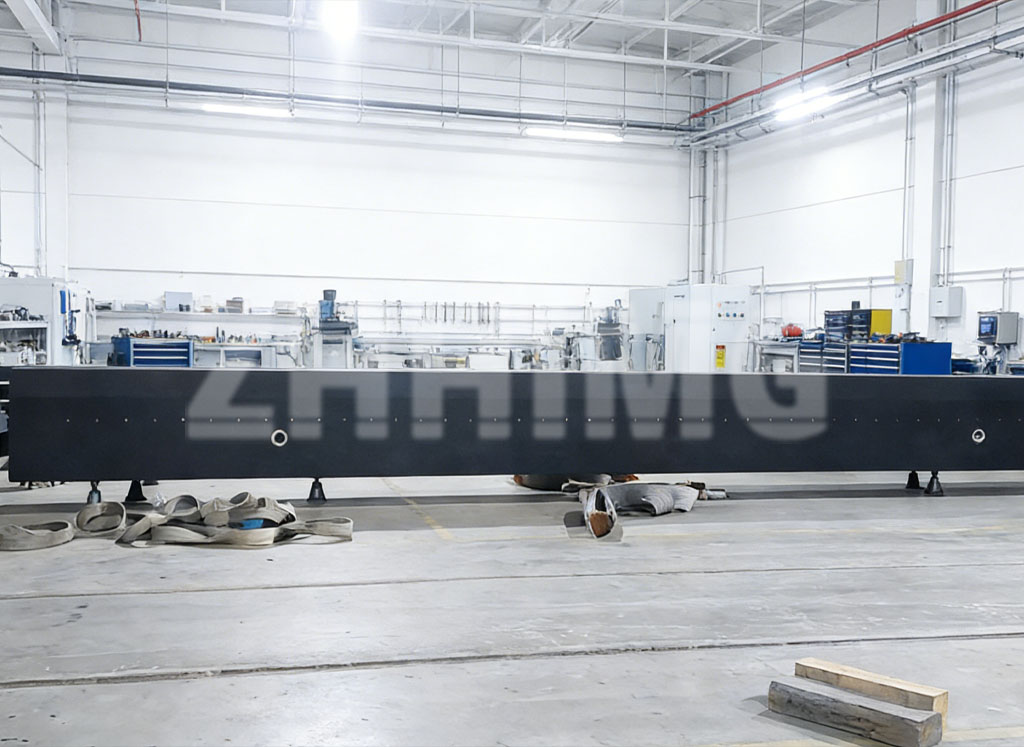
Apart from environmental adjustment, regular condition checking of granite dial base cannot be omitted. Check whether the working surface has bumps, burrs or contamination. Foreign attachments on the reference surface will amplify the negative influence brought by temperature and vibration. Keep the base surface clean and protect it from collision. Even small local damage will weaken the stability of dial‑gauge installation and indirectly magnify interference errors.
Procurement stage also lays the foundation for on‑site anti‑interference effect. Buyers need to confirm that the product adopts genuine high‑density industrial granite rather than low‑density marble substitutes. Inferior stone with loose texture shows poor temperature resistance and damping capacity, and no amount of on‑site adjustment can make up for material defects. Meanwhile, confirm that finished products are inspected under constant‑temperature anti‑vibration conditions, with traceable calibration documents complying with international metrology standards.
ZHHIMG reminds global users that granite dial base is a high‑performance benchmark component, rather than an all‑in‑one solution to eliminate all environmental disturbances. Good material performance needs to cooperate with scientific site layout, standardized installation and correct operation habits. As an ultra‑precision component manufacturer, ZHHIMG provides granite dial bases with stable material properties and strictly inspected flatness, and shares practical application experience for global metrology users, helping customers reduce measurement uncertainty caused by on‑site temperature and vibration interference.
Post time: Aug-06-2026