
As a benchmark enterprise in the ultra-precision stone industry, ZHHIMG has long been engaged in the R&D and production of ultra-precision components including granite, ceramic, metal and glass parts. Drawing on cooperation experience with metrology institutes worldwide, international testing standards and decades of craftsmanship, we have established a professional stone selection system tailored for high-end gantry components. It accurately distinguishes stone quality from four dimensions: material essence, physical properties, surface texture and stability, effectively solving the industry problem of shoddy products.
1. Distinguish Material Essence: Differentiate Granite from Marble to Eliminate Material Fraud
The core cause of inferior low-cost granite gantry components on the market lies in incorrect base material selection rather than defective processing technology. Some suppliers take advantage of industry cognitive gaps, using low-cost marble with poor physical properties to replace industrial precision granite. Despite similar appearances, the two materials differ drastically in precision performance, making marble completely unapplicable to ultra-precision equipment scenarios.
As a carbonate metamorphic rock, marble features loose internal structure, high porosity and poor thermal stability. It is prone to deformation and warpage under changes in temperature, humidity and external force, leading to long-term accuracy deviation. It is only suitable for ordinary decoration rather than industrial precision components. In contrast, high-end black granite dedicated to precision gantries is igneous rock with a compact, uniform structure and regular crystal arrangement, delivering outstanding structural stability.
Two practical and operable identification methods are available. First, texture identification: high-quality industrial granite has a uniform and delicate texture without messy color lines, spots or pinholes and features fine and consistent crystal particles, while marble has disordered textures with uneven lines and obvious natural pores. Second, physical property identification: granite boasts high hardness and wear resistance with a clear and heavy knocking sound, whereas marble is soft, easy to wear, and produces a dull knocking sound. ZHHIMG strictly selects high-end native black granite and rejects all alternative materials to eliminate material fraud at the source and ensure long-term constant precision of gantry components.
2. Verify Core Parameters: Define High-End Industrial Stone Standards via Density Indicators
For high-precision load-bearing and guiding structures such as granite gantries, stone density is the core decisive indicator of stability. Higher density corresponds to a more compact internal stone structure, better deformation resistance, vibration resistance and thermal stability. It can effectively offset vibration interference and thermal deformation during equipment operation, ensuring nano-level and micron-level precision output.
Ordinary low-end granite in the industry generally has a density below 2800kg/m³ with inconsistent physical properties, which is highly susceptible to environmental deformation and fails to meet ultra-precision equipment requirements. The high-end black granite selected by ZHHIMG reaches a density of approximately 3100kg/m³, surpassing the physical performance standards of European and American black granite. As the optimal base material for precision gantry components, it delivers extreme structural rigidity, enabling large-scale gantry components to maintain zero deformation and high precision under working conditions of a maximum processing length of 20 meters and super-large load-bearing capacity.
During procurement and selection, professional density detection and volumetric weight measurement via the drainage method can be adopted to verify stone density and avoid low-density inferior materials, recycled materials and spliced materials. This core parameter serves as the key standard to distinguish industrial-grade precision granite from ordinary civil stone.
3. Inspect Texture Details: Identify Natural Monolithic Stone vs. Spliced & Repaired Stone
In addition to material fraud, another prevalent industry malpractice is processing gantry components with spliced fragments and repaired defective granite. Though polished and refurbished to look intact, such stone hides internal latent cracks, splicing gaps and aging glue layers. Long-term operation will cause cracking, accuracy deviation and local settlement, severely undermining the operational stability of high-end equipment.
High-quality base materials for precision granite gantries must be natural monolithic raw stone without splicing, repair or latent cracks. Three verification methods including strong light side irradiation, water penetration test and fine polishing observation can be used for selection. Qualified stone features a smooth and uniform surface free of microcracks, pinholes and depressions; water droplets condense on the surface without penetrating, proving a compact and pore-free internal structure. In contrast, inferior repaired stone shows local water penetration, texture faults and visible repair traces under strong light.
All gantry component base materials of ZHHIMG adopt integral native black granite raw stone with no splicing or repair. Equipped with a large-scale raw material storage yard, we guarantee the integrity and stability of every component from the raw material end, adapting to rigorous high-end scenarios such as semiconductors, precision metrology and new energy detection.
4. Verify Stability Performance: Core Selection Criteria for Ultra-Precision Working Conditions
As the core reference structure of precision equipment, granite gantry components require not only high hardness and density but also excellent thermal stability, vibration resistance and weather resistance — the essential performance gaps between ordinary stone and industrial-grade precision stone. Inferior stone has a high thermal expansion coefficient, which causes micro-deformation with slight temperature fluctuations, leading to failure in equipment measurement and processing accuracy. Meanwhile, its poor vibration resistance makes it vulnerable to external vibration interference, incapable of meeting the requirements of constant-temperature, constant-humidity and dust-free high-precision workshops.
High-quality industrial granite features an extremely low thermal expansion coefficient, excellent aging resistance and deformation resistance. It adapts to constant-temperature, constant-humidity and dust-free high-precision working environments with no precision attenuation or drift during long-term service. During selection, professional metrology testing equipment can be used to verify core indicators including thermal stability, flatness, roughness and deformation coefficient. Compliance with multinational authoritative metrology standards such as German DIN, American ASME, Japanese JIS and Chinese GB ensures the stone meets ultra-precision industrial production requirements. 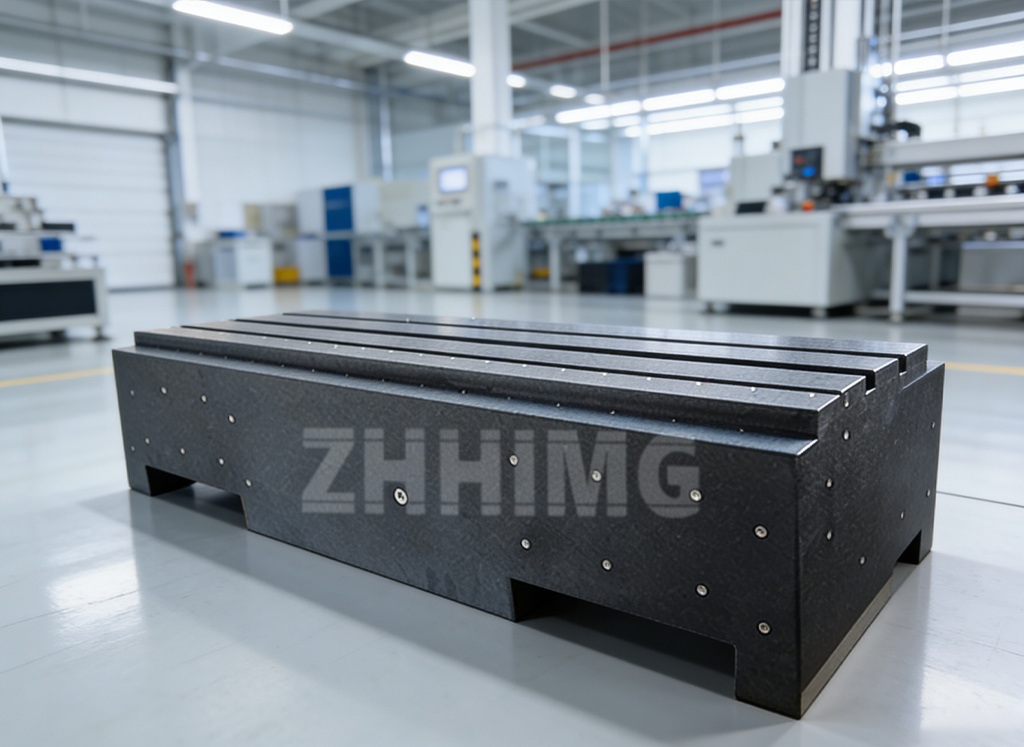
5. Adopt Reliable Production Capacity & Testing Certification to Avoid Selection Risks
Stone quality identification relies not only on raw material performance but also on the manufacturer’s quality control system, testing capabilities and industry qualifications. Most small manufacturers lack standardized selection processes and precision testing equipment, unable to guarantee the precision performance of stone materials through simple visual inspection. In contrast, formal high-end precision stone manufacturers possess complete systems for raw material selection, performance testing and process control.
As one of the few enterprises in the industry holding ISO9001, ISO45001, ISO14001 and CE international certifications, with more than 20 international trademarks and patents registered in the EU, the United States, Southeast Asia and other developed regions, ZHHIMG adheres to the quality policy of “No over-demanding for precision industry is excessive”. We have built a full-process stone quality control system equipped with world-class testing instruments including German Mahr micrometers (0.5μm), Japanese Mitutoyo full-range testing equipment, British Renishaw laser interferometers and Swiss WYLER electronic levels. All raw material performance tests are implemented in accordance with multinational metrology standards, with all calibration data traceable to national metrology institutes. Supported by craftsmen with over 30 years of manual polishing experience, world-class precision processing equipment and a 10,000㎡ constant-temperature, constant-humidity and vibration-proof dust-free workshop, we maximize the inherent performance of high-quality stone and produce granite gantry components with nano-level precision.
Conclusion
The precision ceiling of granite gantry components starts with stone selection. With the rapid development of the ultra-precision industry, stone selection has evolved from simple visual identification to all-round professional verification covering density, stability, material purity and structural integrity. Avoiding industry malpractices such as marble replacing granite, low-density inferior materials substituting high-end raw stone and repaired spliced materials being passed off as premium products, and adhering to standardized, data-driven and professional selection criteria are essential to ensure long-term stable operation of precision equipment. In the future, ZHHIMG will continue to uphold the customer commitment of “No cheating, No concealment, No misleading”. With rigorous selection standards, top-tier processing technology and international quality control systems, we will empower the high-quality development of the global ultra-precision industry.
Post time: Sep-02-2026