
As the core load‑bearing main beam of gantry‑type precision equipment, granite gantries are widely applied in semiconductor inspection, optical metrology, laser micro‑machining and high‑precision automation platforms. At the solution‑design stage, many equipment manufacturers directly select products according to standard external specifications, merely referring to basic parameters such as span, thickness and weight. Comprehensive constraints including load distribution, motion characteristics, on‑site environment and assembly interfaces are often overlooked. Even with high‑quality granite blanks, mismatched gantry structures against actual working conditions may lead to excessive deformation, poor dynamic response and high resonance risks. Consequently, the inherent precision advantages of granite cannot be fully realized. Drawing on abundant practical experience in granite gantry projects, ZHHIMG sorts out core considerations for granite gantry structure matching based on real‑world working‑condition inputs, helping equipment manufacturers formulate reasonable structural schemes.
For granite gantry structure matching, priority shall be given to actual load conditions, including not only total load magnitude but also load distribution patterns. Loads cover weights of sliding‑table modules, actuators, workpieces and fixtures. It is also necessary to distinguish centered loads from offset loads. Under identical total weight, offset‑load conditions impose significantly higher requirements on the gantry’s bending and torsion resistance. If loads are persistently biased to one side of the gantry, simply increasing gantry thickness may fail to solve torsional deformation. It is required to optimize cross‑section forms and rationally arrange reinforcing ribs and weight‑reduction slots. Blindly adopting large cross‑sections to enhance rigidity will result in excessive overall mass, increase the burden on driving systems and reduce equipment motion acceleration. On the contrary, overly thin cross‑sections will cause excessive static deflection and dynamic deformation. A balance between rigidity and self‑weight should be achieved. Gantry height, cross‑section width, internal hollow‑out shapes and positions of weight‑reduction slots shall be determined according to load‑center‑of‑gravity positions, preventing weight‑reduction designs from weakening key stress‑bearing sections.
Secondly, structural selection shall be completed in combination with dynamic motion indicators. The designed maximum operating speed, acceleration and acceleration‑deceleration response directly determine rigidity requirements for granite gantries. Under high‑speed and high‑acceleration conditions, gantries bear frequently‑changing inertial forces. Apart from static deflection checks, structural natural frequency shall be verified to avoid resonance with motors, lead screws and linear modules. Natural frequency is closely associated with gantry span and cross‑section moment of inertia. Longer span brings lower natural frequency and higher possibility of coupling with external vibration sources. For long‑span granite gantries, simply increasing thickness is not the only solution. Optimizing cross‑section profiles and adopting closed‑cavity structures can improve bending and torsion rigidity and raise structural natural frequency. For low‑speed inspection equipment with minor dynamic impact, weight‑reduction structures can be properly optimized to control overall machine weight. If structural modal frequencies approach equipment excitation frequencies, resonance will be triggered during operation despite premium stone quality, resulting in jitter and unstable positioning.
Thirdly, assembly interfaces and overall‑machine installation constraints must be coordinated. As non‑stand‑alone components, granite gantries need to connect with two‑side columns, sliding seats, guide rails, linear encoders, limit assemblies and other parts. Interface layouts in turn restrict gantry structural design. Guide‑rail mounting bases, encoder mounting grooves, screw holes, locating pin holes, cable‑routing grooves and clearance notches shall be planned simultaneously in the structural‑design phase. Improper screw‑hole arrangement, e.g. holes too close to edges, will cause stress concentration around stone holes and bring risks of orifice chipping during operation. For long‑span granite gantries, minor thermal expansion and contraction caused by temperature variation shall also be taken into account. Reasonable clearance shall be reserved in interface design to avoid internal stress generated by thermal‑expansion squeezing. Drilling and slotting added in later project phases will introduce new stress and even invisible stone cracks due to secondary machining. Therefore, interface features should be finalized together with structural schemes in advance.
Environmental working conditions also affect the selection of granite gantry structural schemes. Workshop vibration levels, temperature fluctuation ranges, and exposure to cutting fluid, moisture and dust shall all be evaluated. For factories with numerous surrounding vibration sources, besides material inherent damping, closed and thick cross‑sections are preferred for gantry structures to improve overall structural damping transmission performance. In high‑humidity scenarios with cutting‑fluid splashes, structural design shall minimize dead grooves prone to liquid accumulation, and surface anti‑seepage protection shall be implemented. Where on‑site temperature‑control conditions are limited, gantry cross‑sections shall be designed for uniform heat conduction to mitigate bending deformation induced by local temperature differences.
Meanwhile, machining process feasibility must be considered. Though hollow‑out structures, slots and cavities can be processed on granite, not all arbitrary structures are achievable. Over‑narrow ribs, excessively deep tiny slots and sharp inward‑concave structures are difficult to machine, prone to chipping during production and serve as stress‑weak points in service. Sharp inner right angles shall be avoided in design, and fillet transitions are preferred. Weight‑reduction slots and cavities cannot be excavated infinitely; sufficient solid wall thickness must be reserved to guarantee structural strength. ZHHIMG carries out process reviews at the solution stage. Using high‑density black granite with a density of 3100 kg/m³ and leveraging processing capacity in constant‑temperature anti‑vibration workshops, the team conducts process‑feasibility verification for customer‑proposed structures, identifies stress‑weak positions, and puts forward optimized suggestions without compromising equipment performance. This prevents ideal drawings from being unworkable in actual production or finished parts from inheriting latent defects. 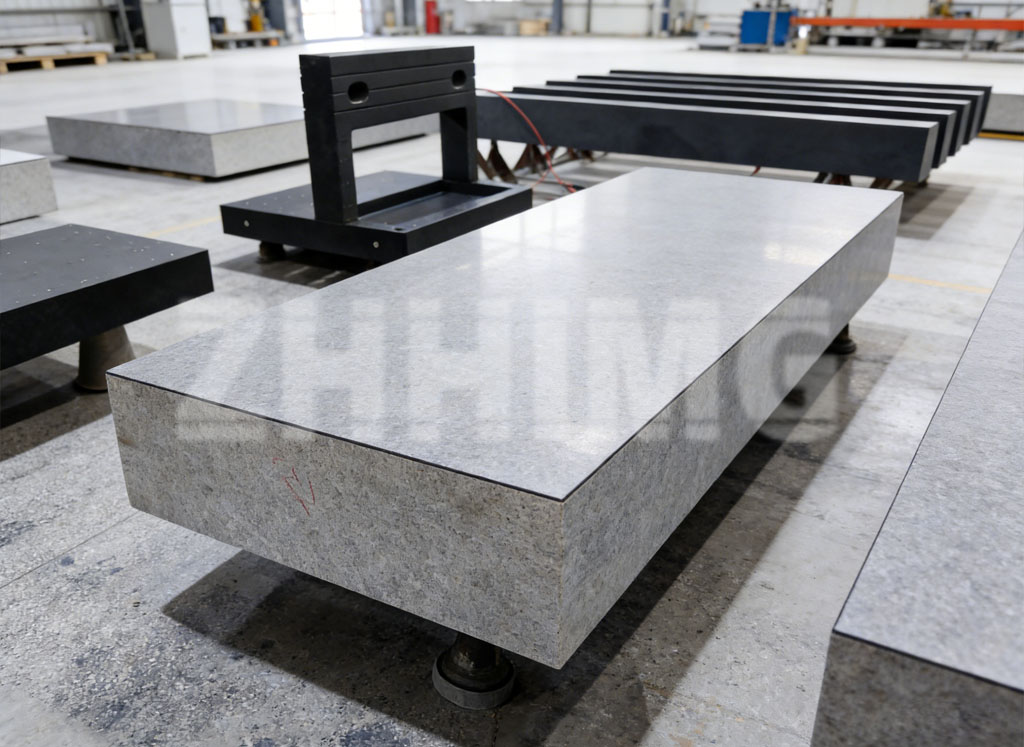
Sound structure matching is multi‑dimensional coordination covering load, dynamics, interfaces, environment and craftsmanship rather than single‑parameter selection. Supported by a full set of traceable metrological inspection systems and process technicians proficient in multiple national metrology standards, ZHHIMG implements full‑chain control from solution review, blank screening and precision machining to mating grinding and factory acceptance tests. Holding ISO triple‑system certifications, CE certification and multiple international patents and trademarks, the company refuses to accommodate unreasonable structural requirements and avoids post‑delivery precision issues originating from mismatched structural design.
Many equipment manufacturers focus on material grades and surface‑precision indicators while neglecting structure matching. With identical granite raw material, reasonable or unreasonable structural design leads to huge differences in final overall‑machine performance. The essence of granite gantry adaptation lies in tailoring structures for working conditions instead of forcing working conditions to adapt to off‑the‑shelf parts.
Looking ahead, gantry‑type equipment keeps evolving toward longer travel strokes, higher speed and higher precision. Only by sorting out constraints of load, dynamic performance, interfaces, environment and craftsmanship and completing customized granite gantry structure matching can granite material advantages be fully unlocked and long‑term stable operation of gantry‑type equipment be guaranteed.
Post time: Sep-03-2026