
Precision granite bases serve as the core load-bearing reference components for ultra-precision equipment, testing instruments and automated modules. Their load-bearing capacity, structural rigidity and deformation stability directly determine the operational accuracy and service life of equipment. Industrial scenarios vary greatly in static load, dynamic load and intermittent impact load. Blind selection of universal-specification bases often leads to heavy-load deformation, uneven stress, precision drift and support failure. Different from gantry precision grinding, structural reinforcement and equipment working condition adaptation, the core advantage of precision granite bases lies in the accurate matching of load capacity with specifications, materials, processes and support systems. With rich experience in processing super-large tonnage components, superior high-density black granite materials and comprehensive project implementation capabilities, ZHHIMG has established a standardized and scientific granite base selection system covering light-load precision detection, medium-load automatic processing, heavy-load large-scale equipment, dynamic alternating load and constant-temperature metering load scenarios. It helps enterprises achieve scenario-based accurate matching while balancing precision, stability and cost performance.
I. Core Judgment Logic for Granite Base Load Selection
Load-based selection is not simply determining base thickness according to equipment weight, but a systematic matching process combining load type, stress mode, operating condition, precision grade and environmental factors. Three core parameters must be clarified before selection to ensure accurate matching. First, load attributes, including static constant load, reciprocating dynamic load and intermittent impact load, which impose completely different requirements on stone rigidity, fatigue resistance and stress relief performance. Second, stress forms, including concentrated point load and uniform surface load; point load requires enhanced local compression resistance, while surface load focuses on overall rigidity and flatness. Third, precision requirements; ultra-precision metrology scenarios prioritize low deformation performance, while industrial processing scenarios balance load capacity and long-term precision retention.
Leveraging the excellent physical properties of 3100kg/m³ high-density black granite and compliance with international DIN, ASME and JIS metrology standards, ZHHIMG has built a four-dimensional selection standard of “load grade – material specification – processing technology – support structure”, abandoning the extensive industry model of dimension-only selection and ensuring every base accurately matches its corresponding load condition.
II. Accurate Selection and Matching Solutions for Segmented Load Scenarios
1. Light-Load Precision Metrology Scenarios: Prioritize Low Deformation and High Flatness
This scenario applies to laboratory precision inspection, 2D vision measuring instruments, small CMM calibration, optical AOI detection, tool micro-inspection and other equipment with a total load of ≤500kg. Dominated by static constant load and micro dynamic adjustment load without impact pressure, it requires extreme flatness, ultra-low deformation and high-precision reference stability. It has low requirements for load-bearing tonnage but extremely strict demands for material uniformity and processing accuracy.
Selection key points: Adopt ZHHIMG high-purity black granite base featuring ultra-low thermal expansion coefficient, zero pores and no internal cracks to eliminate micro precision drift under light-load conditions. Thin high-precision structures are adopted without unnecessary thickening and weight increase, focusing on ensuring nano-level flatness and micron-level parallelism of working surfaces. Ultra-fine grinding and constant-temperature dust-free aging treatment completely release internal stone stress and avoid micro deformation caused by long-term static stress. The bases fully comply with 00-grade ultra-high precision metrology standards to support long-term calibration and detection stability. Inferior marble is firmly rejected to prevent precision failure caused by loose texture and uneven material structure.
2. Medium-Load Automatic Operation Scenarios: Prioritize Balanced Rigidity and Fatigue Resistance
Applicable to PCB drilling machines, precision laser processing equipment, new energy lithium battery testing equipment, medium and small linear motor platforms and other devices with a load range of 500kg–5t. Characterized by high-frequency reciprocating dynamic load and intermittent start-stop load, continuous long-term operation generates persistent vibration and alternating stress, requiring balanced structural rigidity, anti-fatigue deformation capability and jitter-free dynamic operation.
Selection key points: High-density homogeneous black granite bases are adopted for high compression resistance and rigidity to adapt to long-term alternating dynamic load, effectively absorb micro vibration and suppress dynamic deformation. Standard thickened substrates and optimized dimension ratios avoid mid-span sagging caused by excessive span. Integrated one-piece forming eliminates splicing gaps and ensures uniform overall stress distribution. Professional multi-stage stress relief technology offsets fatigue stress generated by long-term reciprocating operation, preventing precision attenuation and ensuring stable continuous automatic production.
3. Heavy-Load Large-Scale Equipment Scenarios: Prioritize High Rigidity and Integral Load-Bearing Performance
Covering large gantry CMMs, industrial CT, XRAY inspection equipment, ultra-large precision CNC beds and perovskite coating machines with a load of ≥5t (some single equipment loads reach dozens of tons). Dominated by long-term static heavy load and constant pressure, these scenarios require ultra-high overall rigidity, strong compression resistance and zero structural deformation. Such working conditions demand superior integral forming capability, high substrate compactness and structural reinforcement technology, which cannot be met by spliced bases from small manufacturers.
Selection key points: Adopt ZHHIMG one-piece ultra-large granite bases. Supported by the capacity for processing single components up to 100 tons and 20 meters in length, integral non-spliced forming eliminates loosening and deformation risks of splicing gaps. The 3100kg/m³ high-density black granite features higher compression resistance than ordinary and European and American stone materials, maintaining stable performance without structural deformation under long-term heavy constant pressure. Targeted substrate thickening and optimized support layout strengthen overall load capacity. Multi-stage constant-temperature aging thoroughly eliminates residual processing stress, ensuring long-term dimensional stability and invariant benchmark accuracy for heavy-duty precision equipment. 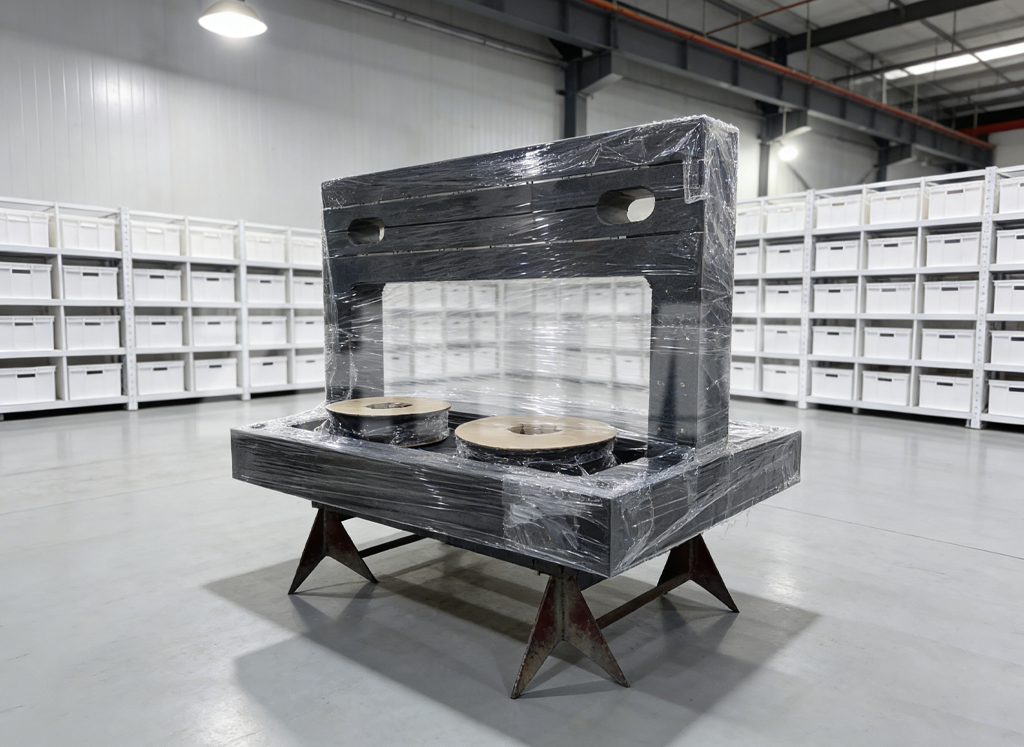
4. Special Impact Load Scenarios: Prioritize Shock Resistance, Buffering and Stress Dispersion
Certain precision processing and sampling testing equipment operates with intermittent start-stop impact, material reciprocating collision and rapid module movement, resulting in fluctuating dynamic load and instantaneous impact force. Ordinary bases are prone to local precision damage and flatness deviation after long-term impact, requiring excellent stress dispersion, anti-impact and shock resistance.
Selection key points: On the basis of high-quality material and reasonable specification selection, optimize structural and environmental adaptation solutions. Homogeneous and compact granite substrates avoid internal defects that cause local weak anti-impact performance. Uniform stress structure and multi-point balanced support disperse instantaneous impact load and prevent concentrated local stress. Processed in a constant-temperature and vibration-isolated workshop, the bases maintain excellent flatness and structural stability to enhance overall shock and impact resistance for special dynamic load scenarios.
III. Supporting Process and Environmental Selection Key Points for Load Adaptation
Accurate load selection must be matched with corresponding processing technology and environmental adaptation to maximize the load-bearing and precision performance of granite bases. ZHHIMG exclusively adopts high-stability black granite instead of inferior marble to ensure consistent physical performance under all load conditions. In terms of processing technology, light-load scenarios focus on ultra-fine grinding and flatness calibration; heavy-load scenarios focus on integral forming, stress relief and rigidity reinforcement; dynamic load scenarios focus on anti-fatigue and anti-vibration optimization.
For environmental adaptation, bases applied in constant-temperature metrology laboratories undergo long-term constant-temperature aging to adapt to subtle temperature changes. The low thermal expansion property of granite effectively avoids deformation deviation caused by temperature and humidity fluctuation in ordinary industrial workshops. All testing data is traceable to national metrology institutions and compliant with global multi-national metrology standards, ensuring precision stability and compliance under diverse load conditions.
IV. Avoiding Common Industrial Selection Misconceptions
Two typical misconceptions prevail in granite base selection. First, over-specification: adopting thick heavy-load bases for light-load scenarios, resulting in unnecessary cost waste. Second, under-specification: applying thin ordinary or spliced bases for heavy-load and dynamic working conditions, causing long-term deformation and precision failure. Some manufacturers shoddily replace high-grade black granite with low-density marble. Although the dimensions appear identical, the load-bearing and anti-deformation performance differ greatly, failing to meet precision load requirements.
ZHHIMG adheres to scenario-based accurate selection. Supported by a 200,000 ㎡ production base, ultra-large precision grinding equipment and 30 years of sophisticated processing experience, the company customizes exclusive base specifications, materials and structures according to actual load weight, load type, operating condition and precision requirements. It avoids both performance waste and insufficient stability, realizing efficient and accurate adaptation for all load scenarios.
Conclusion
The core of precision granite base selection is comprehensive accurate matching of load conditions with materials, specifications, processes and structures, rather than simple superposition of dimension and precision. Static load, dynamic load and impact load scenarios have distinct requirements for base rigidity, deformation resistance, fatigue resistance and flatness. With high-quality raw materials, integral forming capability, mature load adaptation technology and strict quality inspection standards, ZHHIMG has established a full-range selection system covering light-load metrology, medium-load automation, heavy-load large-scale equipment and special impact working conditions. It provides highly adaptable, stable and long-service-life granite load-bearing bases for ultra-precision industries, continuously empowering the high-quality development of the global ultra-precision manufacturing sector.
Post time: Aug-26-2026