
In scenarios such as large‑scale coordinate measuring machines, heavy‑duty inspection tooling, heavy‑load XY motion platforms and large‑size laser processing equipment, granite tables are required to bear long‑term workpiece dead weight, module loads, reciprocating impacts and continuous static compression. Many purchasers simply check the overall dimension and flatness indicators during selection, while ignoring special material and structural requirements for heavy‑duty conditions. After commissioning, problems including local depression of tables, creep deformation under long‑term compression, edge chipping and continuous accuracy decline may occur. For heavy‑duty applications, larger size does not always mean better performance. Comprehensive evaluation covering load magnitude, force mode, support layout and operating temperature is essential. Drawing on abundant project experience of large‑tonnage granite components, ZHHIMG sorts out key selection points for granite tables under heavy‑duty conditions, helping customers avoid selection pitfalls and guarantee long‑term stable operation of benchmarks.
Mineral composition and compactness of raw materials constitute the primary evaluation criterion for heavy‑duty selection. Not all granite grades are qualified for heavy‑duty service. Some stone materials feature loosely‑bonded mineral grains, tiny pores and weak interlayers. Slow micro‑creep will take place under sustained static compression. Even if accuracy passes outgoing inspection, geometric precision will gradually degrade under long‑term loading. Ordinary variegated granite and marble are completely unsuitable for heavy‑duty scenarios. Priority shall be given to high‑density black granite raw materials with compact mineral structure and high compressive strength. Reaching a density of 3100 kg/m³, such material features tightly interlocked mineral grains and outstanding compression resistance. It effectively mitigates creep risks under sustained static loads and transient impact loads. Physical property reports of stone shall be reviewed during selection. Judging material quality merely by appearance and color should be avoided to prevent inferior substitutes falsely marketed as heavy‑duty‑grade granite.
Structural thickness and load distribution directly determine the anti‑bending deformation capacity of tables. Restricted by installation space, many users tend to adopt thin‑walled tables. Under heavy loads, bending deflection easily emerges at span positions and damages the flatness of reference surfaces. Selection shall focus not only on total weight but also distinguish concentrated load from uniformly distributed load. When loads concentrate on small local areas, local pressure rises sharply, placing higher demands on plate thickness and local reinforcement structures. When undertaking heavy‑duty projects, ZHHIMG calculates reasonable plate thickness according to customers’ maximum actual load, support spacing and concentrated‑load zones. Rib‑reinforcement or bottom‑cavity reinforcing structures are adopted when necessary to improve overall bending rigidity. Excessive unsupported spans shall be avoided. Support‑point layout shall match actual stress zones to prevent overloading at single points. Simply increasing length and width without raising thickness still results in compression‑induced deformation.
Support schemes shall be matched with granite tables synchronously, which is frequently overlooked by purchasers. Granite boasts high hardness yet limited shear resistance and local extrusion tolerance. Under heavy‑duty conditions, hard point‑to‑point supports generate excessive pressure at supporting positions and trigger hidden local crushing damage at table bottoms. Damages spread inward and eventually manifest as abnormal working‑surface accuracy. Heavy‑duty tables should avoid sparse hard supports with small contact areas. Contact pressure shall be dispersed by rationally designing contact areas of support pads and selecting proper shock‑absorbing buffer mats. At the project proposal stage, ZHHIMG provides suggestions on support layout, including quantity and position of support points as well as pad materials. The supporting system is treated as an integral part of the whole reference solution so as to prevent hidden damages caused by self‑assembled supports after table procurement.
Suitable grades shall be selected according to actual working conditions, distinguishing static heavy‑duty from dynamic heavy‑duty service. Static heavy‑duty mainly refers to long‑term placement of heavy workpieces, with deformation risks originating from long‑term creep. Dynamic heavy‑duty involves reciprocating module motion and cyclic impacts. Apart from static loads, cyclic vibration shall also be endured, imposing higher requirements on impact resistance and fatigue performance of stone. For dynamic heavy‑duty scenarios, besides material and thickness, overall table rigidity shall be emphasized to avoid resonance triggered by vibration excitation which amplifies measurement errors. Ambient temperature fluctuation cannot be neglected. Coupled temperature cycling and heavy loads will aggravate stress‑induced deformation. For heavy‑duty sites with large temperature swings, granite substrates with low thermal expansion coefficients are preferred to reduce comprehensive deformation caused by combined load and temperature effects.
Machining processes and outgoing verification serve as vital guarantees for performance of heavy‑duty granite tables. Even with qualified material and thickness, insufficient aging of raw blocks and incomplete release of internal residual stress will lead to superposition between residual stress and load stress under long‑term heavy compression and accelerate table deformation and failure. Raw blanks for heavy‑duty tables require sufficient static aging and secondary stress relief after rough machining. Rapid‑production blanks are prohibited. Finishing shall be completed inside stable constant‑temperature‑humidity workshops to reduce additional stress introduced during processing. For finished‑product inspection, beyond conventional flatness and parallelism tests, ZHHIMG conducts simulated load‑bearing verification for heavy‑duty projects. Real‑world customer load conditions are simulated to track accuracy recovery after unloading and screen irreversible deformation risks. All testing instruments are traceable to metrology standards. Drawing on decades‑long experience and global metrology standards, technical teams confirm component qualification for heavy‑duty service before delivery. 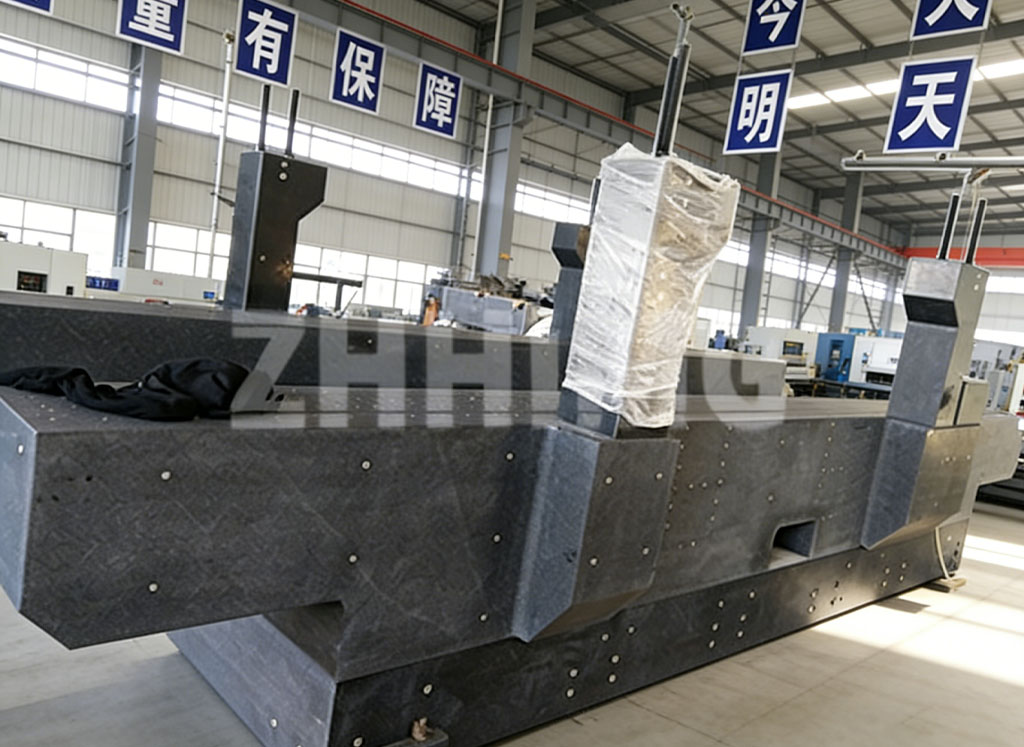
A common customer misconception is over‑reliance on outgoing flatness. Factory‑delivered accuracy only reflects instantaneous inspection status. Heavy‑duty service truly tests accuracy retention under long‑term loads. Through industry‑university‑research cooperation with overseas metrology institutes and universities, ZHHIMG accumulates deformation databases of granite components under various loads and spans. It participates in customer scheme evaluation at early project phases and provides selection suggestions for material grade, plate thickness and support layout. Possessing complete ISO three‑system certifications, CE qualification and more than 20 international patents and trademarks, ZHHIMG abides by its customer commitment: no cheating, no concealment, no misleading. Low‑grade stone will never be recommended for heavy‑duty scenarios for cost‑reduction purposes.
Properly‑selected heavy‑duty granite tables are widely applied in heavy‑duty coordinate measuring machines, large‑scale automatic inspection lines, heavy‑load linear‑motor equipment and large‑size optical inspection platforms. Selecting heavy‑duty granite tables is a systematic work integrating material, structure, support and working‑condition verification, instead of simply purchasing plates according to drawings. Upholding its quality policy “For precision‑oriented business, no pursuit of perfection is excessive”, ZHHIMG assists customers in completing pre‑selection control, avoids later‑stage equipment precision failure caused by improper selection, and delivers reliable granite benchmarks for industrial heavy‑duty precision equipment.
Post time: Sep-07-2026