
Specify the wrong material for a UHV chamber and you won’t find out during design review. You’ll find out weeks later, when a pump-down that should reach 10⁻⁹ Torr stalls somewhere in the 10⁻⁷ range and nobody can figure out why. Outgassing problems are like that — quiet, delayed, and expensive to trace back to a single component buried inside an assembly. Ceramics are usually the right answer for UHV insulators, spacers, and structural parts, but “ceramic” isn’t a single material, and treating it as one is where a lot of selection mistakes start.
Why Ceramics Show Up in UHV Designs at All
Metals bring conductivity where you don’t want it and, in some alloys, trap gas in ways that are hard to bake out completely. Polymers are almost always disqualified outright — most have vapor pressures too high for true UHV service, and they degrade under bakeout temperatures anyway. That leaves technical ceramics as the practical choice for anything needing electrical isolation, thermal stability, or a non-metallic structural element inside the vacuum envelope. Alumina (Al₂O₃) dominates this space for good reason: low porosity, strong dielectric properties, and a long track record in semiconductor and accelerator applications. Machinable ceramics like Macor get specified when a part needs finish-machining after the vacuum system is partially assembled, though usually at some cost to mechanical strength and outgassing performance compared to fired alumina.
Outgassing Is the Real Selection Criterion
Everything else — mechanical strength, thermal expansion, dielectric constant — matters, but outgassing rate is what actually determines whether a ceramic belongs in a UHV chamber. This comes down to porosity and surface finish more than the base material chemistry. A dense, well-sintered alumina part with a properly finished surface will outgas far less than a porous or poorly fired piece of the same nominal material. This is where machining quality stops being a cosmetic concern and becomes a functional one: micro-porosity introduced during grinding, or residual machining fluid trapped in surface texture, becomes a long-term gas source that bakeout alone doesn’t always fully resolve. We’ve seen customers chase a vacuum problem for weeks before tracing it back to a supplier’s finishing process rather than the material itself.
Thermal Considerations During Bakeout
UHV systems get baked out at 150–450°C depending on the application, and any ceramic component in the assembly needs to survive repeated thermal cycling without microcracking. This is where coefficient of thermal expansion (CTE) matching against adjacent metal parts becomes important — a ceramic-to-metal joint with mismatched CTE is a common failure point, showing up as vacuum leaks at braze joints after a few bake cycles rather than on first use. Selecting a ceramic isn’t just about the part in isolation; it has to be evaluated against what it’s mounted to or sealed against.
Mechanical and Dimensional Requirements
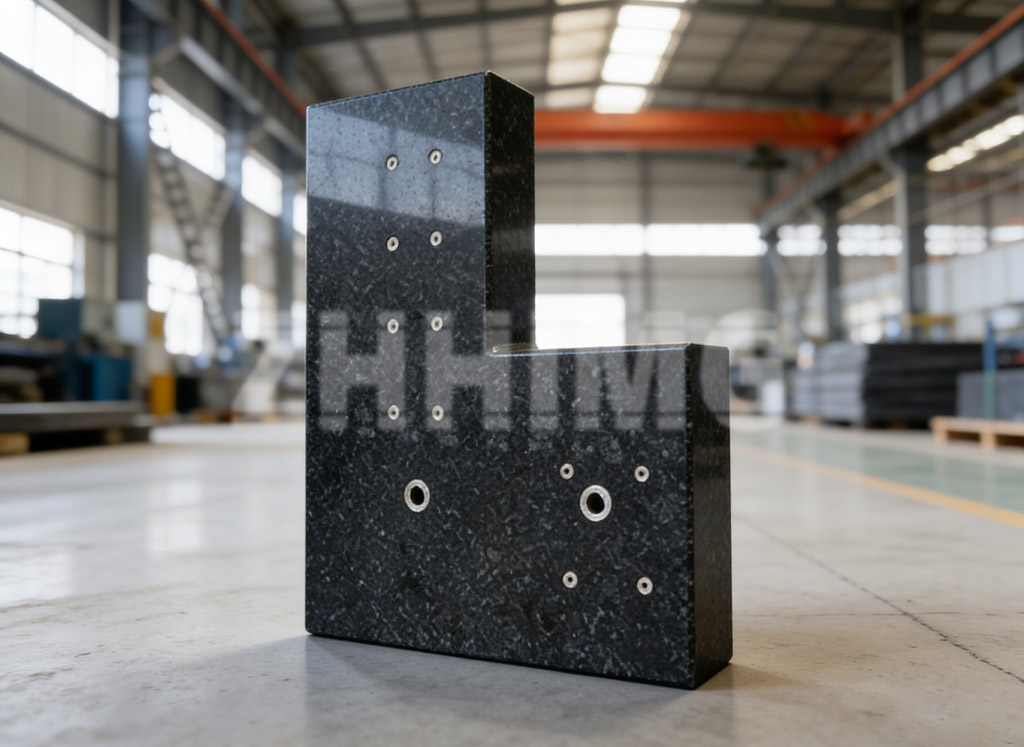
Precision ceramic components for UHV work often carry tight dimensional tolerances alongside the vacuum requirement, particularly for insulating standoffs, feedthroughs, and structural spacers in semiconductor and metrology equipment. This combination — vacuum-grade material plus micron-level dimensional accuracy — narrows the supplier field considerably, since not every ceramics shop that handles industrial-grade parts also runs precision grinding and measurement capable of holding those tolerances. In our own ceramic component work, parts destined for vacuum-adjacent or cleanroom equipment go through the same measurement chain we use for granite reference tooling — calibrated gauges traceable to national metrology institutes — because a vacuum-rated part that’s out of dimensional spec is just as unusable as one with the wrong porosity.
Questions Worth Asking a Supplier
Before ordering, it’s worth confirming a few specifics rather than trusting a datasheet alone: what firing process and density was achieved, whether outgassing testing has actually been performed or just assumed from material class, and how the final surface is finished. A supplier who can answer these without hesitation has likely shipped into vacuum applications before; one who can’t is probably supplying general industrial ceramics and hoping the classification is close enough.
A Reasonable Approach to Selection
There’s no universal “best” ceramic for UHV — the right choice depends on whether the part needs machinability after firing, how it interfaces thermally and mechanically with surrounding components, and how aggressive the bakeout cycle will be. What matters most is treating outgassing and finishing quality as design requirements, not assumptions baked into the material name. A well-specified alumina part from a shop that understands vacuum finishing will consistently outperform a “vacuum-grade” label attached to a part that was never actually tested for it.
Post time: Aug-07-2026