
Semiconductor photolithography represents one of the most demanding manufacturing processes on earth. As node sizes shrink toward the sub-nanometer scale, the structural foundation supporting the optical and motion systems dictates the ultimate yield. Ultra-precision granite has emerged as the baseline material for these critical structures, replacing traditional metallic frames due to its unique physical properties.
Thermal stability is the primary driver in this material transition. Photolithography tools operate in environments where temperature fluctuations are measured in millidegrees. Metallic structures expand and contract with thermal shifts, introducing geometric distortions that directly translate to overlay errors on the wafer. High-density black granite possesses a coefficient of thermal expansion significantly lower than steel or cast iron. This thermal inertia allows the machine base to maintain geometric integrity even when ambient conditions fluctuate slightly. In practical terms, this reduces the frequency of thermal recalibration cycles, directly improving equipment uptime and throughput.
Vibration damping is equally critical. Lithography systems utilize air bearings and linear motors that generate micro-vibrations during high-speed scanning. These vibrations must be dissipated before they reach the reticle or wafer stage. Granite’s crystalline structure provides inherent damping characteristics that metals lack. Rather than transmitting vibrational energy, the material absorbs and dissipates it. This isolation is essential for maintaining focus and alignment during the exposure step. Machine designers increasingly specify custom granite bases with integrated air bearing surfaces to leverage this property, creating a unified structural system rather than assembling discrete components.
Flatness and geometric stability define the reference plane for all precision motion. Modern lithography equipment requires base flatness in the nanometer range over multi-meter spans. Achieving this requires both superior raw material and advanced finishing processes. High-density granite, typically exceeding 3100 kg/m³, offers the compressive strength and wear resistance necessary to maintain this geometry over decades of operation. The material’s natural aging process eliminates internal stresses that could cause long-term drift.
Manufacturing these components demands rigorous environmental control. Precision grinding and lapping must occur in temperature-stabilized environments to prevent thermal distortion during fabrication. Facilities equipped with massive concrete foundations and isolation trenches ensure that external vibrations do not compromise the finishing process. Measurement verification requires traceable metrology equipment capable of nanometer-level resolution. Laser interferometers and electronic level systems provide the data necessary to certify flatness specifications.
Long-term dimensional stability distinguishes ultra-precision granite from alternative materials. Metals may require periodic resurfacing or anti-corrosion treatments. Granite maintains its performance with minimal intervention. This stability reduces lifecycle costs and ensures that measurement traceability remains intact throughout the equipment’s operational life. For semiconductor fabs where downtime costs thousands of dollars per minute, this reliability is non-negotiable.
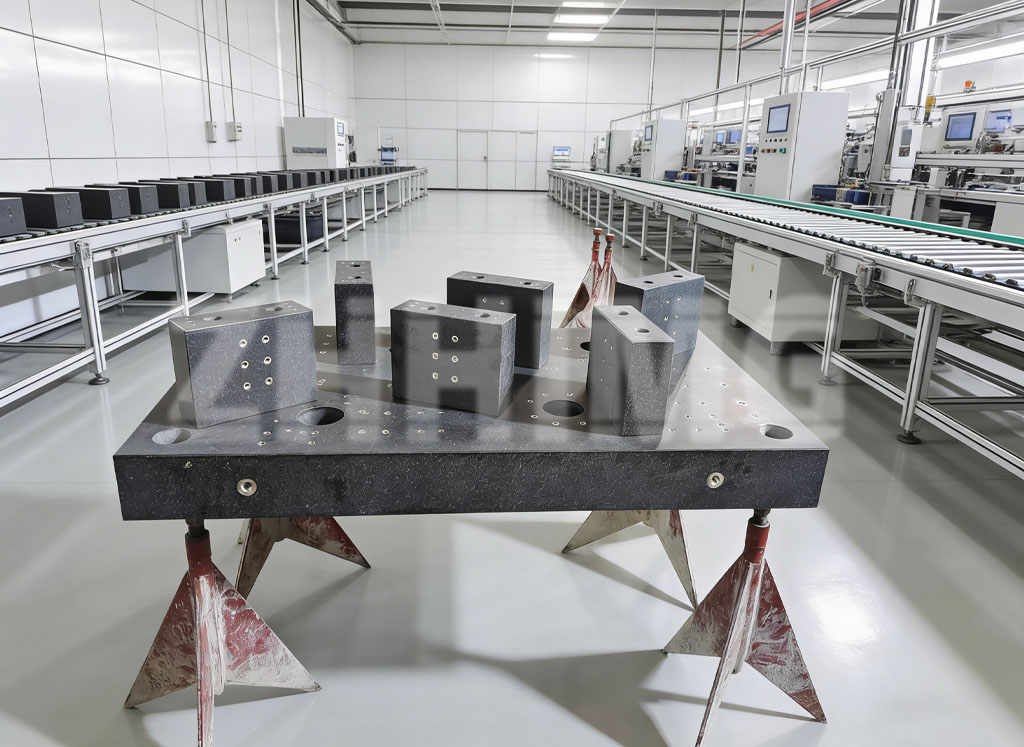
Custom engineering integration represents the next evolution in granite component design. Rather than serving as passive platforms, modern granite bases incorporate threaded inserts, mounting interfaces, and cable channels machined directly into the structure. This integration eliminates assembly errors associated with multi-material joints. Finite element analysis guides material thickness and reinforcement design to optimize rigidity while minimizing weight. Early collaboration between equipment manufacturers and granite specialists ensures that structural geometry aligns with system requirements.
The shift toward ultra-precision granite reflects broader industry trends. As photolithography pushes toward higher numerical apertures and smaller feature sizes, the tolerance for structural compromise disappears. Material selection is no longer a secondary consideration but a primary design parameter. Equipment manufacturers who recognize this reality gain measurable advantages in yield and reliability.
For engineering purchasers and quality managers evaluating structural components, the focus should extend beyond initial specifications. Material density, manufacturing environment, measurement traceability, and long-term stability data all contribute to real-world performance. Suppliers with documented expertise in semiconductor applications provide more than components—they offer validated solutions backed by metrological evidence.
The semiconductor industry continues to redefine the boundaries of precision. Ultra-precision granite components will remain foundational to this progress, providing the stability and accuracy that next-generation photolithography demands. The material’s unique combination of thermal, vibrational, and geometric properties makes it indispensable for applications where nanometer-level accuracy is the baseline expectation.
Post time: Aug-12-2026