
Many people mistakenly believe that the wear resistance of granite machine bases merely stems from high material hardness, and that hard stone alone guarantees reliable performance. Under real‑world operating conditions, abnormal wear on reference surfaces is rarely caused purely by frictional consumption. It is also triggered by multiple factors including surface grain spalling, abrasive wear from dirt trapped in surface micropores, loose surface grains induced by internal micro‑stress, and localized stress concentration caused by manufacturing defects. For granite machine bases to retain sound reference‑surface conditions after years of high‑frequency motion, dust exposure and load variations, joint efforts are required: raw‑material screening, internal crystal‑stability control, multi‑stage ultra‑precision grinding, surface micro‑treatment and pre‑delivery inspection, rather than relying solely on natural material properties.
Raw‑blank screening acts as the first line of defense against premature wear. Ordinary stone features uneven grain size, micro‑cracks and loosely bonded mineral particles. Even with satisfactory Mohs hardness values, surface crystals tend to peel off under repeated friction and particle compression, forming pitting pits and triggering a vicious cycle of abrasive wear. Premium wear‑resistant granite blanks feature densely interwoven fine mineral grains with tight inter‑mineral bonding, reaching a density of 3100 kg/m³, with barely any loose pores or hidden internal cracks. ZHHIMG conducts non‑destructive flaw detection on raw blanks and rejects workpieces with interlayers and inter‑crystal cracks, fundamentally avoiding loose and spalling surface grains under friction. If loosely‑textured marble is misused, even sophisticated grinding processes cannot compensate for inherently weak crystal bonding, and surface grain loss and rapid reference‑surface damage will occur after a period of operation.
Multi‑stage aging processes indirectly protect surfaces and reduce secondary wear induced by stress. Many manufacturers regard aging only as a solution to overall deformation, ignoring its contribution to wear service life. After sawing, grooving and drilling, machining forces leave residual stress along surface crystal boundaries. Without sufficient stress relief via aging, internal stress within components remains unbalanced, putting surface crystals of reference planes under tensile stress. When guide rails and sliding tables reciprocate across surfaces, frictional loads superimpose on residual internal stress, making surface grains more prone to loosening and spalling and accelerating localized wear. After static holding post‑rough‑machining and multi‑stage temperature‑cycling aging, stress at crystal interfaces re‑balances, surface mineral particles remain firmly bonded, grain spalling under external frictional loads is largely avoided, risks of abrasive wear drop sharply, and intrinsic surface wear‑resistance can be fully realized.
Gradient ultra‑precision grinding executed in constant‑temperature workshops optimizes surface micro‑topography and lowers frictional loss. Wear resistance does not equate to rough surfaces. Protruding grains on coarse surfaces become stress‑concentration points during friction; raised particles are prone to shear spalling and turn into hard abrasives that repeatedly scratch reference surfaces. Inside constant‑temperature anti‑vibration workshops, ZHHIMG adopts gradient grinding workflows, gradually transitioning from rough grinding to ultra‑precision manual fine lapping. All micro‑protrusions are removed to obtain continuous, complete reference surfaces with low roughness. Smooth and uniform micro‑surfaces deliver more consistent contact for motion pairs, avoiding overload from localized point‑contact and generating mild friction instead. The probability of grain shear spalling is reduced. Meanwhile, temperature fluctuations during grinding that cause surface micro‑cracks are avoided, preventing micro‑defects from becoming starting points for later‑stage wear.
Micropore control blocks conditions that give rise to abrasive wear. Granite naturally contains tiny micropores. If open, workshop dust and metal chips embed inside cavities. During equipment operation, hard particles trapped in micropores act like grinding grit, continuously scraping guide rails and granite reference surfaces and aggravating wear on both sides. This represents a major hidden cause of wear for many granite machine bases. Fine grinding combined with vacuum sealing treatment closes open surface micropores and reduces space for particle embedding. Dust only accumulates on the exterior and can be easily blown or wiped away. Impurities are prevented from burying deep inside stone and causing persistent abrasive damage, breaking the abrasive‑wear cycle and extending service life of reference surfaces. 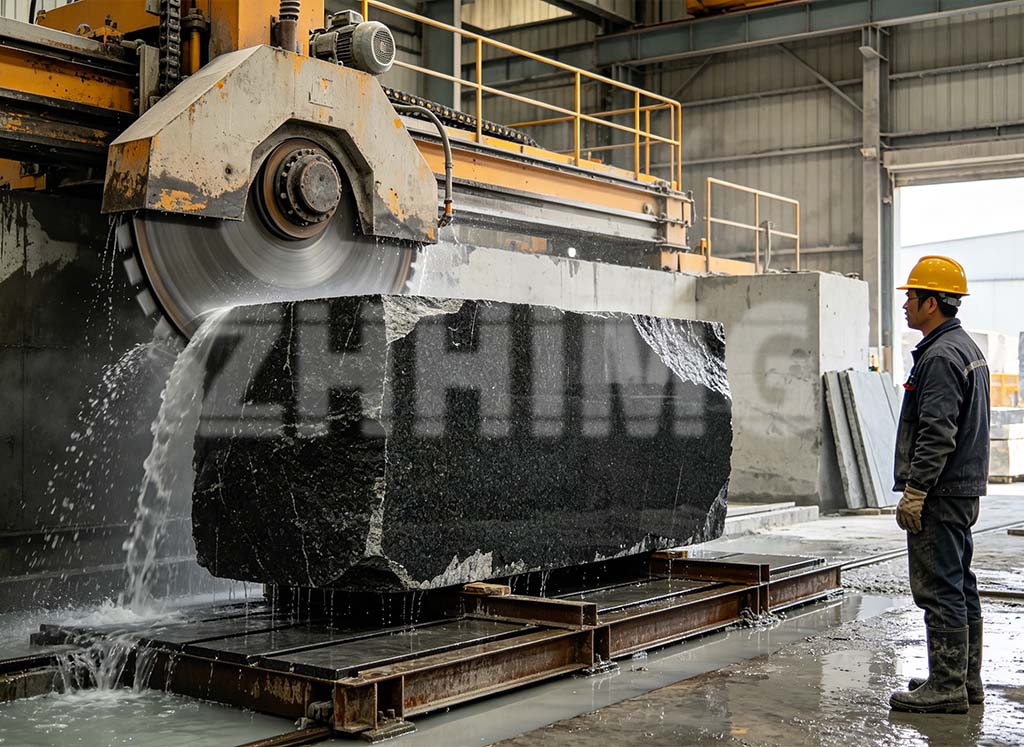
Comprehensive pre‑delivery inspections intercept wear‑related risks at the factory stage. Beyond conventional dimensional tests for flatness and perpendicularity, surface micro‑conditions and grain‑bonding status are verified to spot barely‑visible micro‑chipping and inter‑crystal damage. Blanks with potential loose‑surface‑grain risks are eliminated before delivery. Even with qualified raw‑materials and processes, violent impacts, persistent hard‑particle contamination on reference surfaces and offset overload on‑site will still lead to artificial surface damage. Long‑term wear‑resistance of granite machine bases results from both manufacturing quality and proper field application.
Through rigorous raw‑material selection, multi‑stage stress relief, constant‑temperature gradient grinding, micropore‑sealing treatment and full sets of traceable metrological verification, ZHHIMG converts granite’s inherent high hardness into practical long‑term wear‑resistant performance for real‑world conditions. Machine bases adapt to high‑frequency reciprocating operation of linear‑motor platforms, on‑line inspection equipment and precision metrology machinery and preserve geometric conditions of reference surfaces over extended periods.
Post time: Sep-08-2026