
In the field of ultra‑precision equipment, dimensional stability directly determines whether equipment can sustain its designed accuracy over long‑term operation. Many precision devices pass initial inspection specifications, yet suffer reference offset and deteriorated repeatability after being put into production. Most of these problems stem from hidden dimensional changes of the base. Compared with conventional base materials such as cast iron and welded steel parts, granite equipment bases stand out in dimensional stability thanks to unique material properties and full‑set process control. Drawing on abundant project experience, ZHHIMG analyzes the specific manifestations of dimensional stability for granite bases from the perspectives of intrinsic material characteristics, stress evolution, environmental adaptability, working‑condition resistance and long‑term service performance.
First comes the inherent stability derived from material properties. High‑grade black granite is igneous rock naturally crystallized and solidified over geological ages, with tightly interwoven mineral crystals and densely, evenly distributed crystal grains. It barely generates time‑dependent creep commonly seen in metallic materials. Under regular workshop loading conditions, the material itself will not produce slow plastic deformation over time. By contrast, even after annealing treatment, some cast metal components may release internal stress gradually over long‑term placement and trigger slight warping deformation of the base. Premium granite fundamentally avoids such time‑dependent deformation risks, laying the foundation for dimensional stability.
Second is static dimensional stability achieved by processing stress relief. Residual local stress will be generated inside stone during blank quarrying, sawing and grinding. Without sufficient stress release, finished bases will release stress slowly in service, resulting in distorted flat surfaces and offset hole positions. Mature manufacturing processes implement multiple aging cycles including blank static placement and semi‑finished product shelving at different processing stages, so as to gradually release processing stress induced by cutting and grinding before subsequent fine machining. After multi‑round aging treatment, the geometric shape of granite bases becomes stabilized. There will be no phenomenon that products pass factory acceptance but suffer gradual accuracy decline months after commissioning, ensuring static geometric dimensions remain in original status for a long time.
Third is deformation resistance under alternating temperature conditions. Workshops can hardly maintain ideal constant temperature all the time. Equipment self‑heating, seasonal changes and air‑conditioning fluctuations will lead to temperature variations. The dimensional stability of granite bases is reflected in minor overall deformation and uniform deformation response when exposed to temperature gradients and temperature swings. It will not produce obvious warping caused by partial heating, nor repeated expansion and contraction of reference surfaces due to day‑night temperature differences. For non‑stop semiconductor production lines and laser inspection equipment, such temperature adaptability reduces reference drift induced by temperature changes and lowers the frequency of repeated equipment calibration. It should be noted that this performance heavily relies on stone grade. Inferior stone or marble features high thermal expansion coefficient and generates considerable deformation under slight temperature variation, failing to meet requirements of precision equipment.
Fourth is deformation‑resistant performance under loaded conditions. Static and dynamic loads are continuously exerted on the base by equipment modules, moving parts and tooling workpieces. The dimensional stability of granite bases manifests in low rebound deformation under continuous dead weight and assembly loads. It can rapidly restore original geometric form after load removal and hardly produce permanent deformation. In heavy‑duty scenarios such as large‑span gantry structures and heavy‑duty CMM units, persistent sinking or bending will not occur between supporting points of the base, so relative positions of guide‑rail mounting references and measurement references stay unchanged for long periods. This is particularly critical for large‑size bases, since large‑span components are prone to bending deformation under loads. Benefiting from high modulus, granite restricts load‑induced deformation to an extremely low level. 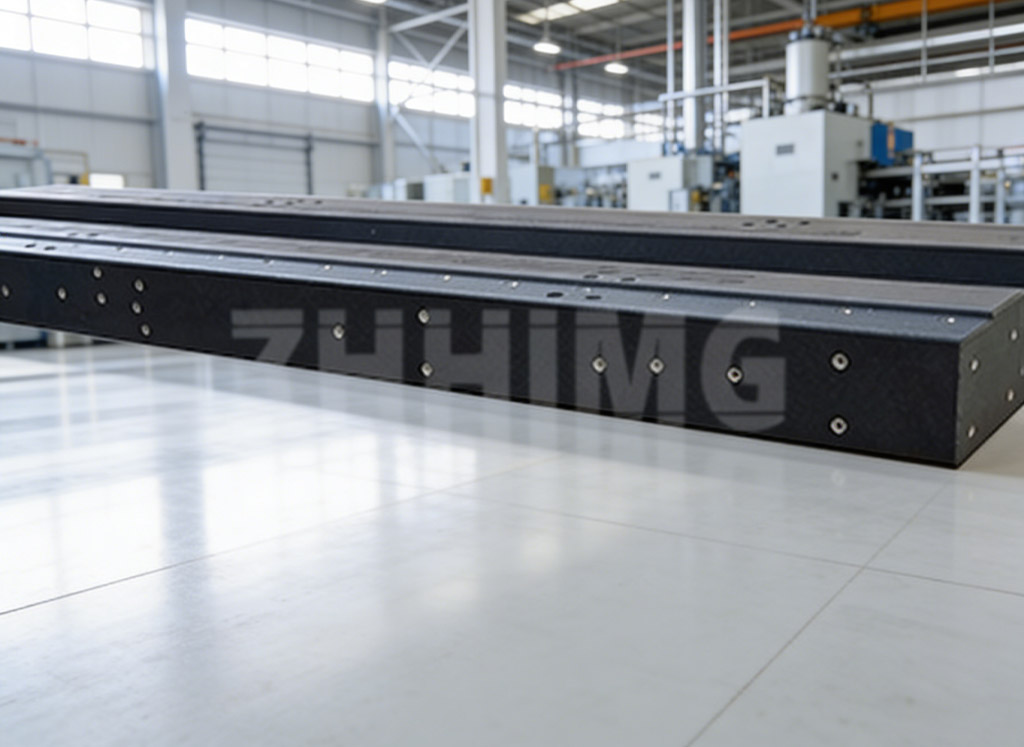
Fifth is long‑term dimension retention capacity against environmental erosion. Industrial sites are inevitably exposed to moisture, cutting fluid and slight oil contamination. Metallic bases tend to rust, and expanded rust layers will alter surface geometry. Granite avoids rusting, coating peeling and oxidation expansion. Its working surface will not undergo volume change caused by chemical erosion. Provided violent impact is avoided, the geometric form of reference surfaces can be well preserved for years, and slow dimensional variation triggered by surface corrosion will not occur, mitigating accuracy degradation caused by environmental corrosion.
Nevertheless, excellent stability of granite bases cannot be simply guaranteed by raw stone itself. High‑quality raw‑material screening, multi‑stage stress‑relief processes, qualified processing environment and post‑processing metrology verification are all indispensable. If blanks with cracks or mineral segregation are adopted, or fine machining is conducted without aging procedures, even granite will suffer dimensional drift. Some low‑cost products on the market cut corners by skipping aging processes. They perform well in short‑term tests yet lose stability rapidly once in service.
ZHHIMG strictly screens for blank defects in production, implements staged stress‑relief treatment, conducts fine machining under controlled environments, and verifies all geometric indicators of finished products via comprehensive metrology tools. It converts the intrinsic stability of granite into practical product performance. For metrology laboratories, semiconductor, new‑energy, optical inspection and other scenarios with strict requirements for long‑term consistency, stable granite bases serve as vital guarantees for equipment to deliver reliable data continuously.
Post time: Aug-14-2026