
1. Damages to Precision Induced by Non‑standard Handling
Granite tables belong to heavy‑load precision components. Lifting, relocation, loading and unloading represent the highest‑risk procedures. Common on‑site malpractices including binding directly on precision reference surfaces, single‑point lifting, direct contact between steel wire ropes and ground surfaces, dragging with tilt angles, and hoisting with sharp swings bring multiple hidden risks to precision.
First, direct compression from steel wire ropes on precision ground surfaces creates indentations, edge chipping and local pits, directly damaging reference flatness and deteriorating flatness indicators. Second, single‑point lifting and improperly designed lifting points generate bending moments from self‑weight and irreversible micro‑deformation after unloading due to internal bending stress within stone material. Third, collisions and impacts during handling not only cause direct physical damage but also disturb residual internal stress of granite, resulting in torsional deformation after stress release over time.
ZHHIMG implements mature internal handling specifications for large‑size granite beds and platforms. Silent overhead cranes are deployed in workshops. For extra‑long components up to 20 meters and single‑unit weight of 100 tons, lifting‑point distribution is strictly calculated. Cushion pads isolate lifting tools from precision reference surfaces to avoid direct contact between steel wire ropes and working surfaces. Custom wooden frames and buffer corner protectors are applied for large‑size products; dragging and rolling are strictly prohibited. All operators receive professional training covering metrological standards worldwide including DIN, ASME and GB, complying with requirements for precision stone handling. Initial precision damage from handling is avoided before delivery. Even with adequate factory‑side protection, ZHHIMG provides complete handling instruction manuals for overseas customers to specify hoisting prohibitions on‑site.
2. Precision Degradation Triggered by Improper Storage
After receiving granite tables, many enterprises place them randomly on the ground, lean them vertically against walls, apply insufficient support points, lay products directly on rough ordinary floors, or store parts in areas with sharp temperature‑humidity swings and ground vibration or settlement. Such practices lead to continuous precision degradation over time.
- Unreasonable support points: For long granite tables, insufficient support points or inconsistent support heights trigger creep bending under self‑weight. Granite does not feature infinite rigidity. Long‑term uneven loading generates permanent bending deformation, exceeding flatness and straightness tolerances and incurring extremely high re‑grinding repair costs.
- Unqualified storage floors: Placement on settling or vibration‑prone ordinary floors transfers subtle ground settlement to stone bodies. Large diurnal temperature variation and humidity fluctuation in ordinary workshops cause moisture absorption and expansion through stone micropores and trigger precision drift. That explains why ZHHIMG constructs its constant‑temperature & constant‑humidity workshop with over 1000 mm ultra‑hard concrete floors together with 2000 mm deep anti‑vibration trenches to isolate vibration and ground deformation and secure stable precision during processing and inspection storage.
- Vertical leaning storage: To save space, many workshops store granite platforms vertically leaning against walls. Full self‑weight concentrates on unilateral edges and easily induces torsional deformation. Vertical storage is strictly forbidden for large‑size platforms.
- Stacked storage: Direct stacking of multiple granite tables imposes heavy compression on lower‑layer products, crushing reference surfaces and superimposing stress‑induced deformation.
Qualified storage requires horizontal placement of granite tables with evenly distributed multi‑point elastic buffer support pads. Storage zones shall avoid direct sunlight, air vents, oil stains and moisture, and stay away from vibration sources such as stamping equipment. ZHHIMG operates a dedicated 20 000 m² stone stockyard. Finished‑product areas follow strict horizontal‑placement and multi‑point‑support rules. Semi‑finished and finished goods are stored separately to release stone stress and prevent precision loss during storage. 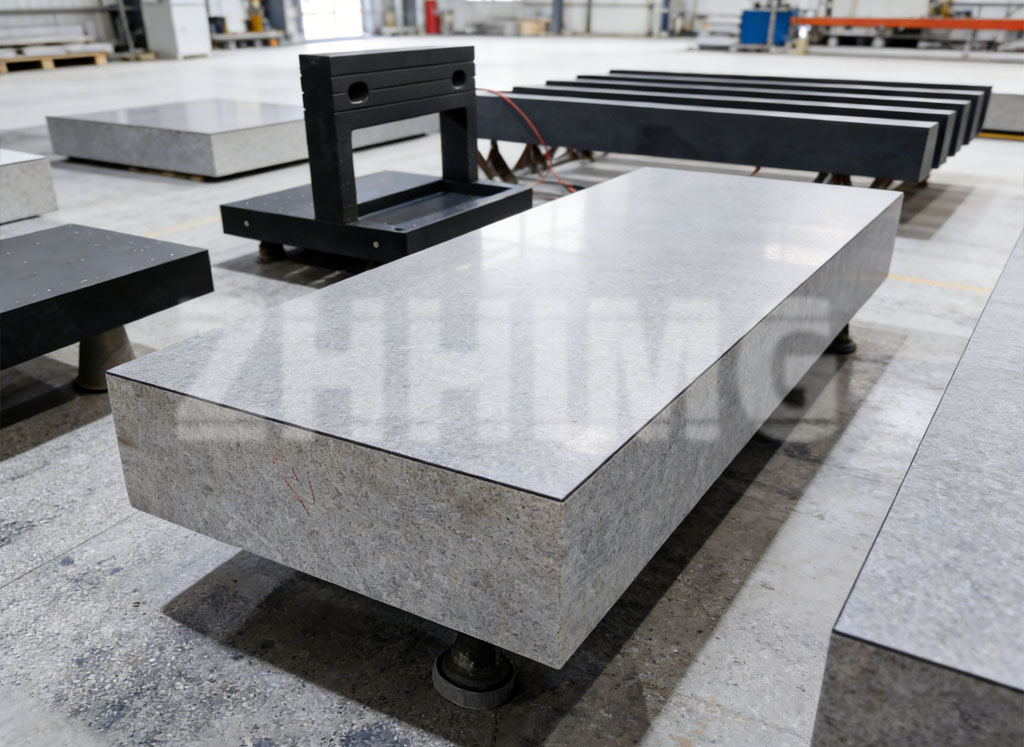
3. Latency of Handling‑storage Damage: Precision Drift Undetectable by Naked Eyes
Visible cracks from collisions can be spotted easily, yet stress‑induced precision degradation displays latency. Products may pass inspection right after handling and storage. Deformation gradually emerges weeks or months later as internal stress releases. This accounts for customer feedback that products pass acceptance upon arrival yet lose precision after a period of service. Such issues may stem from latent damage introduced by handling and storage instead of manufacturing defects.
Therefore, only visual inspection upon receipt is insufficient for granite tables. ZHHIMG recommends customers re‑verify flatness and straightness with measuring tools such as Mahr dial gauges, WYLER electronic levels and laser interferometers. All ZHHIMG deliveries come with traceable calibration certificates issued by municipal and provincial metrology institutes. Customers can compare re‑measured data against factory reports to identify precision changes induced by handling and storage in a timely manner.
4. Full‑chain Control by ZHHIMG to Mitigate Precision Risks from Handling & Storage
Running two large‑scale factories covering 200 000 m² with capability for single‑unit components up to 20 meters long and 100 tons, ZHHIMG designs dedicated hoisting structures at the product development phase for large‑size items to prevent arbitrary on‑site lifting points. Custom shockproof and moisture‑proof packaging is applied for shipment, together with complete technical documents covering handling, storage and installation. Our staff receive annual training on global metrological standards including DIN876, ASME, JIS and GB. Polishing technicians with over 30 years of experience participate in evaluation of large‑component handling schemes, extending ultra‑precision concepts beyond grinding to logistics and delivery.
ZHHIMG granite platforms, granite bases and air‑bearing bases are widely adopted in semiconductors, PCB drilling machines, CMMs, femtosecond laser equipment, perovskite coaters and lithium‑battery inspection devices. Our partners include Fortune 500 enterprises such as GE, Samsung, Bosch and SCHUNK, as well as the National University of Singapore, Stockholm University and multiple national metrology institutes worldwide. Beyond guaranteeing grinding precision, we attach great importance to the full logistics chain of handling and warehousing to help customers retain finished‑product precision.
Industry Conclusion
The final precision of granite tables depends not merely on material and grinding processes. Handling and storage constitute two indispensable links for preserving finished‑product precision. Nano‑level precision achieved in processing can suffer irreversible degradation due to one improper hoisting operation or long‑term unreasonable storage, raising customers’ maintenance and rework costs.
Going forward, ZHHIMG adheres to the quality policy “The precision business can’t be too demanding”, together with core values of Openness, Innovation, Integrity, Unity. We honor our customer commitment: No cheating, No concealment, No misleading. We keep supplying high‑quality ultra‑precision components including precision granite, precision ceramics, mineral castings, UHPC and carbon‑fiber beams. Meanwhile, we deliver complete technical guidelines for handling, storage and installation to global customers and facilitate high‑quality development of the worldwide ultra‑precision industry.
Post time: Aug-06-2026