
In high-power laser optics, semiconductor photolithography, and advanced optical metrology, precision glass remains a fundamental material. Modern photonics applications demand physical substrates that go beyond standard transparency. They require sub-nanometer surface roughness, near-zero thermal expansion, and mechanical stability across extreme spectral ranges.
As optical systems shift toward shorter wavelengths and higher energy densities, the engineering criteria for optical glass substrates have tightened significantly. Understanding optical glass performance requires evaluating chemical formulations, surface finishing techniques, and structural integration inside high-precision platforms.
Material Formulations Shaping Modern Optical Components
Selecting the right glass substrate involves balancing refractive index, optical transmission, coefficient of thermal expansion (CTE), and mechanical hardness. Different photonics applications demand specific physical trade-offs.
-
Synthetic Fused Silica: Offering exceptional deep ultraviolet (DUV) and near-infrared (NIR) transmission, fused silica features a low CTE (around 0.5 x 10^-6 / K) and high resistance to laser-induced damage. It serves as the material of choice for high-power laser windows, beam splitters, and precision optical scales.
-
Zero-Expansion Glass-Ceramics: In optical metrology and astronomy, temperature variations can introduce destructive wave-front errors. Glass-ceramics engineered with near-zero CTE (0 ± 0.02 x 10^-6 / K) eliminate thermal distortion under variable lab or outdoor operating conditions.
-
Optical Crown and Flint Glasses: Borosilicate crown glass (such as N-BK7) remains the workhorse for visible spectrum optics, offering high homogeneity, low bubble inclusion rates, and cost-effective processing for general-purpose lenses and reference prisms.
Manufacturing Advances: Sub-Nanometer Polishing and Surface Quality
A glass substrate’s functional limits are defined by its surface finishing. Even tiny subsurface micro-cracks or nanometer-scale surface roughness can scatter light, cause beam distortion, or lower laser damage thresholds (LIDT).
[ Precision CNC Shaping / Grinding ]
                 │
                 ▼
[ Magnetorheological Finishing (MRF) / Chemical Mechanical Polishing ]
                 │
                 ▼
[ Sub-Nanometer Surface Roughness Inspection (Interferometry) ]
                 │
                 ▼
[ Controlled Cleanroom Assembly & Thin-Film Coating ]
Recent fabrication advances center on controlling three critical surface metrics:
1. Surface Flatness (Wavefront Errors)
Ultra-precision optical flats require surface flatness down to λ/20 or better (where λ = 632.8 nm). Achieving this level of flatness relies on advanced Magnetorheological Finishing (MRF) and ion beam milling, which selectively remove material at the nanometer scale.
2. Surface Roughness (Angstrom-Level Polish)
Extreme ultraviolet (EUV) and high-power laser optics demand surface roughness values below 2 to 5 Angstroms (0.2 to 0.5 nm) RMS. Chemical Mechanical Polishing (CMP) protocols remove subsurface damage left by mechanical grinding steps.
3. Scratch-Dig Specifications
Laser optics require strict scratch-dig standards, such as 10-5 or 20-10 according to MIL-PRF-13830B or ISO 10110 standards, preventing localized absorption points that trigger thermal destruction under intense illumination.
Material Property Comparison for Precision Substrates
| Material Type | Transmission Range (nm) | Coefficient of Thermal Expansion (x 10^-6 / K) | Density (g/cm3) | Primary Optics & Photonics Use |
| Synthetic Fused Silica | 185 – 2,100 | ~ 0.5 | ~ 2.20 | Laser windows, EUV optics, precision scales |
| Zero-Expansion Glass-Ceramic | 400 – 2,500 | ~ 0.00 ± 0.02 | ~ 2.53 | CMM reference mirrors, telescope substrates |
| N-BK7 Borosilicate | 350 – 2,000 | ~ 7.1 | ~ 2.51 | Visible light lenses, prisms, optical flats |
| Sapphire (Single Crystal) | 150 – 5,500 | ~ 5.3 (parallel to c-axis) | ~ 3.98 | Extreme environment windows, pressure ports |
Integrating Precision Glass into Metrology and Machinery Frames
Precision glass components rarely operate in isolation. They must integrate seamlessly with machine structural foundations, including air bearing stages, positioning tables, and linear encoders.
Key integration challenges involve managing thermal expansion mismatches between glass elements and their supporting metal or mineral structures. Using elastic mounting designs or matching glass substrates with low-expansion structural materials prevents mechanical stresses from warping optical reference planes.
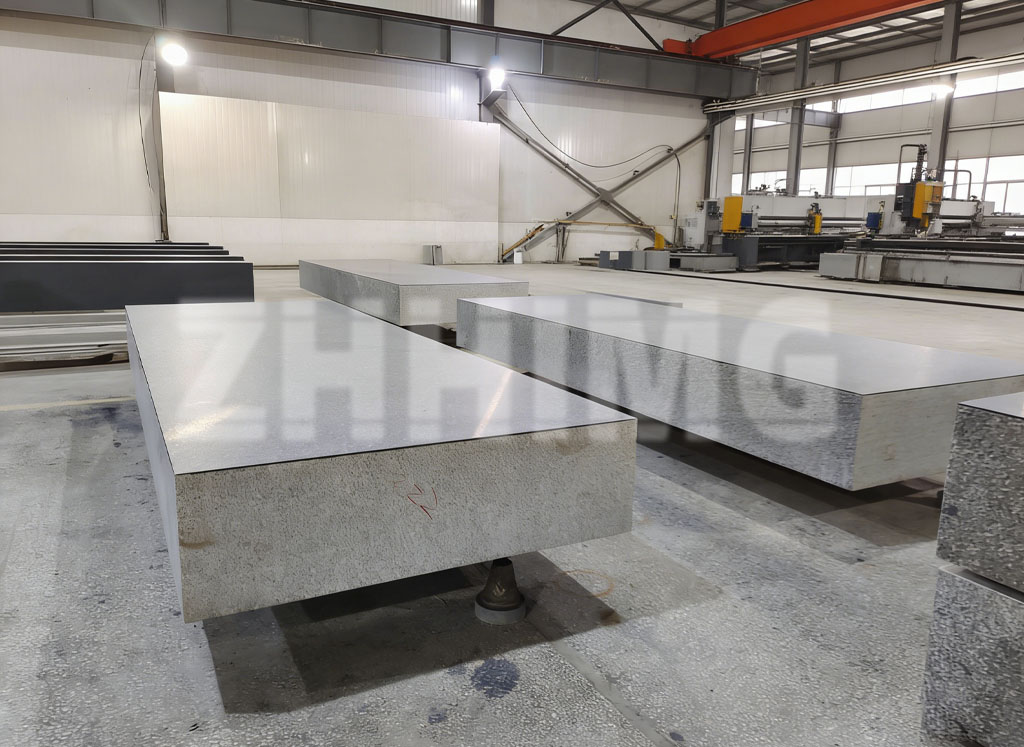
At ZHONGHUI Group (ZHHIMG®), our multi-material precision engineering covers natural granite components, advanced ceramics, and precision glass manufacturing. By leveraging strict environmental controls—such as 10,000 ㎡ temperature and humidity-stabilized production areas with isolated anti-vibration foundations—we produce ultra-flat glass structures and reference substrates built to withstand the rigorous demands of global photonics, semiconductor inspection, and metrology applications.
Post time: Aug-24-2026