
A micron is nothing you can see or feel. It’s also exactly the size of the error a truck idling outside a building, or a forklift crossing a concrete floor thirty meters away, can put into a flatness reading. Most shops never notice this, because most shops aren’t measuring anything close to that fine. Ours is, most days, and that’s the reason the floor under our constant-temperature room isn’t ordinary factory concrete.
The room the trench protects
The constant-temperature, constant-humidity workshop covers 10,000 m². The floor is poured in high-strength concrete not less than 1000 mm thick — considerably more mass than a standard industrial slab, which is closer to 150–300 mm on typical factory floors. That extra thickness does two things: it raises the floor’s own resonant frequency well above the frequencies that typically travel through soil and structure from nearby equipment, and it simply has more mass to absorb energy before it can transmit as measurable motion.
Around the perimeter of the room runs an anti-vibration trench, 500 mm wide and 2000 mm deep, physically separating this floor slab from the surrounding building structure and the ground outside it. The trench is an air gap, not a filled expansion joint — vibration traveling through soil or through an adjoining floor slab has to cross that gap, and an air gap doesn’t transmit vibration the way solid material does. This is the same basic principle used to isolate seismographs and interferometer labs: decouple the mass you care about from everything around it, rather than trying to damp the vibration after it arrives.
What’s actually trying to get in
None of this is theoretical. Here’s what a 10,000 m² precision floor is contending with, on an ordinary working day:
Forklifts and material handling. Moving a granite blank or a finished component means driving heavy equipment across a factory floor. Every wheel crossing a floor joint or an uneven section sends a shock into the slab. On an undivided floor, that shock propagates outward and can register on a sensitive level or interferometer meters away — enough to show up as noise in a reading, or in bad cases, enough to make repeat measurements disagree with each other for no apparent reason.
Overhead cranes. Moving a multi-ton granite block requires an overhead crane, and cranes are not naturally quiet — motor start/stop, especially under load, transmits vibration through the crane rail into the building structure. This is why the cranes inside our constant-temperature room are silent-type: quieter drive systems and smoother start/stop behavior specifically so that moving one piece of work through the room doesn’t disturb a measurement being taken on another piece of work in the same room.
Nearby machining. Grinding and other machining processes generate their own vibration at the machine itself, and that vibration can travel through a shared floor into an area where flatness or straightness is being measured. Separating the measurement room’s floor from the production floor’s foundation matters as much as separating it from the outside world.
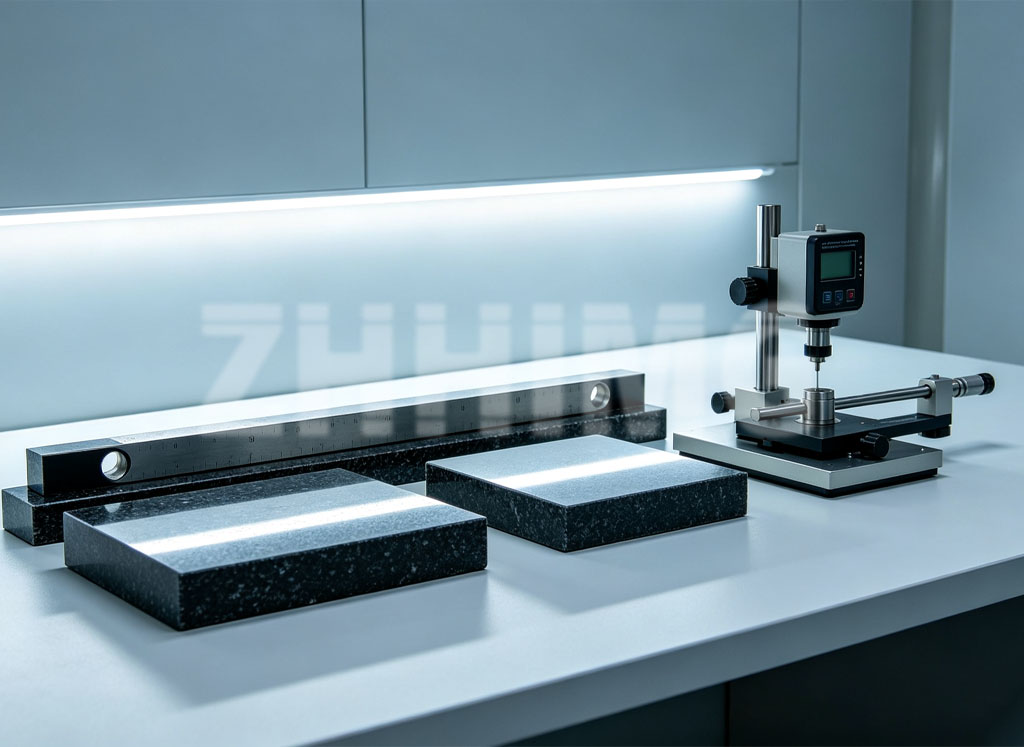
External traffic and construction. Trucks on an adjacent road, construction equipment, even heavy foot traffic near a building’s foundation, all put low-frequency vibration into the ground, and ground-borne vibration doesn’t stop at a building’s exterior wall unless something is specifically designed to stop it there.
None of these sources would matter if the work being measured tolerated a few microns of noise. Most industrial work does. Ours, for the equipment this room serves — Grade 00 surface plates, granite bases feeding semiconductor and optical equipment, air bearing surfaces — doesn’t have that margin. A flatness measurement taken while the floor is moving, even by an amount too small to feel underfoot, adds noise directly into the reading, and on a repeat measurement that noise can look indistinguishable from an actual error in the part.
What this buys, in practical terms
The result isn’t that vibration disappears completely — no isolation scheme achieves that. It’s that the noise floor drops low enough that a measurement taken in that room reflects the part, not the building. When we issue a flatness or straightness certificate for a component measured in that room, the environmental conditions section of the certificate reflects a controlled, isolated measurement environment, not a best-effort reading taken on a normal factory floor between forklift passes.
It also matters for grinding, not just final measurement. Our four large Nanterme (NTC) grinding machines, capable of grinding workpieces up to 6000 mm, are precision equipment in their own right, and vibration isolation on the floor they sit on affects the finish and accuracy they can achieve just as much as it affects a measurement taken afterward.
When this level of isolation isn’t necessary
Most components don’t need this. A granite plate specified to a mid-range grade, destined for general workshop inspection use rather than a metrology lab or a semiconductor cleanroom, doesn’t benefit meaningfully from having been ground or measured in a vibration-isolated room versus a well-run standard facility — the achievable tolerance on that grade of work isn’t sensitive enough to the difference. Paying a premium tied to this kind of facility for work that doesn’t need it is money spent on a margin you’ll never use.
Where it matters is at the tight end: Grade 00 plates, air bearing surfaces, straightedges and reference tooling, and any granite base going into equipment where the end application itself is vibration-sensitive — CMMs, laser measurement systems, semiconductor handling stages. If your tolerance requirement sits in that range, ask any supplier what their floor actually is, not just what grade they claim to hold, because the floor is often the limiting factor nobody mentions until something doesn’t measure the way it should.
Next step
If your specification is tight enough that measurement environment matters — and if you’re not sure, tell us the tolerance and we’ll tell you honestly whether it does — ask us what room a given component will be ground and measured in, and what the certificate will state about environmental conditions at time of measurement. For work that doesn’t need this level of isolation, we’ll say so rather than routing it through here unnecessarily.
Post time: Sep-15-2026