
Anyone can claim “nanometer precision” on a spec sheet. Far fewer companies can show you the room where that precision is actually produced. At ZHHIMG®, the workshop itself is engineered with the same rigor as the products that come out of it — because in this industry, the building is part of the instrument.
If you’re evaluating a granite supplier and wondering what actually separates a genuine precision manufacturer from a shop that just grinds stone flat and calls it done, the workshop is where you find out.
A Room Built to Not Move
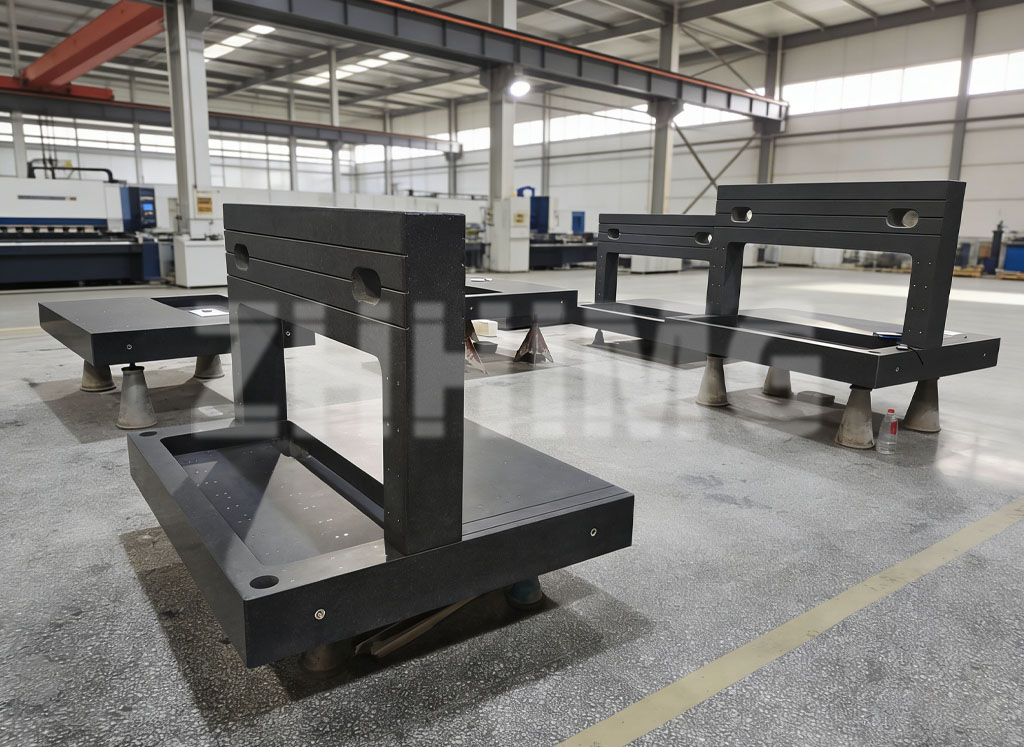
Precision measurement lives or dies on stability, and stability starts with the floor. Our climate-controlled workshop spans 10,000m², and the floor beneath it isn’t ordinary factory concrete — it’s a super-hard concrete pour, no less than 1,000mm thick, engineered specifically to resist deflection under heavy granite loads and to stay dimensionally inert over years of use.
Around the perimeter of the workshop, we’ve cut anti-vibration trenches — 500mm wide and 2,000mm deep — physically isolating the precision zone from external vibration sources like foot traffic, forklifts, or nearby machinery. It’s a detail most visitors never think to ask about, and one that matters enormously once you’re trying to hold a surface flat to within a few hundred nanometers.
Overhead, even the cranes are part of the design. We use silent overhead cranes throughout the climate-controlled area specifically because conventional cranes introduce mechanical noise and micro-vibration — exactly what you don’t want humming above a granite surface plate mid-inspection.
Climate Control That Isn’t Just for Comfort
“Temperature and humidity controlled” sounds like a marketing phrase until you understand what happens without it. Granite is dimensionally stable, but no material is perfectly immune to thermal expansion — and at the tolerances this industry works to, even small ambient swings can register as measurement error. Our workshop holds a consistent temperature and humidity environment year-round, which means a part measured on a Monday morning behaves the same way it did on a Friday afternoon.
We’ve also built a dedicated temperature- and humidity-controlled clean room, modeled on semiconductor cleanroom standards, used specifically for granite component assembly. This is where the most sensitive builds happen — away from dust, airborne particulate, and the everyday variability of a general production floor.
The Machines Behind the Finish
A stable room only gets you so far without the right equipment inside it. Our grinding capability centers on four large-format Taiwan Nante grinding machines, each representing an investment of over $500,000 USD, capable of grinding metal and non-metal precision platforms up to 6,000mm in length.
Alongside the grinders, our overhead cranes and CNC machining centers are rated to handle single workpieces up to 100 tons, with the capacity to machine parts as large as 20m in length, 4,000mm in width, and 1,000mm in thickness — a scale few granite manufacturers anywhere can match.
We currently run four dedicated production lines for precision granite machine beds, with monthly output reaching roughly 20,000 sets of 5,000mm-class granite precision beds — output that, combined with our tonnage capacity, puts us among the fastest-producing, highest-volume precision granite manufacturers anywhere in the world.
Measurement Equipment That Matches the Room
None of this matters without instruments capable of verifying it. Our metrology equipment includes German Mahr dial indicators (0.5μm resolution), Mitutoyo dial indicators, Mitutoyo digital calipers and roughness testers, inductive displacement sensors, Swiss WYLER electronic levels, and UK Renishaw laser interferometers — every one of them carrying calibration certificates issued by the Jinan and Shandong Institutes of Metrology, with traceability back to national metrology standards.
We didn’t choose this equipment by accident. As our founder puts it plainly: if you can’t measure it, you can’t manufacture it. Good products start with good measurement, not the other way around.
Why This Level of Investment Matters to You
It’s fair to ask why any of this should matter to a customer evaluating a granite base or surface plate. The honest answer is this: a workshop without vibration isolation, climate control, and calibrated measurement infrastructure can still produce a granite part that looks flat — but “looks flat” and “measurably stable to nanometer tolerance, verified and traceable” are two very different products wearing the same label.
When your equipment’s accuracy depends on the granite underneath it, the room that granite was made in isn’t a footnote. It’s the foundation.
Frequently Asked Questions
Why does floor thickness matter for granite manufacturing? A thin or standard factory floor can flex minutely under the weight of large granite masses and heavy machinery, introducing vibration and settling that shows up later as flatness drift. A 1,000mm reinforced floor resists that deflection.
What do anti-vibration trenches actually do? They physically decouple the precision workshop from ground-borne vibration outside the trench line — vehicle traffic, nearby equipment, even foot traffic — so external disturbances don’t transmit into the grinding and measurement zone.
Why use silent cranes instead of standard overhead cranes? Standard cranes generate mechanical vibration and noise during operation. In an environment where measurements are taken at the sub-micron level, that vibration can register as measurement noise, so silent crane systems are used specifically to eliminate it.
Is the workshop’s calibration equipment independently verified? Yes — all measurement instruments carry calibration certificates from the Jinan and Shandong Institutes of Metrology, with traceability to national metrology standards.
See It for Yourself
Specifications on a page only tell part of the story. If you’re evaluating suppliers for a project where base stability and measurement integrity actually matter, we’re glad to arrange a facility tour — virtual or in person — and walk you through exactly how your granite base would be produced, ground, and verified.
Contact our team to schedule a facility tour or request a technical consultation.
Post time: Sep-16-2026