
As the core fundamental components for ultra-precision industry, ZHHIMG granite assembly components feature high density, superior stability and low deformation. They serve as the base and supporting structure for high-end equipment including semiconductor machinery, precision measuring instruments, laser equipment and coordinate measuring machines (CMMs). The inherent rigidity and precision advantages of ZHHIMG granite components come not only from rigorous raw material selection and precision machining processes, but also from refined on-site assembly and installation operations. Unlike ordinary mechanical parts, granite is highly brittle with extremely low precision tolerance. The slightest installation deviation, uneven stress or environmental interference may invalidate nanometer-level flatness and cause equipment offset, directly affecting the inspection and operational accuracy of the whole precision system. Drawing on ZHHIMG’s ultra-precision assembly standards and decades of practical experience, this article comprehensively breaks down the core installation details of granite assembly components, helps avoid common installation pitfalls, and guarantees long-term component precision and stable equipment operation.
I. Pre-installation Preparation: Strictly Control Installation Environment and Block Precision Disturbances
Granite components are highly sensitive to environmental conditions. Temperature, humidity, vibration and cleanliness of the installation environment form the first line of precision protection, which are also the most easily overlooked critical details. All installation activities must be carried out in a standardized precision assembly environment.
First, precise temperature and humidity control. Installation is prohibited in open-air or ordinary workshops with dramatic temperature fluctuations, high humidity or direct sunlight. The optimal working environment is kept at a constant temperature of 20℃±2℃ with relative humidity between 45% and 60%. Granite has slight thermal expansion and contraction; sudden temperature changes can induce invisible component deformation and destroy the finished nanometer flatness and straightness. Before installation, ZHHIMG granite parts, matching metal fittings and calibration tools shall be thermally stabilized in the working environment for no less than 24 hours to ensure uniform temperature and eliminate assembly errors caused by temperature difference.
Second, thorough vibration isolation. The installation site shall be kept away from vibration sources such as machine tool processing, heavy equipment operation and vehicle traffic. A professional dust-free assembly workshop equipped with vibration isolation trenches and ultra-hard concrete flooring is preferred. The floor must be perfectly flat without settlement or hollow areas to prevent component misalignment from micro-vibration during installation and resonance deformation during later equipment operation. Frequent personnel movement and tool collision are restricted during operation to minimize environmental vibration.
Finally, full-range cleaning. ZHHIMG precision granite mating surfaces, threaded holes, positioning grooves and gaps of air-bearing structures easily accumulate dust, iron filings and oil stains. Tiny impurities will create gaps between fitting surfaces and uneven stress, resulting in precision failure. Before installation, wipe contact surfaces repeatedly with anhydrous ethanol and ultra-fine dust-free cloth, and blow residual debris out of cavities with clean compressed air. Avoid touching precision working surfaces with bare hands to prevent sweat and grease residue from damaging material and assembly fit accuracy.
II. Base & Support Installation: Uniform Force Distribution to Prevent Invisible Deformation
ZHHIMG granite components are mostly large-size, heavy and high-rigidity structures, with individual unit weight up to dozens of tons. Base levelling and support layout are critical to avoid cracking and precision drift. The “hard contact” installation method for common machinery is totally unsuitable for granite. The core principle is multi-point uniform loading, stress-free fitting and zero forced correction.
The installation base must be levelled and calibrated in advance with base flatness error controlled within 0.01mm, to avoid suspended sections and overloading at single points caused by uneven base height. For large ZHHIMG granite beds and platform assemblies, support points shall be arranged following the standard of three-point positioning plus multiple auxiliary supports. Special precision support blocks with matched hardness and ultra-low deformation coefficient must be adopted; ordinary metal or rubber blocks cannot be mixed for use. All support points must sit on the same horizontal reference plane. Disordered supports at different heights will lead to long-term tension/compression stress on granite, inducing invisible bending deformation or even cracking risks.
No violent operations are allowed during fine levelling. Minor horizontal deviation shall be corrected by adjusting support block thickness and levelling bolts evenly. Never strike or pry the granite body to force alignment. Granite is highly brittle; external impact creates invisible internal cracks. These cracks may not show immediately but propagate gradually over time and cause continuous precision degradation. Electronic levels and laser interferometers shall be used for real-time monitoring during calibration to fully control horizontality and flatness.
III. Alignment & Tightening: Precise Fitting to Avoid Assembly Stress
ZHHIMG granite assembly components cover beds, bases, air-bearing units and spliced platforms. Refined alignment, bolt tightening and splicing directly determine assembly precision and service life of the whole equipment, with two key risks to avoid: deformation from over-tightening and offset from under-tightening.
Component alignment follows the principle of “lower gently, adjust slowly, fit precisely”. Flexible slings must be used for hoisting and transportation; steel wire ropes cannot bind components directly to prevent scratches on ZHHIMG precision working surfaces and edge chipping. Lower components slowly with fine adjustment space reserved. Recheck transverse and longitudinal dimensions repeatedly with precision gauges to guarantee uniform splicing gaps and accurate alignment of locating holes, free from dislocation, offset or forced compression. Especially for granite air-bearing assemblies and guideway mounting bases, alignment deviation must be controlled at micrometer level to preserve subsequent operation accuracy of linear motors and guide screws.
Bolt tightening follows the rule of symmetrical multi-stage tightening and uniform force. All fixing bolts shall be 304 stainless steel precision bolts to prevent rust-induced fastening failure and precision deviation. Tighten diagonally in 3–4 gradual stages with torque wrenches for precise force control. One-time violent tightening or excessive stress on one side is forbidden. This method effectively disperses assembly stress and prevents indentation and deformation of ZHHIMG granite under localized heavy pressure, fundamentally securing flatness and assembly stability. Splicing gaps should remain evenly sealed without trapped debris. Do not over-compress sealing; leave tiny buffer space for thermal deformation.
IV. Precision Calibration: Multi-dimensional Re-inspection to Lock Micron-level Accuracy
Installation of ZHHIMG granite components is not completed once positioned and fixed. Multi-dimensional precision calibration is essential to meet ultra-precision requirements, complying with globally accepted metrology standards for comprehensive inspection.
After preliminary installation, let the assembly stand for 4–8 hours to release assembly stress before full precision inspection. Use laser interferometers, electronic levels, roughness testers, dial gauges and other precision metrology instruments to sequentially test flatness, straightness, parallelism, perpendicularity and other core parameters. Focus on checking consistency at splicing joints and stress-bearing positions to ensure nanometer flatness and micron dimensional tolerance for the whole assembly.
Calibration covers both static precision and dynamic stability. For ZHHIMG granite assemblies equipped with air bearings, separately inspect flatness of air-bearing surfaces and uniformity of air flow to eliminate local protrusions or depressions and ensure smooth air-bearing motion without jitter. Record all calibration data, benchmarked against international precision standards including German DIN, American ASME and Japanese JIS, to match assembly accuracy requirements of high-end precision equipment. 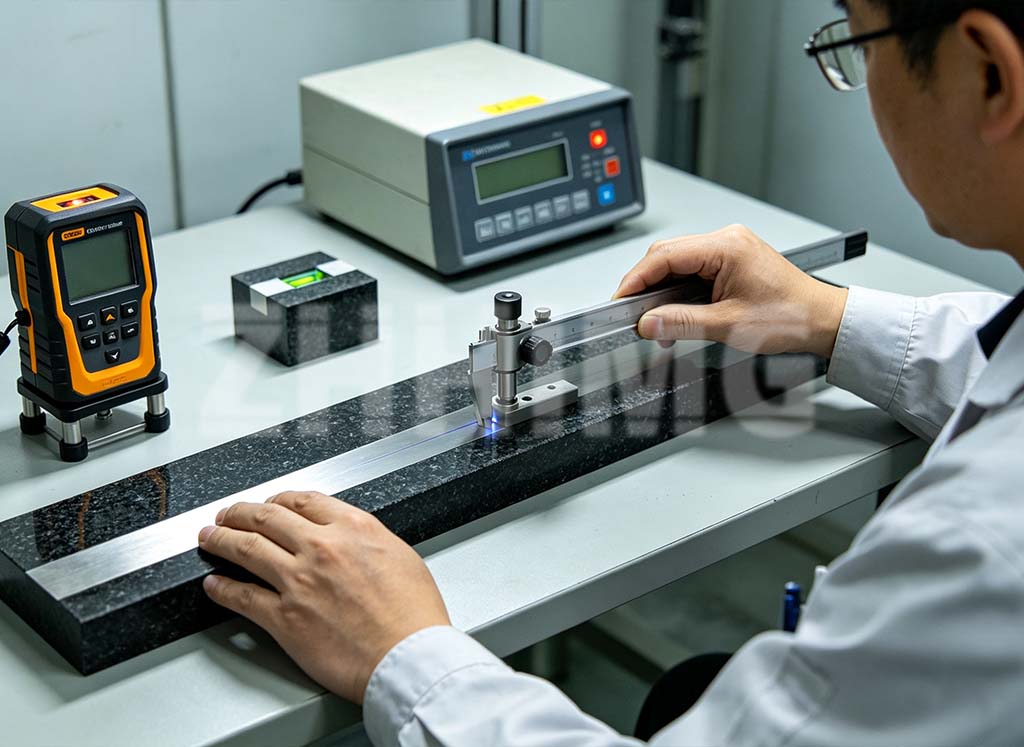
V. Finished Product Protection & Finalization: Long-term Maintenance to Preserve Original Precision
Protection and finishing work after installation of ZHHIMG precision granite components is vital to avoid precision loss and extend service life. Many later precision failures arise from inadequate protection in this phase.
First, protect working surfaces. Immediately apply dust-proof protective film after installation to prevent dust, oil, acid and alkali from corroding precision surfaces, and avoid scratches and knocks during subsequent equipment assembly and commissioning. Install protective corner guards on component edges to prevent chipping and deformation.
Second, eliminate later stress interference. During equipment commissioning and accessory installation after granite assembly, welding, drilling or violent striking on ZHHIMG granite components are prohibited. Do not stack overweight materials on granite surfaces to avoid secondary deformation and precision damage. Maintain constant temperature, humidity, dust-free and vibration-free conditions in the assembly area to prevent precision drift caused by environmental fluctuation.
Finally, complete re-inspection and filing. After all installation and calibration work, leave the assembly for 24 hours for final precision recheck. Once all parameters are qualified, retain calibration reports and build equipment precision archives to serve as reference for later equipment maintenance and precision recalibration.
VI. Summary of Industry Pitfall Avoidance
The core logic of granite assembly installation differs from ordinary mechanical installation which only requires “fixing the part”. Its essence lies in stress-free assembly, full environmental disturbance control, micron-level calibration and long-term protection. Most precision failures in the market are not caused by raw material or machining defects, but inadequate installation environment, uneven stress, violent assembly and insufficient protection. Upholding ZHHIMG’s quality policy: The precision business can’t be too demanding. Only by controlling every installation detail can we fully leverage the physical advantages of high-density black granite, maintain nanometer precision over long service periods, and lay a solid foundation for stable operation of equipment in semiconductor, precision inspection and high-end intelligent manufacturing sectors.
Post time: Sep-17-2026