
In ultra-precision manufacturing, many equipment manufacturers fall into a hidden trap. Even when top imported spindles, guide rails and sensors are adopted, and the commissioning precision meets specifications, accuracy will drift unexpectedly, repeatability deteriorates and test data becomes scattered after a period of mass production.
Most engineers tend to inspect moving components, control systems, temperature and humidity conditions first, while overlooking a fundamental principle: the precision ceiling of precision equipment never lies in its motion system, but in the stability of its supporting reference base.
This is why manufacturers in semiconductor inspection, laser micro-machining, CMM metrology and new energy precision testing have gradually replaced conventional metal and cast iron bases with granite support blocks in recent years. Yet debates persist across the industry. Are granite support blocks truly more reliable than metals, alloys and cast iron? Is it merely a material marketing gimmick? What exactly separates low-cost stone products from high-end precision granite?
Breaking away from sales-oriented narratives, we will objectively analyze this question based on the operating fundamentals of precision equipment.
1. Why Do Precision Equipment Fear Micro-deformation?
General machinery allows micron or even larger baseline errors without compromising finished product quality. Ultra-precision equipment operates on a totally different principle. For femtosecond laser machining, semiconductor visual inspection, CMM dimensional calibration, precision tool measurement and optical alignment, all precision performance hinges on an absolutely stable reference plane.
Traditional metal and cast iron support structures suffer from three inherent drawbacks: First, high temperature sensitivity. Minor temperature fluctuations in workshops or continuous heat generation from equipment cause slight thermal expansion and contraction of metal bases, leading to immediate precision deviation. Second, continuous stress release. Internal stress within cast metal components remains unstable after machining, resulting in gradual deformation over time. The longer the equipment runs, the worse its precision becomes. Third, poor vibration resistance. Micro-vibrations generated by workshop fans, adjacent machinery and pedestrian movement transmit to the working surface and disrupt nano and micron-level precision operations.
Simply put, three core requirements must be met for long-term stable precision equipment: no deformation, no vibration and no drift. Premium granite naturally excels at these three points.
2. Inherent Material Advantages: The Core Reason Granite Support Blocks Are Reliable
Misconceptions about granite support blocks stem from market chaos. Many suppliers sell ordinary marble as precision granite at rock-bottom prices. Such substitutes exhibit poor stability, prone to warping, discoloration and flatness failure after service.
This leads many equipment manufacturers to believe all stone supports are unreliable. In fact, inferior marble is not the same as engineering-grade precision granite; they are two completely different materials for separate applications.
Black granite used for ultra-precision equipment features high density and uniform internal structure, outperforming equivalent stone materials from Europe and America. It delivers high density, extremely low porosity and outstanding chemical inertness. Its biggest merit is not hardness, but exceptional physical stability.
It generates minimal deformation under temperature variation and eliminates thermal drift. Formed over millions of years through natural aging, the natural stone contains nearly no internal stress and avoids progressive deformation. Meanwhile, it possesses vibration-damping properties unavailable in metals, rapidly dissipating vibration waves and keeping the equipment working surface in a static steady state.
This explains why granite is the preferred reference substrate for high-end metrology, optical and semiconductor equipment worldwide. 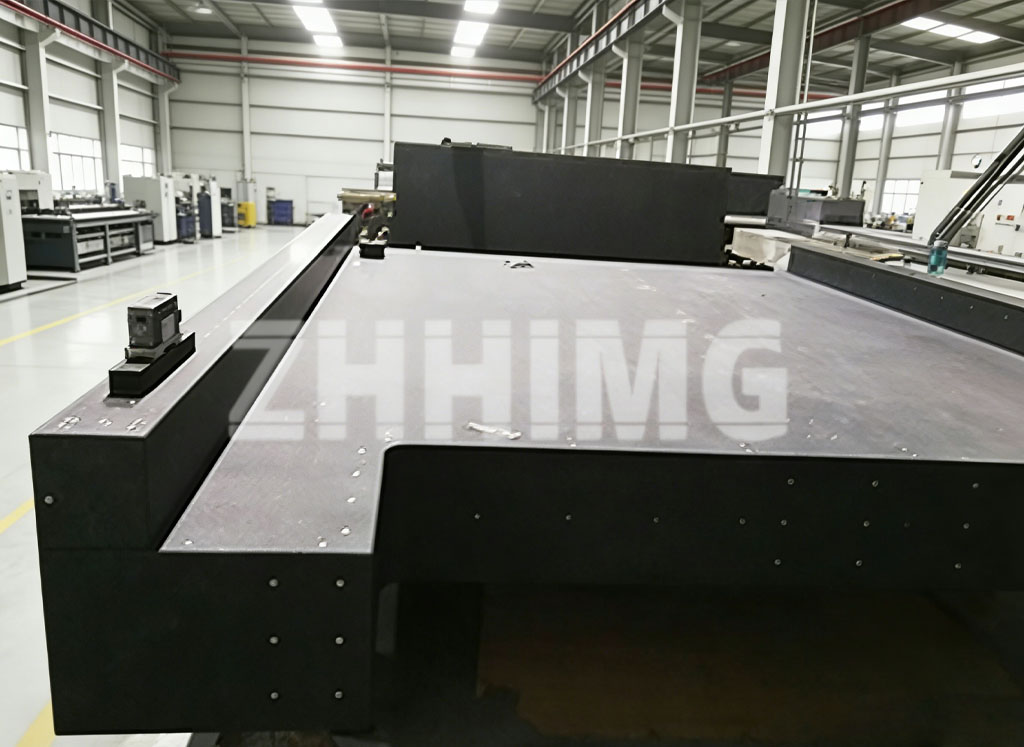
3. Why Some Granite Blocks Perform Well While Others Fail
Material quality is only the foundation. The reliability of precision support components ultimately depends on machining philosophy, precision control and process standards — this marks the major dividing line in the industry.
Ordinary stone fabricators only carry out cutting and polishing, focusing on surface smoothness and dimensional compliance. They ignore core demands of precision equipment: consistency, repeatability and durability of reference precision. Without strict constant-temperature machining, precision calibration and stress relief treatment, their granite blocks serve merely as ordinary plates and cannot satisfy ultra-precision applications.
Trusted precision granite support components feature controllable precision:
- Its flatness, parallelism and perpendicularity remain stable through long-term use, not just at factory delivery.
- Precision calibration follows global metrology standards, with measurable, traceable and reproducible results, instead of subjective visual judgment.
- Its lapping process is not purely automated cutting. Refined manual fine lapping modifies geometry to micron and nano accuracy, meeting stringent requirements of high-end equipment.
A well-recognized consensus in precision industries: automated machines can complete standard processing, yet nano-scale precision correction relies on accumulated craftsmanship and standard expertise. This forms the core barrier that premium granite support blocks cannot be replaced by cheap alternatives.
4. What Precision Equipment Requires Granite Support Blocks?
Many equipment manufacturers hold a misunderstanding: granite is only necessary for high-precision machines, not for low-precision devices. The reality is the opposite. Stable reference bases are required wherever inspection, alignment or precision machining takes place.
Mainstream application scenarios cover nearly all ultra-precision sectors: semiconductor AOI inspection, X-ray equipment, industrial CT, laser precision machining tools, CMM and optical profile projectors, PCB precision drilling machines, new energy lithium battery inspection instruments, precision tool calibration equipment, linear motor stages, perovskite coating machines and more.
In these applications, granite support blocks are far more than simple plates. They act as the precision reference origin for the whole machine. A stable origin guarantees stable overall equipment accuracy; an unchanged origin prevents long-term precision drift.
5. Final Verdict: Selecting Proper Granite Support Blocks Is a Solid Investment for Precision Equipment
Back to the original question: Is granite support blocks a reliable choice for precision equipment?
The answer is clear: low-grade marble knockoffs are unreliable, while precision granite support blocks manufactured with high standards, sophisticated processes and rigorous inspection deliver dependable performance.
In precision manufacturing, equipment upgrades, algorithm optimization and component replacement are value-added refinements. Stable reference support is the fundamental guarantee. Metal bases offer cost benefits but have low precision limits; cast iron bases have limited stability. Only premium precision granite combines vibration suppression, thermal stability, low deformation and long service life, fitting perfectly with development trends of ultra-precision industries.
Future competition in precision manufacturing will eventually boil down to competition in reference accuracy. A qualified granite support block consolidates the precision baseline for equipment, ensuring stable, accurate and trustworthy results in every machining cycle, inspection test and dataset.
Post time: Sep-16-2026