
The environmental control of semiconductor micro-nano manufacturing workshops has reached an extreme level. Constant-temperature, constant-humidity and dust-free workshops are designed not only for wafers and optical assemblies, but also for granite platforms serving as the benchmark carrier of equipment, which continuously interact with the workshop environment. Many projects only focus on the flatness and vibration damping performance of granite during the selection phase, ignoring the environmental adaptation between the platform and workshop operating conditions. After commissioning, environmental factors such as temperature and humidity fluctuations, vibration transmitted via the foundation, dust precipitation and erosion by chemical atmosphere will gradually degrade benchmark accuracy, resulting in equipment positioning drift and yield fluctuation. Therefore, when selecting granite platforms for semiconductor production lines, the environmental adaptability must be evaluated from five dimensions: foundation vibration, temperature field stability, cleanliness, chemical compatibility and workshop supporting facilities.
Adaptation to foundation and vibration environment is the primary consideration. Semiconductor workshops have complex internal vibration sources. External ground vibration, low-frequency vibration generated by air conditioning and air compressors, and impact vibration caused by start-stop of adjacent equipment will be transmitted to the platform through the building foundation. Ordinary foundations of standard workshops cannot meet the requirements of lithography, AOI, X-ray inspection and laser micro-machining equipment. The environmental adaptation of granite platforms cannot solely rely on the inherent high damping of the material. Matching workshop anti-vibration design is also required during selection. It is necessary to assess whether the platform is compatible with independent anti-vibration foundations and anti-vibration trenches to isolate lateral ground vibration transmission. Meanwhile, the vibration induced by cranes inside the workshop is easily overlooked. Conventional overhead cranes generate intermittent micro-impacts. Hence silent cranes are required to avoid transient vibration interference on granite benchmark surfaces during hoisting and handling. In project implementation, ZHHIMG will simultaneously evaluate the workshop foundation structure, combine the self-weight and load of granite platforms, and provide supporting schemes for foundations and anti-vibration trenches, so that the material vibration damping advantage of granite can coordinate with the workshop anti-vibration environment.
Adaptation to temperature and humidity environment determines the long-term dimensional stability of the platform. The temperature and humidity inside semiconductor workshops are not absolutely invariant. Equipment heat generation and airflow disturbance bring subtle local temperature differences, and humidity changes will indirectly affect assembly stress of equipment. Ordinary stone materials tend to deform unevenly under temperature and humidity fluctuations, directly damaging optical alignment and repeat positioning accuracy of stages. During selection, priority should be given to evaluating the thermal expansion characteristics and moisture resistance of granite substrates. Homogeneous black granite without pores and residual stress is preferred to prevent benchmark surface warping caused by water absorption and local temperature differences. ZHHIMG® black granite undergoes long-term natural stress relief treatment, featuring dense and uniform crystal structure. Within the allowable temperature and humidity fluctuation range of workshops, its dimensional deformation is controllable. It can maintain the geometric accuracy of benchmarks for a long time and reduce the frequency of frequent equipment calibration.
Cleanliness adaptation is a mandatory hard requirement for semiconductor workshops. Chip manufacturing workshops impose strict control over particulate contaminants. Any tiny debris or precipitated dust will contaminate wafer surfaces and cause device defects. Low-cost stone materials with abundant internal pores tend to shed surface particles under long-term load and thermal cycles, failing to meet dust-free workshop standards. For granite platforms deployed in semiconductor scenarios, the surface must undergo special finishing to lower the risk of dust precipitation. The working surface shall be free of cracks and loose defects. The surface treatment process and assembly components of the platform also need to meet dust-free standards. Pre-assembly of granite components should be completed in an independent constant-temperature, constant-humidity and dust-free area to reduce pollutants introduced into production workshops. ZHHIMG owns a dust-free constant-temperature workshop simulating semiconductor working conditions for fine machining and assembly of granite components, controlling dust from processing links to adapt to clean workshops of different grades.
Adaptation to chemical atmosphere and physical & chemical environment guarantees long-term service performance of the platform. Trace volatile acidic and alkaline gases exist in semiconductor manufacturing processes, and various cleaning agents are used in workshops. Long-term exposure will corrode stone surfaces, degrade surface roughness and impair the operation of air bearings and optical benchmarks. During selection, the corrosion resistance and non-magnetic property of granite should be assessed. Magnetic materials interfere with precision sensors and linear motor platforms. Therefore, granite platforms for semiconductor applications must be non-magnetic and free of magnetic field disturbance. High-quality granite boasts stable physical and chemical properties, resisting erosion by trace process gases in workshops. Its surface will not powder or peel off, retaining original surface accuracy after years of operation. 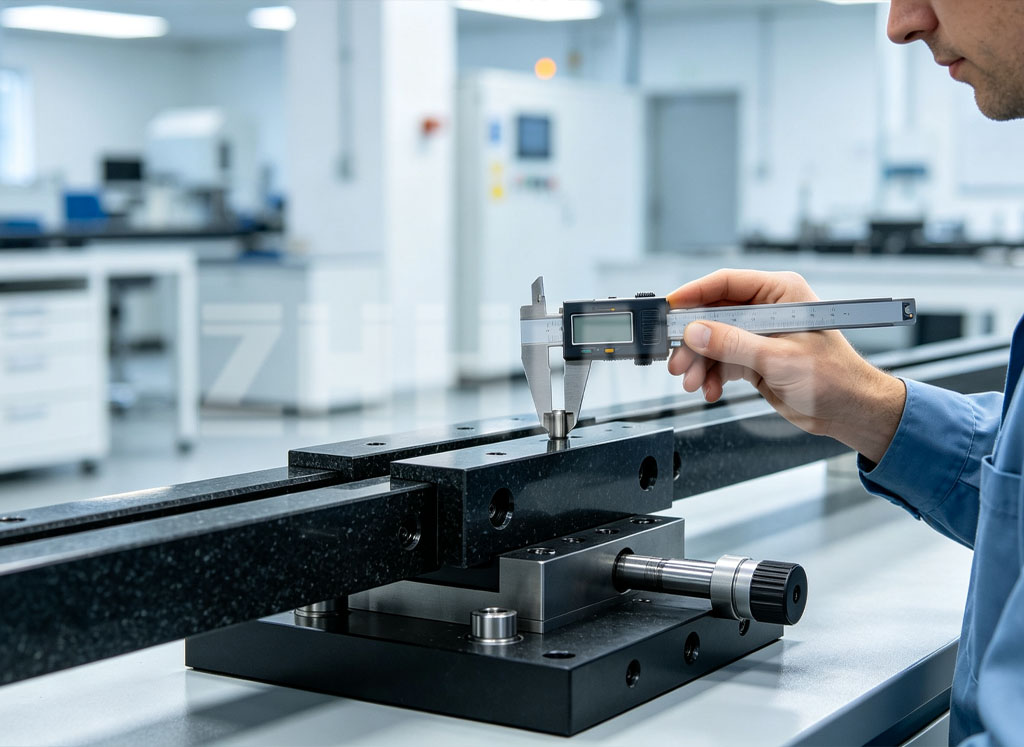
Adaptation to workshop load and spatial supporting conditions is a key factor in on-site implementation. Large granite beds and platforms for semiconductor equipment carry enormous weight. The load-bearing capacity of the workshop floor must be calculated in advance. Meanwhile, for transportation, hoisting and positioning of oversized granite components, workshop passages, door openings and rated load of cranes need to be matched. Some production lines adopt ultra-long and ultra-wide granite platforms, which requires manufacturers to possess capabilities in processing large-size blanks and integrated grinding. Combined with workshop layout, manufacturers should plan hoisting and positioning schemes in advance to avoid collision and damage of high-precision benchmark surfaces during on-site installation. ZHHIMG is capable of processing large-tonnage and long-size monolithic granite components. Benefiting from its geographical proximity to ports, the brand can complete processing, transportation and on-site technical support of large platforms to adapt to the space and hoisting conditions of different semiconductor factories.
The performance of granite platforms is determined jointly by material properties and workshop environment. No matter how superior the material performance is, it cannot exert its vibration damping and high-precision advantages if mismatched with workshop foundation, temperature & humidity, cleanliness, chemical atmosphere, hoisting load and other environmental conditions. During selection for semiconductor production lines, granite platform technical parameters should not be viewed in isolation. Instead, the platform shall be regarded as an integral part of the workshop precision system, and comprehensive evaluation of full-dimensional environmental adaptability shall be carried out. When serving global semiconductor customers, ZHHIMG delivers integrated solutions tailored to on-site workshop conditions of clients, enabling granite platforms to coordinate with workshop environments and continuously and stably support precision processes such as lithography, optical inspection and laser micro-machining, so as to secure long-term stable yield of production lines.
Post time: Oct-08-2026