
In semiconductor equipment, linear motor platforms, CMM bases and laser inspection machinery, granite tables are often embedded with threaded sleeves, locating pin sleeves, connecting bushings and other metal fittings for locking and assembling guide rails, modules and tooling assemblies. Embedded metal structures solve the problem that granite cannot be tapped directly and is prone to chipping under repeated tightening. Nevertheless, metal and granite feature vastly different physical and chemical properties. Poor control during embedding may lead to hole‑position deviation, loose or pulled‑out sleeves and cracked adhesive layers. Interfacial stress release under thermal cycles will further trigger local deformation and flatness deterioration of the table, eventually resulting in abnormal overall equipment accuracy. Many projects focus merely on the final lapping accuracy of granite tables while ignoring process risks in embedding, so hidden failures only emerge after product delivery. Drawing on rich manufacturing experience in ultra‑precision components, ZHHIMG sorts out core control points for machining granite tables with embedded metal fittings. It avoids secondary precision problems induced by embedding from multiple dimensions: base material, structural design, drilling, bonding and curing, constant‑temperature finish lapping and finished‑product inspection.
Base material and structural design constitute preconditions for embedding technology. Drilling and embedding break the continuity of stone and create stress‑concentrated zones around holes. Insufficient plate thickness or unreasonable hole layout may generate micro‑cracks around hole openings under bolt‑locking loads, and the cracks will gradually expand. For granite tables with dense embedded metal parts, ZHHIMG reinforces plate thickness according to embedding density and single‑hole load to prevent spring‑back deformation caused by reduced stone rigidity after hole opening. Hole‑edge distance and hole spacing are strictly specified, keeping holes away from bedding planes and mineral aggregation defects inside stone. In terms of metal‑fitting selection, thin‑walled simple sleeves are rejected. Thickened stainless‑steel embedded bushings are preferred, with material grades differentiated for ordinary and corrosive working conditions. Knurling is processed on outer surfaces of bushings to improve adhesive bonding performance and lower risks of rotation and pull‑out under external force. Some manufacturers tap threads directly on granite without metal sleeves; repeated disassembly and assembly will easily damage stone threads and cause irreversible damage.
Quality of drilling and counter‑boring determines the inherent performance of embedding. Granite boasts high hardness. Improper cooling or feeding parameters during drilling will produce invisible micro‑cracks on hole walls. These cracks expand gradually under vibration, temperature alternation and bolt‑locking force and become sources of later‑stage failure. ZHHIMG adopts diamond water‑cooled drilling to remove cutting heat continuously and suppress thermally induced micro‑cracks. Coaxiality of counter‑bores and cleanliness of hole bottoms are strictly controlled. Powder and debris inside holes must be thoroughly cleared. Residual dust will separate adhesive from base material and form gaps at bonding interfaces. Many processing plants skip thorough hole cleaning. Stone powder mixed in adhesive greatly reduces bonding strength and leads to loose and slipped metal parts in service.
Bonding and curing of dissimilar materials are links where hidden risks most easily occur. Stainless steel and granite have distinct coefficients of thermal expansion. They expand and contract to different extents under temperature change, generating continuous shear stress at interfaces. Ordinary general‑purpose adhesives cannot adapt to such working conditions and tend to shrink or debond. ZHHIMG applies low‑shrinkage special epoxy structural adhesive matching granite’s thermal‑expansion properties. Glue dosage is well controlled to fully fill gaps between sleeve outer walls and granite hole walls and eliminate bubbles and cavities. Metal bushings are vertically pressed and positioned with tooling to guarantee perpendicularity and hole‑position accuracy. A complete static curing cycle is critical. Full curing must be finished in a stable environment to release shrinkage stress of adhesive. Lapping procedures shall never start before complete curing. If lapping is carried out while adhesive is not fully set, subsequent adhesive shrinkage will pull local stone and cause flatness drift of the table.
Machining sequence cannot be reversed. Final ultra‑precision lapping shall be performed after embedding, which is vital for finished‑product accuracy. Some manufacturers lap granite tables to finished accuracy first and then conduct drilling and embedding. Drilling impact and adhesive curing stress will disturb well‑finished high‑precision reference surfaces and ruin previous lapping accuracy. ZHHIMG follows standardized process flow: raw‑block aging for stress release → rough grinding for shaping → drilling and counter‑boring → embedding metal fittings → sufficient static curing → final ultra‑precision lapping in constant‑temperature‑humidity workshop. The workshop features heavy‑duty anti‑vibration concrete floor and anti‑vibration trenches to isolate external vibration. After lapping, end faces of metal bushings are kept slightly below granite working surfaces to avoid local stress points caused by protruding metal against assemblies and prevent local warpage after assembly.
Multi‑dimensional finished‑product inspection screens hidden defects brought by embedding. Embedding does not mark the end of quality control. Apart from conventional geometric inspections for flatness, position tolerance and parallelism, special verification for embedded fittings is required. Equipped with world‑class metrology instruments including German Mahr dial gauges, Swiss WYLER electronic levels and British Renishaw laser interferometers, ZHHIMG verifies thread status, perpendicularity and hole‑position tolerance of each bushing one by one. Pull‑out‑resistance sampling tests are carried out to simulate actual assembly locking loads and eliminate hidden risks such as loosening and virtual bonding. All inspection tools hold traceable calibration certificates. Technical teams with over 30‑year lapping experience judge whether stone suffers stress disturbance after embedding in accordance with DIN, ASME, GB and other international metrology standards, preventing defective products from being delivered to downstream customers. 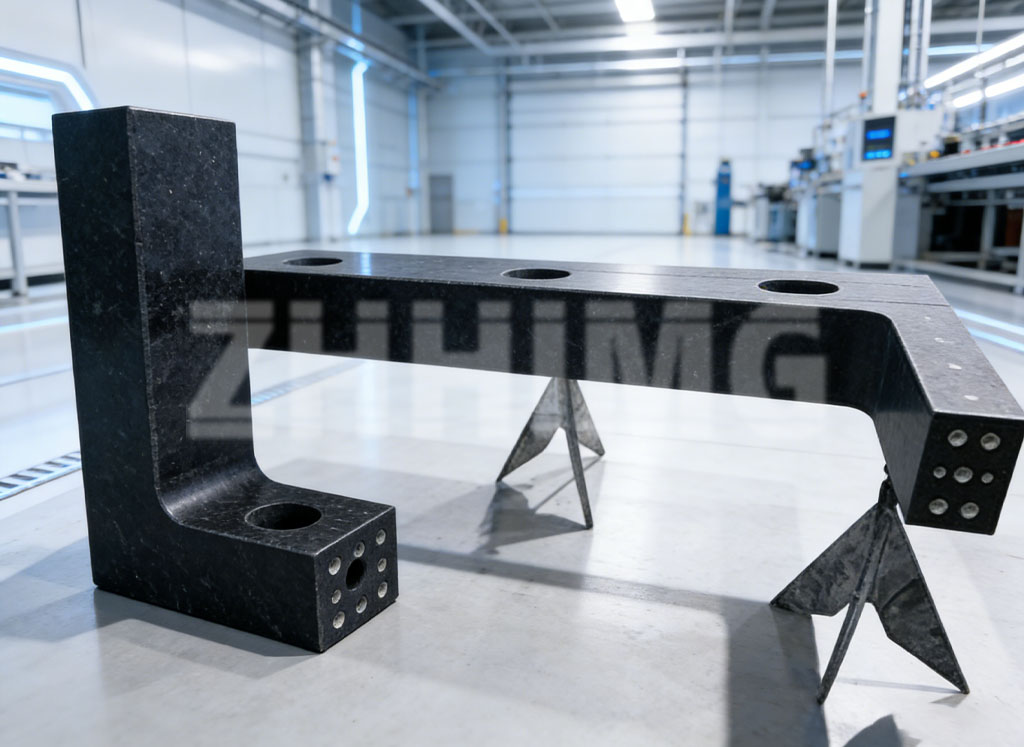
Industry‑university‑research projects further optimize the embedding‑process database. ZHHIMG conducts comparative tests with multiple international metrology institutes and universities. It simulates high‑low‑temperature cycles and continuous vibration working conditions to track long‑term stability of metal‑granite bonding interfaces and summarizes process parameters corresponding to different dimensions, loads and hole layouts. Owning more than 20 international trademarks and patents, as well as ISO three‑system and CE certifications, ZHHIMG adheres to its customer commitment: no cheating, no concealment, no misleading. Process suggestions for embedded structures are provided to customers at early project stages to avoid structural risks originating from drawing design.
Nowadays, granite tables with embedded metal fittings are widely applied in linear‑motor XY stages, semiconductor inspection bases, CMM foundations and precision laser equipment. Embedded metal fitting installation is far more than simple drilling and bushing insertion; it represents an integrated system technology covering material, structure, processing, curing and inspection. Upholding its quality policy “For precision‑oriented business, no pursuit of perfection is excessive”, ZHHIMG incorporates every detail of embedding into quality control. It helps customers avoid equipment‑accuracy failures stemming from defective embedding processes and supplies highly‑reliable granite reference components for global ultra‑precision equipment.
Post time: Sep-07-2026