
1. Substrate Preprocessing: Eliminating Inherent Defects and Consolidating Technical Foundations
The core challenges of machining threaded holes and T-slots on granite lie in edge chipping, internal microcracks and dimensional deviations caused by the hard and brittle properties of stone. Substrate preprocessing serves as the critical first step to avoid such problems. ZHHIMG strictly selects high-quality black granite with high density, uniform texture and zero cracks, and rejects inferior marble and loose stone materials prevalent in the market. This fundamentally avoids processing cracking and forming deformation caused by internal impurities and pores in low-grade stone.
Before processing, the technical team conducts full inspection on granite substrates via high-precision imported testing equipment from Germany and Japan to detect hidden surface and internal cracks as well as uneven density. According to plate dimensions, application scenarios and assembly parameters, the precise processing coordinates, aperture specifications and slot sizes of threaded holes and T-slots are determined to formulate exclusive processing drawings. Meanwhile, plates are placed for static conditioning under constant temperature to adapt to the constant-temperature and constant-humidity dust-free workshop environment, eliminate stone internal stress and prevent structural deformation induced by stress release during machining, laying a solid foundation for high-precision processing.
2. Key Processing Techniques for Precision Threaded Holes
Threaded holes on granite inspection plates are mainly used for equipment fixing, tool locking and module assembly. Different from metal threaded holes, granite has no ductility, making it vulnerable to hole position deviation, rough hole walls, thread chipping and bottom cracking during processing. ZHHIMG adopts a four-step precision processing procedure consisting of positioning drilling, layered hole expanding, precision tapping and hole wall finishing to avoid accuracy loss throughout the process.
First, CNC precision positioning drilling is adopted. Supported by high-stroke high-precision CNC equipment and micron-level positioning systems, hole coordinates are locked with strictly controlled micron-level errors to eliminate hole position and spacing deviation. Considering granite’s brittleness, a low-speed constant drilling mode matched with special stone diamond drill bits is applied for layered cutting. This gradual processing method prevents hole edge chipping and internal microcracks caused by high-speed impact. After drilling, refined hole expanding is performed to correct minor deviations of hole walls and ensure the aperture regularity and verticality meet precision assembly standards.
In the core tapping process, violent mechanical tapping is abandoned and replaced with manual-assisted precision tapping. Operated by senior technicians with over 30 years of precision processing experience, the tapping speed and force are adjusted according to granite hardness to ensure full, regular and flaw-free threads without chipping or slipping. After processing, the inner walls of threaded holes are polished, cleaned and anti-seepage treated to remove residual processing debris and tiny burrs, improving the wear and corrosion resistance of threaded holes. This ensures tight fitting and stable locking of bolts without thread slipping or deformation after long-term repeated disassembly and assembly.
3. Key Processing Techniques for Precision T-Slots
T-slots are core structures for tool sliding, positioning adjustment and multi-station assembly on granite inspection plates, widely applied in the flexible matching of precision fixtures, linear motor platforms and inspection tooling. They impose strict requirements on slot straightness, parallelism, notch flatness and depth uniformity. Targeting the special narrow-top and wide-bottom structure of granite T-slots, ZHHIMG adopts customized differentiated slotting techniques to solve common industrial problems such as slot skew, uneven bottom width, edge chipping and plane misalignment.
In the early processing stage, full-range scribing and positioning is completed via advanced CNC systems to accurately mark the trend, width and depth boundaries of slots, ensuring unified parallelism and symmetry of multiple slots. The slotting process adopts the core strategy of layered milling, rough-first-finish-later and segmented processing. Rough milling is used to remove excess stone allowance with a tiny margin reserved for finishing. Then ultra-large precision grinding machines from Taiwan Nantong are applied for refined milling and grinding to gradually correct the accuracy of slot side walls, bottoms and notches. For the wide bottom structure of T-slots, zoned uniform milling is adopted to prevent stone chipping and deformation caused by unilateral excessive force.
To guarantee long-term operational stability, all T-slot corners are processed with arc transition finishing to avoid acute angle damage. Meanwhile, the entire slot maintains uniform straightness and flat bottom without undulation, ensuring smooth and jitter-free sliding of tooling. After processing, internal slots are finely polished in a dust-free environment to remove residual debris and minor defects, achieving regular structural integrity and consistent accuracy for meeting the requirements of high-frequency sliding, precise positioning and locking of precision tooling. 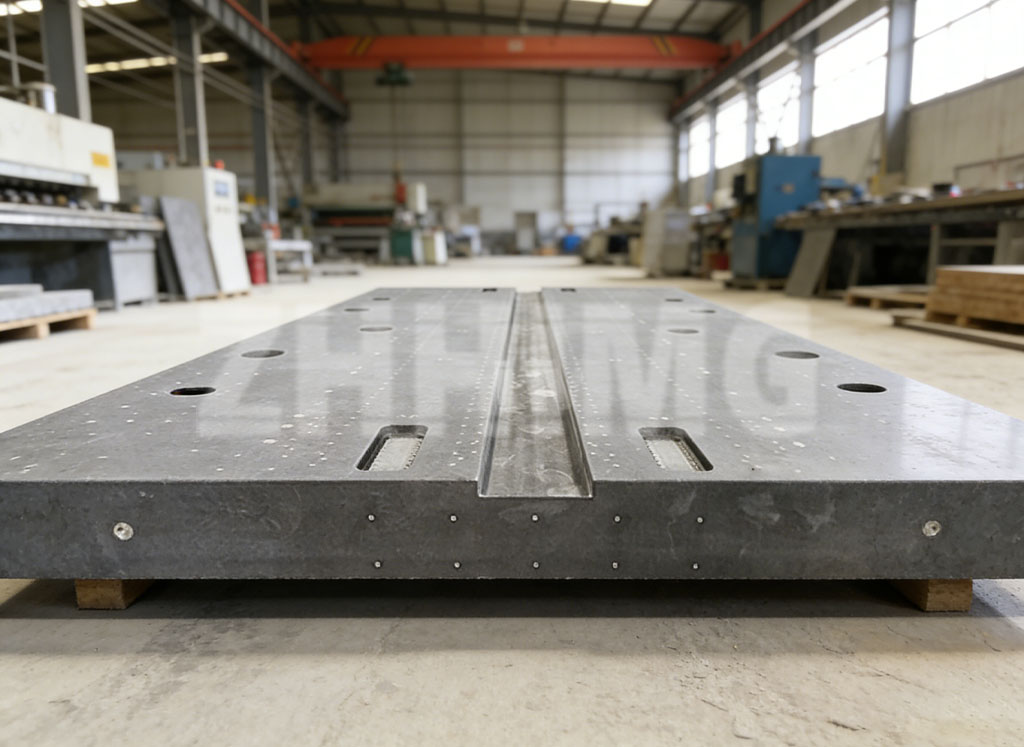
4. Constant-Temperature Quality Control and Full-Range Inspection for Ultimate Finished Accuracy
The processing accuracy of threaded holes and T-slots is extremely susceptible to vibration, temperature difference and processing stress. ZHHIMG implements full-process environmental control relying on a 10,000-class constant-temperature, constant-humidity, shockproof and dust-free workshop. Professional shockproof trenches, silent travelling cranes and ultra-hard shockproof floors completely isolate external vibration interference, and the constant temperature and humidity environment eliminates thermal expansion and contraction deformation of stone, ensuring stable and controllable processing accuracy at all times.
In the finished product inspection stage, world-leading testing equipment including Germany Mahr, Japan Mitutoyo, Switzerland WYLER and UK Renishaw is adopted for full-range refined detection of threaded hole aperture, spacing, verticality and thread accuracy, as well as T-slot straightness, parallelism, depth tolerance and plane accuracy. All test data is traceable to national and provincial metrology standards. Strictly complying with international mainstream precision standards such as German DIN, American ASME and Japanese JIS, ZHHIMG ensures all threaded holes and T-slots meet high-precision requirements and adapt to the assembly needs of global high-end precision equipment.
5. Core Process Advantages and Industrial Value
Compared with simple industrial hole and slot processing methods, ZHHIMG’s processing technology for threaded holes and T-slots on granite plates balances structural integrity, dimensional accuracy, long-term stability and universal adaptability. It effectively solves traditional stone processing pain points including easy chipping, poor accuracy, low durability and assembly misalignment. The granite inspection plates retain nano-level plane detection accuracy while possessing excellent tooling adaptability and structural practicality.
Supported by rigorous process systems, mature processing technology and all-round quality control capabilities, ZHHIMG realizes large-scale high-precision production of oversized granite plates with multiple holes and slots. Its products are widely applied in semiconductor precision equipment, laser processing equipment, coordinate measuring machines, new energy detection tooling and high-end metrology calibration equipment. With multiple international certifications and global patented technologies, the company continuously provides high-stability and high-precision granite supporting components for the global precision metrology and high-end equipment manufacturing industry through ultra-precision processing techniques.
Post time: Aug-27-2026