
After commissioning, large-travel precision inspection equipment and gantry motion platforms often need to carry modules, optical assemblies and fixtures continuously year-round. The deformation stability of the base directly determines the precision service life of the whole machine. Many metal bases suffer from slow plastic deformation under long-term heavy load. Together with expansion and contraction caused by ambient temperature changes, positioning accuracy and plane datum drift after a period of operation, requiring frequent shutdown calibration. ZHHIMG large granite bases leverage the inherent material properties of stone and complete precision machining processes to deliver excellent deformation resistance. The datum accuracy remains stable under continuous heavy load.
Dense interlocking mineral crystals inside granite feature high elastic modulus and no plastic creep like metal materials. Under rated continuous load, only tiny elastic deformation occurs, and the base returns to its original shape after load removal without permanent deformation. High-density granite reaches 3100kg/m³ with few internal pores. Compared with ordinary stone, it is less prone to local compaction and settlement under pressure. When the equipment runs under full load for a long time, the base bears the weight of columns, slides and tooling continuously. Unlike cast iron or welded steel structures, it will not gradually bend irreversibly over time, reducing slow precision drift from the material itself. Its thermal expansion coefficient ≤3e-6/℃. Minor ambient temperature fluctuations cause extremely small expansion and contraction. Even with day-night temperature differences in workshops, deformation of the base stays within micrometer range, and the reference plane will not be damaged by temperature variation.
During machining, ZHHIMG performs multiple aging treatments for large bases to fully release inherent stress from raw blocks and cutting stress generated in rough machining. If stress release is insufficient for large components, the geometry will slowly change due to gradual stress release under sustained load and alternating temperature and humidity, even if inspection passes before delivery. After long-term static aging and repeated measurement, fine grinding starts only when the stress state is confirmed stable. The finished ground base maintains low and balanced internal stress. When put into service under long-term heavy load, it will not deform slowly from continuous stress release, keeping flatness and straightness stable for years.
In the design phase, ZHHIMG conducts mechanical simulation according to customers’ actual heavy-load conditions to optimize section thickness, rib layout and support point distribution of the base. Loads can be evenly distributed across the whole base body to avoid localized stress concentration. Excessively high local compressive stress from concentrated load easily triggers partial micro-deformation. ZHHIMG avoids high-stress zones during design and arranges embedded threaded inserts or mounting holes properly. Holes are placed away from main load-bearing areas to prevent rigidity reduction. When gantry columns and heavy modules are mounted, gravity and alternating dynamic loads from motion transfer uniformly, without excessive local stress, further improving long-term deformation resistance. 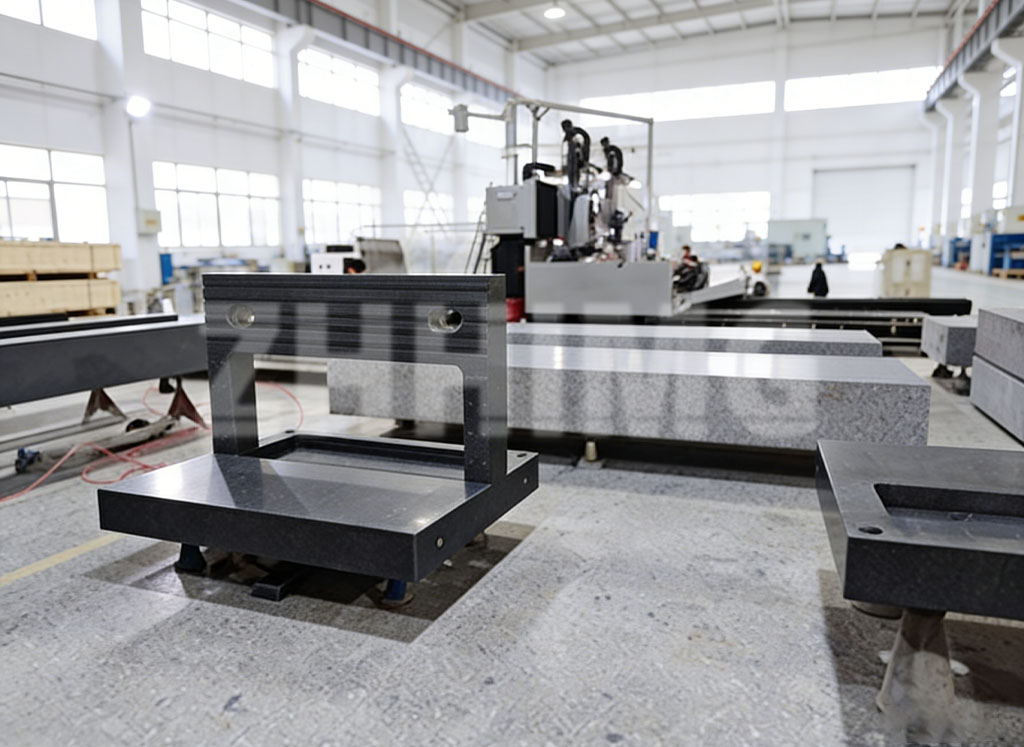
The support scheme also affects deformation performance under heavy load. Improper shim layout after base placement will cause bending under self-weight plus equipment load. ZHHIMG provides matched multi-point support schemes according to base size and load capacity to evenly distribute self-weight and upper equipment loads and reduce bending deformation. During on-site leveling, technicians control contact status of shims to avoid overload at single points and keep the force state consistent with simulation. When the slide moves back and forth and generates alternating dynamic load, the uniform support system suppresses periodic bending rebound of the base and reduces precision fluctuation caused by dynamic deformation.
In the final inspection stage, ZHHIMG carries out heavy-load simulation tests on large granite bases. Laser interferometers and high-precision electronic levels collect geometric tolerance data before and after loading to verify deformation under rated load. All measuring instruments hold CNAS calibration certificates, and measurement data can be traced to metrology institutes. The base can only be packed and shipped after passing loading tests and confirming deformation stays within allowable tolerance. This loading verification simulates long-term heavy-load working conditions in advance, avoiding out-of-tolerance precision after delivery. It ensures stable equipment operation for years and cuts downtime for calibration.
Post time: Sep-20-2026