
In high‑end precision equipment such as semiconductor production tools, femtosecond laser processing machines, coordinate measuring systems and perovskite coating devices, sustained accuracy retention poses one of the biggest engineering challenges. Even if equipment reaches ideal accuracy upon factory acceptance, gradual precision drift will emerge after weeks or months of continuous running. Temperature fluctuation inside workshops, cyclic heat generation from moving modules and ambient climate changes will cause subtle dimensional changes to structural substrates. Such tiny deformations accumulate over operating hours, leading to offset measuring results, deteriorated machining repeatability and increased scrap rate. Many system integrators try to compensate drift through software algorithm correction, yet algorithm compensation cannot physically eliminate deformation triggered by material thermal expansion. Low‑expansion granite mechanical components provide a hardware‑level solution targeting this persistent industry pain point.
Precision drift induced by thermal expansion is often underestimated in component procurement. Some purchasers focus heavily on flatness, straightness and geometric tolerances during incoming inspection, while ignoring the thermal expansion property of base materials. Metal substrates such as cast iron and aluminum alloy feature relatively high thermal expansion coefficients. Minor temperature shifts will produce obvious dimensional stretching or contraction. Certain low‑grade granite on the market contains abundant mineral impurities and internal microcracks. Though its surface meets drawing requirements after grinding, inconsistent mineral composition brings uneven thermal response. Local expansion difference creates twisting and warping, which further drives precision drift under long‑term cyclic temperature conditions.
Low‑expansion granite mechanical components are built upon carefully selected natural black granite with compact crystalline texture. Strict raw stone screening rejects rock sections containing impurity veins, loose mineral zones and heterogeneous inclusions. The qualified stone delivers consistent low thermal‑expansion performance across the whole block. Different from general‑purpose granite materials, its uniform internal mineral distribution ensures synchronous thermal response throughout the component. When workshop temperature rises or falls, the whole granite base expands and contracts evenly without local distortion. This fundamental material property greatly cuts thermal‑triggered geometric variation, reducing the root cause of long‑term precision drift.
Material advantage cannot work independently without targeted structural design and processing control. Simply adopting low‑expansion stone cannot fully avoid drift risk. Professional manufacturers carry out customized structural optimisation for large granite beds, beams and air‑bearing bases. According to thermal stress distribution simulation, engineers adjust rib layout, wall thickness and hole position layout, so as to release thermal stress generated during temperature variation. Cutting direction follows natural grain orientation of raw stone, preventing anisotropic thermal deformation. This material‑structure matching design gives full play to low‑expansion features of granite and avoids partial stress concentration.
Residual stress inside stone is another hidden trigger for long‑term precision drift. Even low‑expansion granite will generate internal stress in mining, cutting and grinding phases. If residual stress remains inside finished parts, slow stress release will couple with thermal cycling, causing slow geometry shift. Reliable suppliers implement multi‑phase stress relief workflows. Combined natural aging and vibration‑simulation aging gradually eliminate internal unbalanced stress. After stress stabilisation, low‑expansion characteristics of granite can maintain steady throughout the whole product lifecycle, rather than only showing good performance at the time of delivery.
Finishing and inspection must be completed under qualified constant‑temperature conditions. If grinding takes place in environments with large temperature swings, temporary thermal deformation will be “frozen” into finished geometry. Once working temperature changes at customer site, hidden deformation will surface and cause precision drift. High‑standard low‑expansion granite components are machined and inspected inside anti‑vibration constant‑temperature‑humidity workshops. Thick reinforced concrete ground and dedicated shock‑absorbing trenches isolate outside interference. All final geometry measurement is finished under stable reference temperature. Test instruments including laser interferometers and electronic levels hold traceable calibration certificates, verifying actual thermal stability instead of only theoretical material parameters. 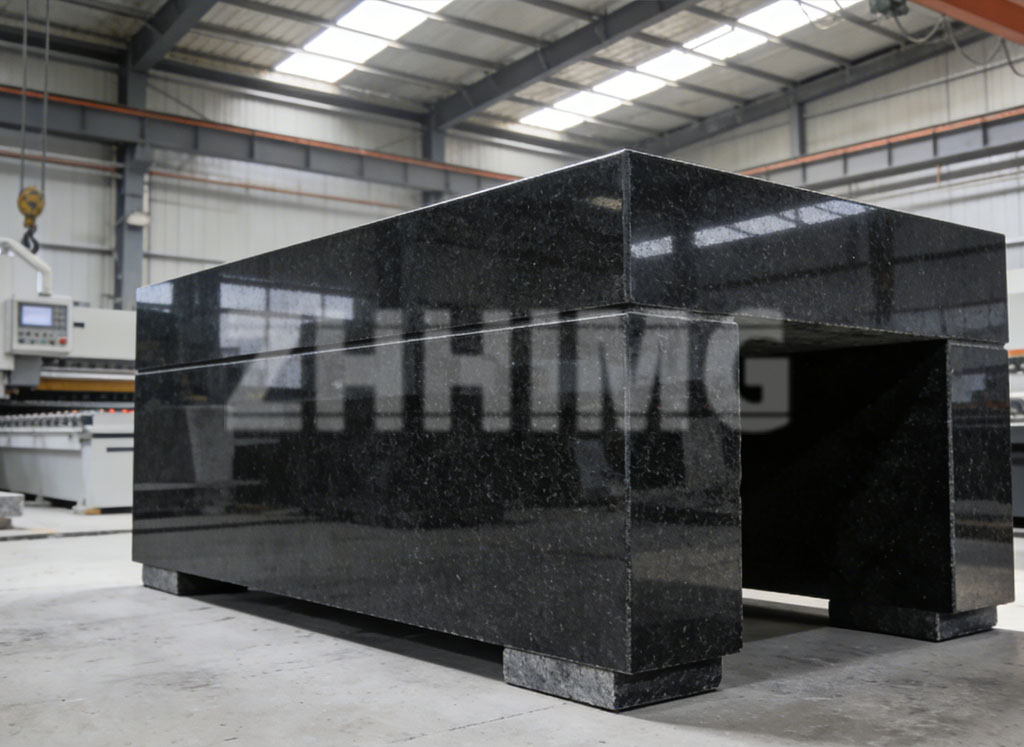
The practical value of low‑expansion granite mechanical components becomes prominent under real‑world operating conditions. For equipment running non‑stop for long shifts, such as PCB high‑speed drilling machines, lithium‑battery inspection platforms and linear motor XY tables, thermal accumulation will inevitably happen inside cabinets. Low‑expansion granite structural parts minimise geometry change caused by heat build‑up. Compared with metal bases or ordinary stone components, they lower the frequency of on‑site recalibration. System integrators reduce dependence on frequent software offset adjustment. Production efficiency improves meanwhile unplanned downtime for precision re‑calibration decreases. This brings tangible benefits for mass‑production oriented high‑precision manufacturing.
Realising stable low‑expansion performance places high requirements on manufacturer’s comprehensive capacity. Stable raw‑material stock yards support batch‑wise stone screening and comparison. Rich experience in oversized monolithic component processing supports customisation of large‑size granite beds and structural beams. Supported by full ISO system certifications, CE compliance and global intellectual property layout, manufacturers can carry out continuous material performance research via cooperation with metrology institutes and top universities. Professional teams familiar with international standards from DIN, ASME to GB guarantee every batch of components delivers consistent low‑expansion performance.
ZHHIMG devotes itself to solving long‑term precision drift trouble for ultra‑precision equipment with low‑expansion granite mechanical components. Starting from strict raw stone selection, we filter blocks with homogeneous mineral texture and stable thermal properties. Through grain‑oriented cutting, optimised structural layout, multi‑stage stress relief aging and constant‑temperature precision inspection, our granite machine beds, structural beams, air‑bearing substrates and measuring parts maintain excellent dimensional stability under temperature cycling. Our low‑expansion granite components serve semiconductor, laser processing, new‑energy and optical detection sectors worldwide, helping Fortune 500 enterprises and research institutions keep stable equipment accuracy over thousands of working hours.
Post time: Aug-10-2026