
There’s a specific skill in precision manufacturing that doesn’t show up on any spec sheet: an experienced granite grinder can run a lapping tool across a surface, stop, and tell you — within a micron or two — how much material just came off. No gauge in hand. Just feel.
It sounds like a craftsman’s exaggeration until you spend time in a shop where surface plates and precision beds are hand-finished after machine grinding. It isn’t magic. It’s the result of doing the same motion, on the same kind of stone, thousands of times over a decade or more, until the hands develop a calibration the eyes never could.
Why machines don’t finish the job alone
Large CNC grinders and specialized granite grinding machines do the bulk of material removal — flattening a slab that might be several meters long down to within tens of microns of final spec. That’s the part automation handles well: repeatable, high-volume, consistent within the machine’s own tolerance.
But the last stage — bringing a surface from “very flat” to sub-micron flatness across its entire working area — is a different problem. At that scale, factors that don’t matter earlier in the process start to matter a lot: the exact pressure applied by hand, subtle variations in how abrasive compound spreads across the stone, even the ambient temperature of the room affecting how the operator’s hand transfers heat to the surface.
This is where hand-lapping, still standard practice in high-end granite finishing, does something automated equipment struggles to replicate economically: an experienced operator can read the interference pattern on an optical flat, or the contact pattern from a reference surface, and correct localized high spots by hand — a kind of real-time feedback loop that’s expensive to fully automate for one-off or low-volume precision components.
What “30 years of experience” actually buys you
It’s a common enough phrase in manufacturing marketing to become almost meaningless — “our craftsmen have decades of experience” — but the actual mechanism worth understanding is this: precision hand-finishing is a skill built on thousands of repetitions of a very narrow, very specific motion, and the feedback loop for learning it is slow. An operator might make a correction, remeasure with an electronic level or interferometer, and only fully understand the result of that specific hand motion hours or days later. It takes years to build an intuitive model of “this much pressure, this much dwell time, this abrasive grade, equals roughly this much material removed.”
That intuition doesn’t replace measurement equipment — a shop still verifies every plate with an electronic level, an interferometer, or an autocollimator before it ships. But it dramatically shortens the number of measure-correct-remeasure cycles needed to hit a tight tolerance, which matters both for cost and for lead time on large or complex geometries where a fully automated finishing pass isn’t practical.
Why this still matters in an increasingly automated industry
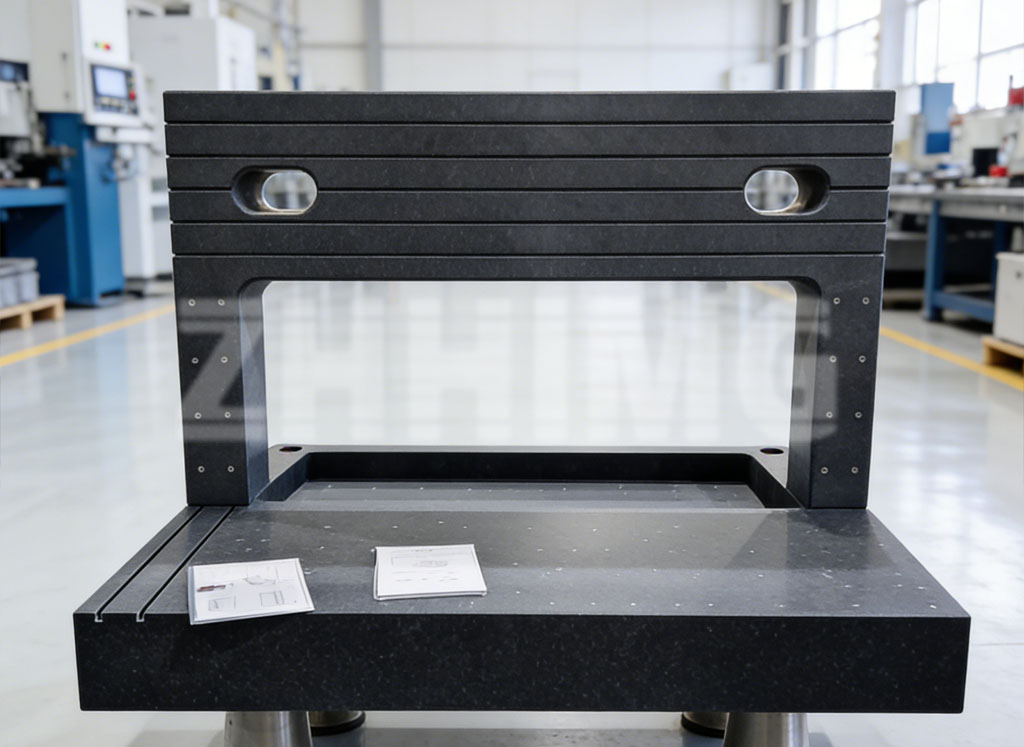
As measurement equipment and CNC grinding get more capable, it’s fair to ask whether hand-finishing is a dying skill or a genuine long-term necessity. The honest answer is probably: both, depending on the part. Standard-sized surface plates in common dimensions are increasingly finished with a higher share of automated process. But large custom beds, complex geometries with air-bearing pockets, or one-off components for research and calibration institutes still lean heavily on operators who can adapt in ways a fixed grinding program can’t.
For buyers, the practical implication is simple: when comparing suppliers, it’s worth asking not just what grinding equipment they use, but how the final finishing stage is done, and how experienced the people doing it are. On the highest-precision components, that’s often where the real difference between suppliers shows up.
Post time: Jul-24-2026