
When purchasing a mineral casting machine base, the overall shape is only part of the specification. Buyers also need to define the embedded components, precision mounting interfaces, support arrangement, and acceptance requirements.
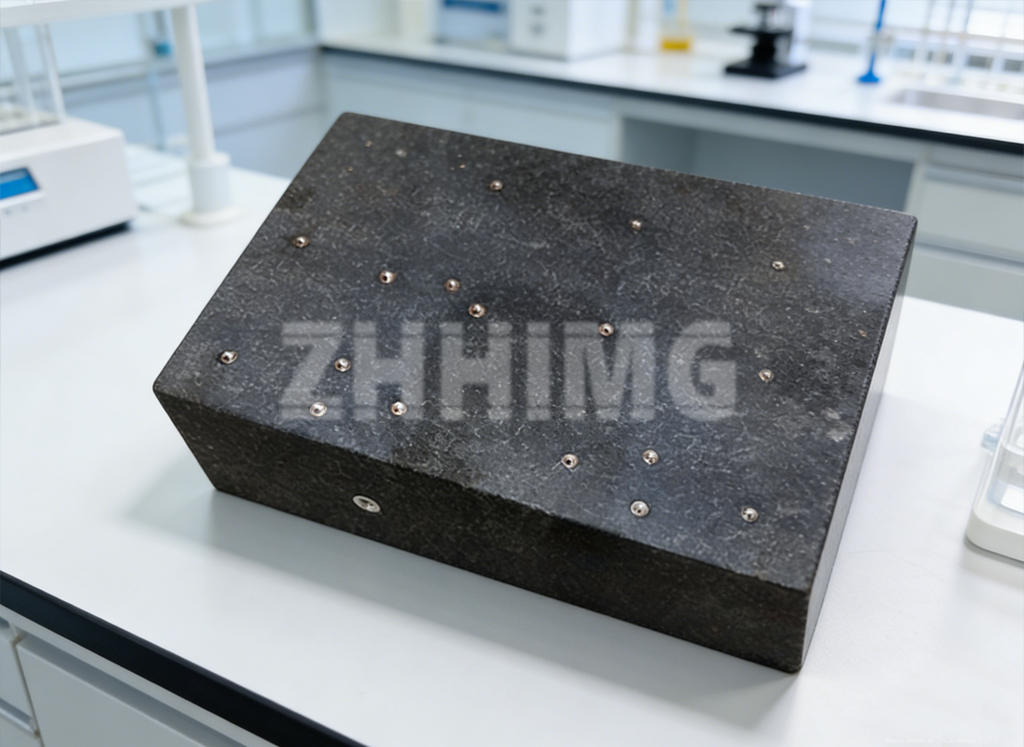
Mineral casting can incorporate threaded inserts, mounting plates, cable routes, and other features within the structure. Precision interfaces may then require additional processing to achieve their specified geometry. These features should be considered during design rather than left until final assembly.
For OEM engineers and procurement teams, a clear request for quotation helps establish what the supplier will manufacture, inspect, and deliver.
This guide explains the information to prepare before ordering a custom mineral casting machine base.
1. Define the Material and Supply Scope
Do not rely on the product name alone to define the material.
In machine-base applications, mineral casting commonly refers to a composite of mineral aggregates and a resin binder. The exact formulation and manufacturing process should be identified for the proposed product.
If your specification uses terms such as “epoxy granite,” “polymer concrete,” or “mineral composite,” ask the supplier to confirm the material system being quoted.
Also distinguish between different delivery scopes:
- A mineral casting body.
- A casting with embedded inserts and mounting plates.
- A base with finished precision interfaces.
- A mechanically assembled module.
- A complete equipment structure with additional components.
These are not equivalent products.
Your RFQ should identify what is included and what remains the customer’s responsibility.
For example:
The required supply scope includes the mineral casting body, embedded threaded inserts, finished mounting interfaces, and dimensional inspection documentation. Linear guides, drive components, and final machine alignment are excluded.
Adjust this statement to match your project.
2. Provide Drawings That Separate Structural and Precision Features
Send the current 2D drawing revision and any available 3D model.
Clearly distinguish:
- General casting geometry.
- Precision mounting surfaces.
- Embedded metal components.
- Threaded inserts.
- Support locations.
- Cable or pipe routes.
- Lifting and handling interfaces.
- Clearance openings.
Not every cast surface needs the same tolerance or finish.
A drawing should show which areas provide structural shape and which establish a functional relationship with other machine components.
Include the relevant datum system so that the supplier understands how critical features will be located and inspected.
If the design is preliminary, mark unconfirmed dimensions and interfaces explicitly.
3. Specify Threaded Inserts in Detail
Threaded inserts should be defined as engineered interfaces, not simply shown as circles on a drawing.
For each insert or insert group, provide:
- Thread type and size.
- Required usable thread depth.
- Location and orientation.
- Position relative to the mounting surface.
- Relevant material requirements.
- Intended fastening or assembly function.
- Applicable loading or tightening requirements.
- Inspection requirements.
Embedded components must be planned within the casting and mould design. Industry guidance notes that their positioning and retention during casting require attention, along with their effect on material flow and mould venting.
For purchasing purposes, ask the supplier to confirm:
- The proposed insert design.
- Whether it is included in the quoted scope.
- How its location will be controlled.
- Which features will be inspected.
- Whether any customer approval is required before production.
If particular inserts are mandatory, provide their drawings or approved specifications.
4. Define Precision Mounting Interfaces Separately
A mineral casting body and a finished precision interface are not the same acceptance item.
Industry manufacturing approaches include machining the composite, finishing embedded metal plates, replication processes, and positioning precision components in a subsequent operation. The appropriate method depends on the design and required result.
Do not assume that the supplier uses a particular method.
Instead, specify the required interface geometry and ask the supplier to explain the proposed manufacturing route.
For each mounting area, identify:
- The component it supports.
- Its dimensions and location.
- Flatness requirements.
- Relationships to other surfaces.
- Hole or insert patterns.
- Required surface texture.
- Any assembly clearance.
- Inspection datums.
For example, two linear-guide mounting areas may need defined relationships to each other and to a reference datum. A general note such as “precision surface” does not communicate those relationships.
5. Review Integrated Channels and Embedded Features Early
Mineral casting designs can include internal routes and embedded elements. Documented applications include cast-in pipes for supply lines and threaded interfaces for other machine components.
If your project requires integrated features, provide:
- Route and cross-section drawings.
- Entry and exit locations.
- Connection details.
- Required clearances.
- Access for assembly and maintenance.
- Applicable cleaning or testing requirements.
Distinguish between:
- An open route for cables.
- A conduit intended to receive cables later.
- An embedded pipe.
- A customer-supplied component incorporated during manufacturing.
These require different information and responsibilities.
If a channel must satisfy a sealing, flow, or pressure requirement, define the test and acceptance criteria rather than assuming a general dimensional inspection will cover it.
6. Describe Loads, Supports, and Operating Conditions
Provide a sketch or drawing showing how the base will be supported and how the machine loads are applied.
Useful information includes:
- Support locations and contact areas.
- Equipment masses and their positions.
- Moving assemblies and travel ranges.
- Relevant operating forces and moments.
- Fastening arrangements.
- Installation interfaces.
- Operating and storage conditions.
- Exposure to fluids or cleaning agents.
If stiffness, deflection, vibration behaviour, or thermal performance is a contractual requirement, define how it will be evaluated.
Do not substitute a generic material-property claim for a project-specific performance requirement.
For example, “good vibration damping” is a product description. A requirement tied to an agreed load case, analysis, or test is a more useful basis for engineering acceptance.
Also distinguish component requirements from completed-machine performance.
7. Confirm Tooling and Design-Change Responsibilities
For a custom mineral casting project, discuss tooling before placing the order.
Ask the supplier to identify:
- Whether new tooling is required.
- Which tooling charges are included.
- Who owns the tooling.
- How tooling will be stored.
- The approval process before production.
- How design revisions will be handled.
- Any charges or schedule effects associated with changes.
Do not assume that ownership, storage, or modification rights are included unless they are stated.
If the project begins with a prototype and may move to repeat production, explain the anticipated sequence. Keep forecast demand separate from committed order quantities.
A clear agreement helps both teams understand what is covered by the initial quotation.
8. Create an Acceptance Plan Before Manufacturing
An acceptance plan should connect each critical requirement to an inspection or test.
The acceptance scope should be agreed before production—not reconstructed after the base arrives.
A practical plan may include:
| Acceptance item | What to define |
|---|---|
| Product identification | Part number, revision, and required traceability |
| Overall geometry | Dimensions to be checked and applicable limits |
| Threaded inserts | Thread specification, location, orientation, and required checks |
| Precision interfaces | Geometric tolerances, datum references, and measurement extent |
| Embedded features | Required checks for location, continuity, or function |
| Visual condition | Defined criteria for specified surfaces and edges |
| Documentation | Report format, recorded results, and required supporting records |
If a conformity statement is required, agree on how measurement uncertainty will be considered and which decision rule applies.
Also clarify whether the customer will witness inspection, review reports before shipment, or carry out a separate receiving inspection.
9. Request Inspection Results, Not Only a General Certificate
A statement that the base has “passed inspection” may not provide all the evidence your quality team requires.
Specify which measured results must appear in the report.
Depending on the project, request:
- Identification of the inspected component.
- Drawing revision.
- Inspected features.
- Nominal values and acceptance limits.
- Actual measurement results.
- Datum references.
- Relevant measurement conditions.
- Instrument identification.
- Approved deviations, if any.
Material documentation and dimensional inspection serve different purposes. If both are required, list them separately.
For assemblies, distinguish the inspection of the casting from alignment or testing performed after additional components are installed.
10. Include Handling, Packaging, and Delivery Requirements
The RFQ should address how the finished base will reach your site.
Provide:
- Delivery destination.
- Requested delivery terms.
- Receiving-site access limitations.
- Unloading arrangements.
- Packaging restrictions.
- Required shipping documents.
- Protection requirements for precision surfaces and interfaces.
Ask the supplier to identify the intended lifting and handling provisions. Do not assume that every embedded attachment point is approved for lifting.
Where special transport or installation arrangements are required, resolve them before shipment.
Also agree on how the component will be identified and how loose accessories, inspection records, and assembly instructions will be supplied.
How to Compare Mineral Casting Machine Base Quotations
Before comparing prices, confirm that each supplier has quoted the same technical and commercial scope.
Review:
- Material identification.
- Drawing revision.
- Tooling.
- Embedded inserts and plates.
- Finished precision interfaces.
- Secondary processing.
- Inspection and documentation.
- Assembly work.
- Packaging and delivery responsibilities.
Ask each supplier to list assumptions, exclusions, and proposed alternatives separately.
A casting-only quotation should not be compared directly with an offer that includes finished interfaces, inspection, and assembly.
The objective is to compare equivalent deliverables rather than similar product descriptions.
Copy-and-Use RFQ Template
Subject: RFQ — Custom Mineral Casting Machine Base
Dear ZHHIMG Team,
Please review the attached drawings and provide a quotation for the following project.
Application:
Part number and drawing revision:
Project stage:
Order quantity:
Overall dimensions:
Required material specification, if defined:
Required supply scope:
Threaded inserts and embedded components:
Precision mounting interfaces:
Critical dimensions and geometric tolerances:
Integrated channels or pipework:
Load and support arrangement:
Operating conditions:
Tooling requirements:
Inspection and documentation requirements:
Packaging and handling requirements:
Delivery destination and terms:
Requested schedule:Please identify missing information, technical exceptions, tooling charges, and assumptions included in your quotation.
Discuss Your Mineral Casting Project with ZHHIMG®
ZHONGHUI Group offers mineral casting machine bases as part of its precision manufacturing product range.
For a project inquiry, send your current drawings, interface requirements, loading information, quantity, and inspection criteria.
If the design is still under development, identify which requirements are confirmed and which remain open for review. This gives both teams a clearer starting point for discussing the structure, manufacturing scope, and acceptance plan.
Post time: Oct-29-2026