
The base material of an ultra-precision machine affects more than the machine’s appearance or total weight. It influences vibration behavior, thermal drift, guideway alignment, assembly complexity, serviceability, and long-term measurement reliability.
Mineral casting and natural granite are both established choices for stationary precision machine structures. Both can provide useful damping, low thermal conductivity, corrosion resistance, and stable support for rails, motors, optical systems, air bearings, encoders, and fixtures. Their production methods and design strengths are different.
Natural granite is cut from selected stone and then machined, ground, lapped, drilled, and assembled into precision components. Mineral casting, also called polymer concrete or epoxy granite, is an engineered aggregate-and-resin composite that is cast into a mold and cured at relatively low temperature.
Neither material is automatically the best choice for every ultra-precision machine. The correct selection depends on the required geometric accuracy, machine size, heat sources, moving mass, integrated functions, production volume, assembly strategy, inspection method, and operating environment.
Granite Creates a Stable Reference Structure
Precision granite components are widely used for CMM bases, metrology platforms, semiconductor inspection equipment, optical systems, granite air-bearing structures, laser machines, guideway supports, precision fixtures, and custom machine assemblies.
Granite offers several practical advantages for stationary reference structures:
- Low thermal conductivity, which slows the movement of localized heat through the component.
- Relatively low thermal expansion compared with common structural metals.
- Natural vibration damping.
- High mass, supporting resistance to external disturbance.
- Corrosion resistance without painting or oiling.
- Non-magnetic and electrically insulating behavior.
- Precision ground and hand-lapped reference surfaces.
- No foundry-related residual stress from casting or welding.
Natural granite commonly has a coefficient of thermal expansion in the approximate range of 4–8 × 10⁻⁶/°C, although the actual result depends on mineral composition and should be confirmed for the selected material. This stable thermal response makes granite particularly useful in measurement systems where rail alignment, encoder position, sensor geometry, and fixture location must remain consistent.
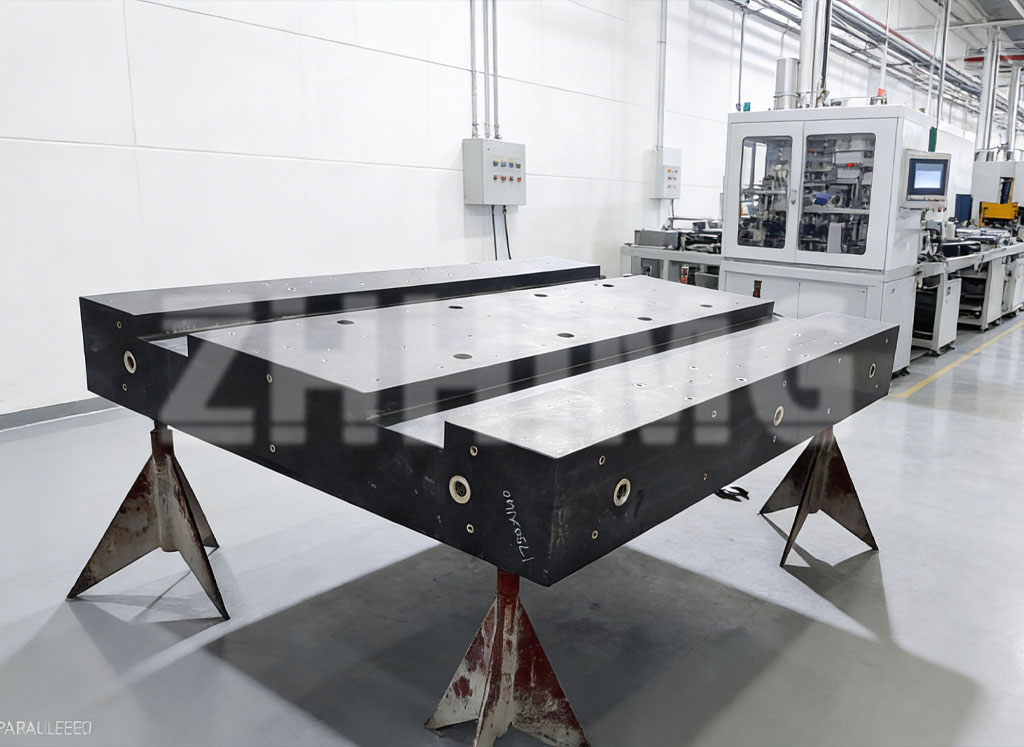
Granite is especially strong when the machine needs a large, flat, straight, parallel, or square mechanical datum. A granite base can be machined with guideway surfaces, threaded inserts, locating holes, air-bearing faces, mounting pockets, and reference planes. These features can be inspected directly against the functional geometry of the completed machine.
Precision granite also supports a modular assembly approach. Large machines can use granite bases, beams, columns, bridges, and rail supports that are manufactured separately and then assembled into a controlled structure.
Mineral Casting Supports Integrated Design
Mineral casting is an engineered composite of mineral aggregates and a polymer resin binder. The material is poured into a mold and cures at room or moderate temperature. This process makes it possible to create near-net-shape machine structures with internal features already incorporated.
A mineral casting base can include:
- Threaded inserts and steel mounting plates
- Cable ducts and conduits
- Cooling channels
- Leveling points
- Reinforcement elements
- Sensor mounts
- Service openings
- Internal cavities and complex rib geometry
This design flexibility is one reason mineral casting is used for high-speed CNC machines, grinding systems, laser equipment, automation platforms, and precision production machinery. Mineral casting can combine substantial mass with high damping and complex integrated functions that would require more machining and assembly work in natural granite.
The damping capability of mineral casting is often a major benefit. The resin binder and aggregate interfaces help dissipate vibration energy. Published supplier data reports that certain mineral-cast formulations can offer damping significantly higher than grey cast iron, although exact performance varies with formulation, frequency range, test method, and the geometry of the complete machine.
For dynamic equipment, high damping can reduce resonance and shorten settling time after acceleration, cutting forces, scanning movement, or direction changes. That can support more consistent machining, surface finish, optical imaging, and measurement cycles.
Thermal Stability Has Different Meanings
Both materials can provide good thermal behavior, but they should not be evaluated using a single claim such as “low thermal expansion.”
Granite typically has a lower coefficient of thermal expansion than steel and cast iron. Its low thermal conductivity also means localized heat does not move through the structure quickly. This is useful for metrology and semiconductor equipment, where even small temperature gradients can change the relationship between guideways, scales, sensors, and workpieces.
Mineral casting generally has low thermal conductivity and considerable thermal inertia. Some mineral-cast materials can absorb more heat energy before changing temperature and transfer heat more slowly than cast iron. Certain formulations, however, may have thermal expansion behavior closer to steel or iron because of their aggregate and resin composition.
This can be beneficial when a mineral-cast base is coupled to steel rails, motors, or mechanical subassemblies. The reduced mismatch in expansion behavior may reduce stress at mounting interfaces during temperature changes.
The right material choice depends on the thermal objective:
| Thermal requirement | Often suitable material direction |
|---|---|
| Stable metrology datum with low expansion | Natural granite |
| Slow response to short-term heat input | Granite or mineral casting |
| Integrated cooling channels and embedded elements | Mineral casting |
| Large optical or semiconductor reference structure | Natural granite |
| Industrial equipment with variable ambient conditions | Mineral casting or granite, based on the full heat-load design |
| Hybrid steel-machine structure requiring compatible interfaces | Mineral casting may offer advantages |
No base material can compensate for poor thermal design. Motors, spindles, lighting, linear drives, cooling lines, vacuum systems, cable carriers, and airflow must still be positioned and managed carefully.
Vibration Damping Is Only Part of the Decision
Both granite and mineral casting can help control vibration, but machine performance depends on the complete structural system.
Granite provides natural damping and substantial mass. It is especially effective as a stable stationary foundation for metrology, optical measurement, semiconductor inspection, laser systems, and air-bearing platforms. The material can reduce the influence of floor-borne vibration and motion-induced disturbance when paired with properly designed guideways and support points.
Mineral casting can provide very high damping and can be molded into complex geometries that manage structural resonances. It is often well suited to high-speed CNC, grinding, dispensing, automated assembly, and production machinery where integrated functions and dynamic behavior are major concerns.
Neither option should be selected only from a quoted damping ratio. Rail mounting faces, joint design, moving mass, motor location, cable routing, floor support, leveling method, and control tuning all influence vibration response.
Comparison for Buyers
| Selection factor | Natural granite | Mineral casting |
|---|---|---|
| Material type | Natural stone | Engineered mineral-resin composite |
| Manufacturing method | Cutting, machining, grinding, lapping and assembly | Molding, curing and finish machining |
| Primary strength | Stable precision reference geometry | High damping with integrated design freedom |
| Precision surfaces | Directly ground and lapped | Usually post-machined or fitted with precision interfaces |
| Internal channels | Require machining or assembly | Can be integrated during casting |
| Threaded interfaces | Added through inserts and machined features | Inserts can be cast into the structure |
| Thermal expansion | Generally low; material-specific | Formulation-specific; may be closer to metal structures |
| Typical applications | CMMs, optics, semiconductor, laser, air bearings and metrology | CNC, grinding, automation, high-speed machinery and complex machine beds |
| Main design consideration | Handling mass, joints, insert layout and transport | Mold design, cure control, material formulation and post-casting accuracy |
Consider a Hybrid Structure
The most effective solution is sometimes hybrid.
A machine may use mineral casting for a complex main bed with integrated cooling passages and heavy damping. Precision granite rails, guideway supports, or metrology references can then be added where controlled flatness, straightness, or long-term geometric stability is most important. A granite base may also be combined with metal inserts, ceramic components, air bearings, or carbon-fiber moving beams.
At ZHHIMG®, both precision granite components and mineral casting structures can be evaluated for custom equipment projects. This allows the discussion to focus on the machine’s actual function rather than forcing every design into one material solution.
Choose by Function, Not Fashion
Choose natural granite when the machine requires large, stable precision datums, strong thermal stability, non-magnetic behavior, corrosion resistance, and precision-lapped reference surfaces. It is often well suited to CMMs, semiconductor inspection platforms, optical systems, laser measurement equipment, and air-bearing assemblies.
Choose mineral casting when the design needs high damping, complex near-net-shape geometry, embedded cooling or cable channels, integrated inserts, and a machine base optimized for industrial dynamic operation.
For ultra-precision machines, the right base material is the one that manages the largest real-world errors in the complete system. A clear error budget, defined thermal environment, controlled interfaces, realistic inspection plan, and experienced manufacturing partner will matter more than any single material claim.
Post time: Aug-18-2026