
1. Multi-part assembled structure: layer-by-layer error accumulation and poor precision controllability
Traditional machine bases mostly use split design. Bases, columns, worktables and gantries are machined as separate pieces and fastened together. Micron-level deviation on a single part may seem negligible, yet every additional joint surface introduces a new source of error. Clearance of locating pins, local stress induced by bolt tightening and minor flatness deviation on mating surfaces all stack up. More parts and longer assembly chains lead to larger cumulative errors. In addition, uneven load distribution and temperature variation may trigger tiny sliding between mating interfaces. After long operation, positioning repeatability gradually deteriorates. Maintaining sub-micron accuracy requires massive working hours for repeated fitting, leveling and re-measurement. Assembly and commissioning costs stay high, while consistency is hard to guarantee, resulting in obvious accuracy differences among machines in mass production.
2. Monolithic granite structure: eliminate joint interfaces and cut off error transfer
ZHHIMG monolithic granite mechanical systems are machined from a single high-density granite blank. Base, gantry, mounting steps, T-slots and sensor reference surfaces are all formed on one stone block. There are no split seams and no assembly of separate structural components. The whole mechanical system has one unified benchmark. All critical positioning surfaces are produced in one clamping setup under the same machining coordinate system, without conversion deviation between benchmarks of different parts. Without mating joints, error sources such as assembly clearance, bolt stress and interface slip are removed. The path for errors to transfer and amplify step by step is blocked fundamentally, so the overall geometric accuracy stays close to the calibrated level after machining.
3. Lower assembly stress and avoid hidden deformation later
When tightening bolts for split assemblies, preload stress is introduced around joint areas. These invisible stresses release gradually during machine operation, temperature fluctuation and load change, causing tiny deformation of reference surfaces and slow accuracy drift. Many machines pass factory acceptance tests but lose precision after field operation, largely due to the release of assembly stress. ZHHIMG monolithic granite components undergo extended natural aging and artificial stress relief to fully release internal stone stress. The monolithic structure carries no assembly preload stress from joints. Under variable load and minor temperature fluctuation, hidden deformation induced by stress release at split joints will not occur. The geometric status of benchmarks remains stable for long-term service and reduces risks of later accuracy drift.
4. Simplify machine assembly and improve batch consistency of equipment
Split structures involve complicated assembly procedures. Each machine requires separate adjustment, fitting and repeated calibration, heavily relying on manual experience. Accuracy inconsistency easily occurs among different batches. With ZHHIMG monolithic granite mechanical systems, equipment manufacturers can greatly cut assembly workload. Fitting, grinding and alignment of multiple base components are no longer required. Motion components including linear motors, guideways and optical scales can be mounted directly. Fewer variables in assembly reduce uncertainty brought by manual commissioning. Machine repeatability and batch consistency are significantly improved, shortening assembly and commissioning cycles and accelerating mass production of new products. 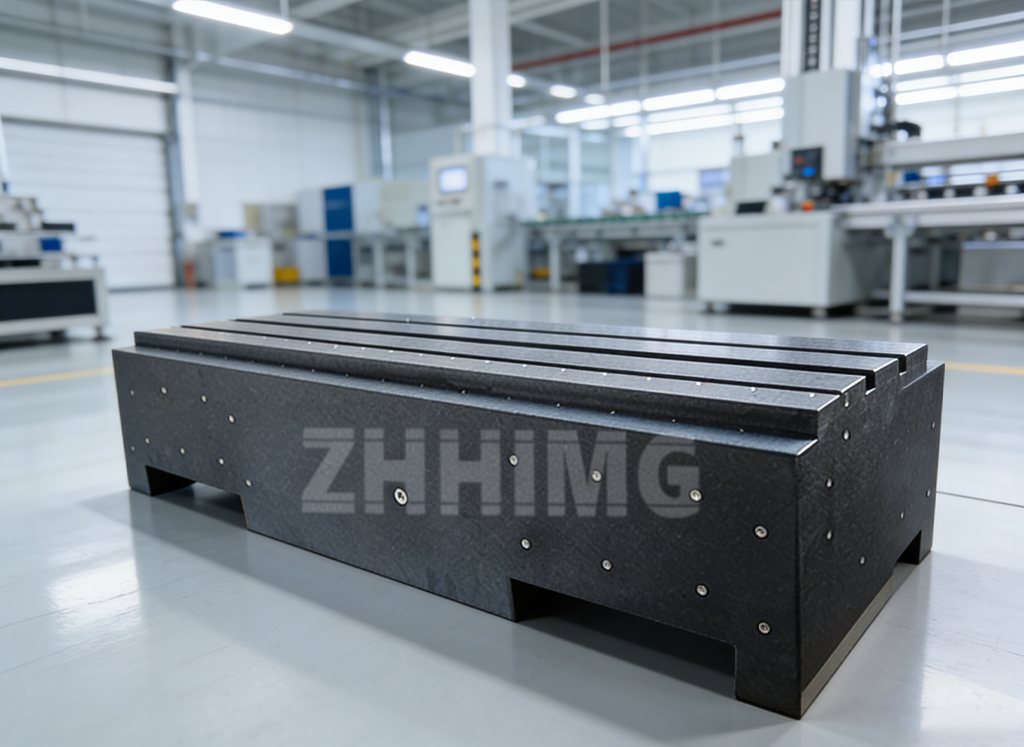
5. Applicable scenarios for monolithic structures
Monolithic granite mechanical systems are ideal for applications demanding high geometric accuracy and repeat positioning performance: optical scanning stages, wafer inspection equipment, high-precision CMMs, laser micromachining machines and linear motor motion platforms. These devices have strict requirements for straightness, squareness, flatness and orthogonality. Even small cumulative errors will directly affect machining or inspection results. Nevertheless, monolithic solutions are limited by raw stone size and machining travel. Optimized split designs will be adopted for extra-large structures. ZHHIMG evaluates monolithic or optimized split schemes according to machine travel and accuracy requirements to balance cost, dimension and precision.
Conclusion
Cumulative assembly error is an inherent drawback of multi-part split structures. Featuring one-piece forming from natural stone, ZHHIMG monolithic granite mechanical systems reduce joint interfaces, eliminate benchmark conversion errors and avoid assembly preload stress, greatly lowering error stacking caused by multi-component assembly. Besides improving overall geometric accuracy, they simplify commissioning and enhance batch consistency of equipment. Precision machines can easily maintain sub-micron geometric benchmarks stably, making monolithic granite an important structural solution for ultra-precision equipment to reach ultimate accuracy.
Post time: Sep-18-2026