
As precision equipment develops toward special dimensions, special‑shaped structures and multi‑function integration, standard‑size granite tables can no longer satisfy all equipment development requirements, and the application proportion of custom‑made non‑standard granite tables keeps rising. Non‑standard products are individually manufactured according to equipment drawings in terms of dimensions, openings, mounting interfaces and functional structures, bringing higher design flexibility. Meanwhile, numerous easily‑overlooked risks are introduced. In many projects, only outline drawings and nominal accuracy are confirmed, while critical conditions such as stone material property constraints, process limits, assembly matching and working‑condition adaptability are neglected. Consequently, finished products suffer insufficient structural strength, unmanufacturable features, assembly interference and progressive accuracy degradation during long‑term service, resulting in project delays and cost losses. Drawing on rich practical experience of non‑standard granite components, ZHHIMG sorts out core easily‑ignored requirements in non‑standard customization. It safeguards practical service performance of non‑standard products from multiple dimensions: preliminary scheme review, material adaptation, structural technology, tolerance allocation and inspection verification.
Feasibility review for stone‑material processing on drawing documents constitutes the indispensable first step for non‑standard customization. Mechanical designers draw drawings mainly based on overall equipment functions and are often unfamiliar with the process boundaries of granite, a brittle non‑metallic material. Structures such as tiny overhanging thin walls, narrow ribs, densely‑packed openings and sharp notches can be realized on metal parts. Restricted by granite brittleness, however, chipping and hidden cracks tend to occur during processing, lapping, transportation and assembly. Many non‑standard orders are directly put into production according to equipment drawings without stone‑oriented structural optimization. Rework and drawing revision become necessary only when unworkable structures are found in processing. Upon receiving non‑standard demands, ZHHIMG carries out independent drawing process review. Optimization suggestions are provided for high‑risk structures including sharp corners, thin walls, deep holes and cantilevers, such as adding fillet transitions, reinforcing weak sections and adjusting hole layout. Structures are adapted to granite material properties without compromising overall equipment functions so as to eliminate design defects at the source.
Material selection must fit practical working conditions of non‑standard products, and general‑purpose stone shall not be applied indiscriminately. Non‑standard tables feature diverse shapes: some are large‑span special‑shaped frames, some require non‑magnetic performance, some bear heavy loads continuously, and others operate in workshops with drastic temperature fluctuations. Different working conditions impose differentiated requirements on mineral composition, density and thermal expansion coefficient of granite. To simplify workflows, some customization projects directly adopt universal black granite and ignore material demands for special operating conditions. For instance, if raw blocks with low ferromagnetic‑impurity content are not screened for non‑standard tables used in weak‑magnetic inspection, finished parts will carry weak residual magnetism. If large‑span slender non‑standard components are made of stone with insufficient compactness, slow creep deformation will emerge over time. ZHHIMG matches corresponding raw blocks according to service scenarios, load conditions and environmental conditions of non‑standard parts. Incoming screening for mineral composition, magnetic susceptibility and thermophysical parameters is added for products with special requirements. One single stone grade is never used for all non‑standard projects.
Reasonable tolerance allocation for non‑standard components is a frequently‑overlooked key point. Many customers apply the highest‑grade accuracy to all positions of non‑standard tables, without distinguishing functional reference surfaces from non‑assembly auxiliary surfaces. Indiscriminately tightening all tolerances greatly raises processing difficulty and manufacturing costs and prolongs delivery cycles. On the contrary, excessively loose tolerances for key assembly benchmarks lead to excessive accumulated errors in subsequent overall‑machine assembly. For non‑standard granite tables, differentiated tolerance setting shall be implemented by distinguishing core working reference surfaces, embedded hole positions, mounting locating surfaces and non‑critical outline surfaces. Combined with actual equipment assembly logic, ZHHIMG helps customers identify core control dimensions and items where tolerances can be moderately relaxed. It balances accuracy targets, costs and delivery cycles and avoids two types of problems: excessive accuracy surplus or insufficient tolerances at key positions.
Stress control for non‑standard structures is more complex than that for standard tables. Non‑standard products often feature abrupt thickness changes, dense local openings and special‑shape cutting, which result in uneven internal stress distribution of stone. Even if raw blocks complete aging treatment, new processing stress will be generated after extensive special‑shape cutting. If simple aging procedures for standard parts are copied without releasing newly‑generated stress, stress will be released slowly in later service and cause flatness drift. For special‑shaped non‑standard parts, ZHHIMG adopts segmented processing‑aging cycles. After rough‑machining special‑shape contours, static stress‑relief cycles are reserved to release cutting‑induced processing stress before semi‑finishing and finishing procedures. All finishing work for large‑size special‑shaped parts is completed in constant‑temperature‑humidity workshops to avoid deformation risks caused by superposition of environmental disturbance and special‑shaped structures.
Process constraints for special functional structures such as embedding, grooves and special‑shaped interfaces. Many non‑standard granite tables integrate a large number of threaded bushings, locating pin sleeves, weight‑reduction grooves, avoidance grooves and stepped surfaces. Over‑deep and over‑narrow weight‑reduction grooves shall be avoided, as excessively thin groove walls are prone to cracking. Hole‑edge distance and sleeve selection for embedded metal fittings shall be recalculated according to plate thickness of non‑standard parts; empirical parameters for standard parts cannot be directly adopted. Every embedded hole position and groove structure of non‑standard parts affects local stone strength. During customization, ZHHIMG reviews all special structures simultaneously and evaluates influences of weight reduction, openings and embedding on overall rigidity. Local structures are adjusted when necessary. Processing sequences for embedding and grooving are clearly defined. Drilling and grooving shall never be performed after lapping reference surfaces, otherwise well‑formed high‑precision benchmarks will be damaged.
Special inspection schemes for non‑standard parts shall not copy inspection modes for standard surface plates. Standard granite surface plates have mature fixed inspection workflows. For special‑shaped and asymmetric non‑standard tables with multiple features, reference positions change, and copying conventional inspection points leads to distorted accuracy evaluation. Apart from conventional geometric dimension inspection, inspection points for non‑standard parts shall be customized according to actual assembly benchmarks specified in drawings. Special tests are carried out for special‑shaped contours, stepped surfaces and position‑related as well as perpendicularity‑related parameters of embedded holes. All measuring instruments are traceable to national metrology systems, and verification is completed in compliance with DIN, ASME, GB and other international metrology standards. For large‑size special‑shaped non‑standard products, inspections are performed under simulated actual supporting‑force conditions. This prevents qualified inspection results under free‑lying conditions from shifting after installation‑induced deformation. 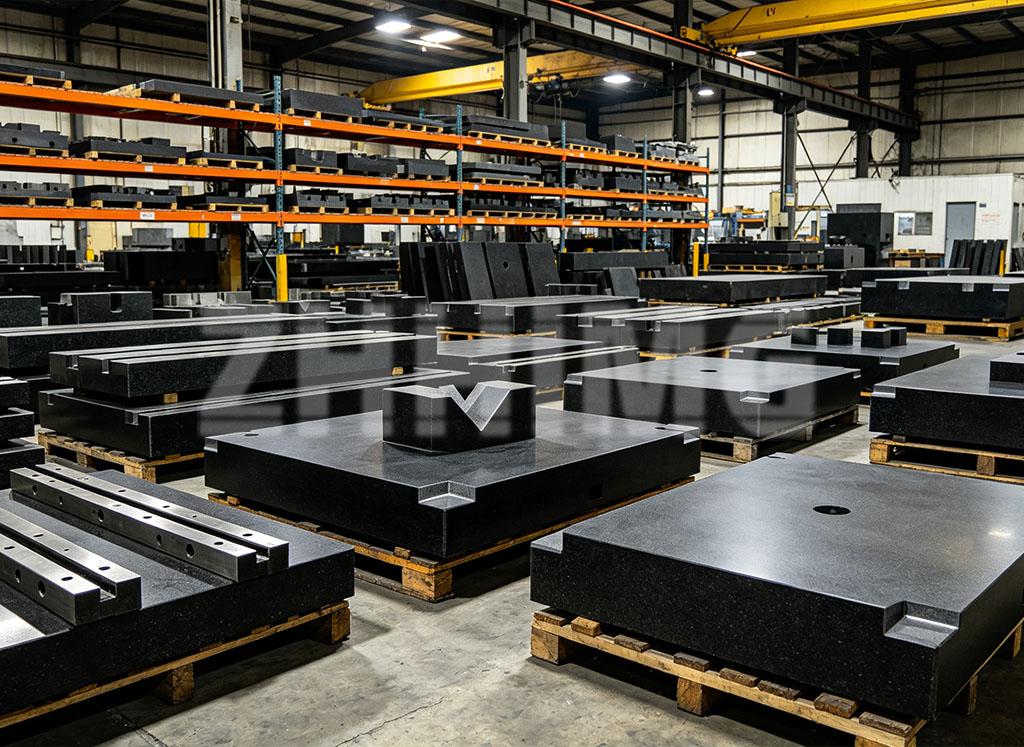
Complete delivery of factory‑issued technical documents also constitutes a neglected link in non‑standard customization. Standard products have fixed parameters, while non‑standard components feature unique attributes including actual material reports, key inspection data, support‑point suggestions, hoisting guidelines and assembly tightening‑torque instructions. Without such documents, improper operations during subsequent installation, transportation and calibration may cause component damage. Leveraging industry‑university‑research cooperation with universities and metrology institutions, ZHHIMG supplies matching technical documents for each custom‑made non‑standard granite table and provides technical guidance for hoisting, installation and operation. The company holds ISO three‑system certifications, CE and CNAS qualifications together with more than 20 international patents and trademarks. Adhering to the commitment of “no cheating, no concealment, no misleading”, ZHHIMG truthfully informs customers of process limits for non‑standard structures and rejects unreasonable requirements exceeding physical boundaries of stone materials.
Non‑standard granite tables are widely applied in custom semiconductor equipment, special‑purpose testing instruments, dedicated laser equipment and custom laboratory platforms. Non‑standard customization means far more than simply manufacturing according to drawings; it represents a systematic workflow integrating design, material selection, processing, inspection and technical services. Upholding its quality policy “For precision‑oriented business, no pursuit of perfection is excessive”, ZHHIMG pays close attention to every implicit constraint in non‑standard projects, helps customers avoid various potential risks brought by customization, and delivers reliable non‑standard granite benchmark solutions for diverse special‑purpose equipment.
Post time: Sep-07-2026