
Semiconductor inspection equipment imposes extremely stringent dual requirements on the environment and base materials. On one hand, precision sensors, optical imaging elements and probe modules inside the equipment are highly susceptible to magnetic interference. Faint magnetism can cause probe offset and imaging distortion, directly leading to false inspection judgments. On the other hand, production lines contain cooling moisture and trace chemical volatiles. Metal components tend to rust after long-term service, and rust debris will contaminate wafers and optical assemblies. With natural non-magnetic and rust-free properties, granite structural components perfectly match the special working conditions of semiconductor inspection production lines and serve as an ideal base solution for semiconductor precision equipment.
Conventional metal bases such as steel and cast iron are inherently magnetic. Even after demagnetization treatment, the material will gradually develop residual magnetism under long-term power supply and electromagnetic coils. Such residual magnetic fields interfere with high-precision displacement sensors, photoelectric detection units and precision probe stations in semiconductor inspection equipment. Once the magnetic field affects probe positioning, the test data of tiny circuits on wafers will deviate, resulting in false acceptance or missed detection of good products. ZHHIMG high-density black granite is a natural silicate mineral with no magnetism of its own. There is no magnetization or residual magnetism issue. No extra demagnetization procedures are required throughout the whole process from raw blanks to finished components. The base itself generates no magnetic interference to ensure stable operation of probes and optical sensors.
Rust is another hidden hazard in semiconductor workshops. When metal bases are exposed to workshop moisture, cooling fluid and trace corrosive volatile media, they gradually oxidize and rust. Rust debris consists of hard fine particles. Once peeled off and falling onto wafers, lenses or inspection chambers, it will scratch wafer surfaces and contaminate optical lenses, causing high costs of product scrap and equipment maintenance. Granite is a chemically inert mineral and will not undergo electrochemical oxidative rusting. The stone features dense crystals and ultra-low porosity. Moisture and trace chemical media only stay on the component surface instead of penetrating into the substrate. Simple wiping is sufficient for daily cleaning. Regular anti-rust coating spraying is unnecessary, preventing volatile anti-rust oil from contaminating clean workshop environments and meeting the control standards of semiconductor cleanrooms.
Semiconductor inspection equipment usually integrates linear motor motion stages, AOI visual inspection, X-ray flaw detection and other modules. Apart from non-magnetic and rust-free features, the base also needs high rigidity and low thermal expansion. ZHHIMG granite components are integrally machined from single stone blanks without splicing or bonding to avoid contamination risks from adhesive layers. Precision lapping is completed in a constant-temperature clean workshop. The finished reference surface is clean and dense and hardly sheds dust. When the XY motion stage moves back and forth at high speed, the granite base will not be magnetized by movement. Meanwhile, it absorbs internal vibration relying on the material’s high damping property to guarantee stable imaging and inspection. 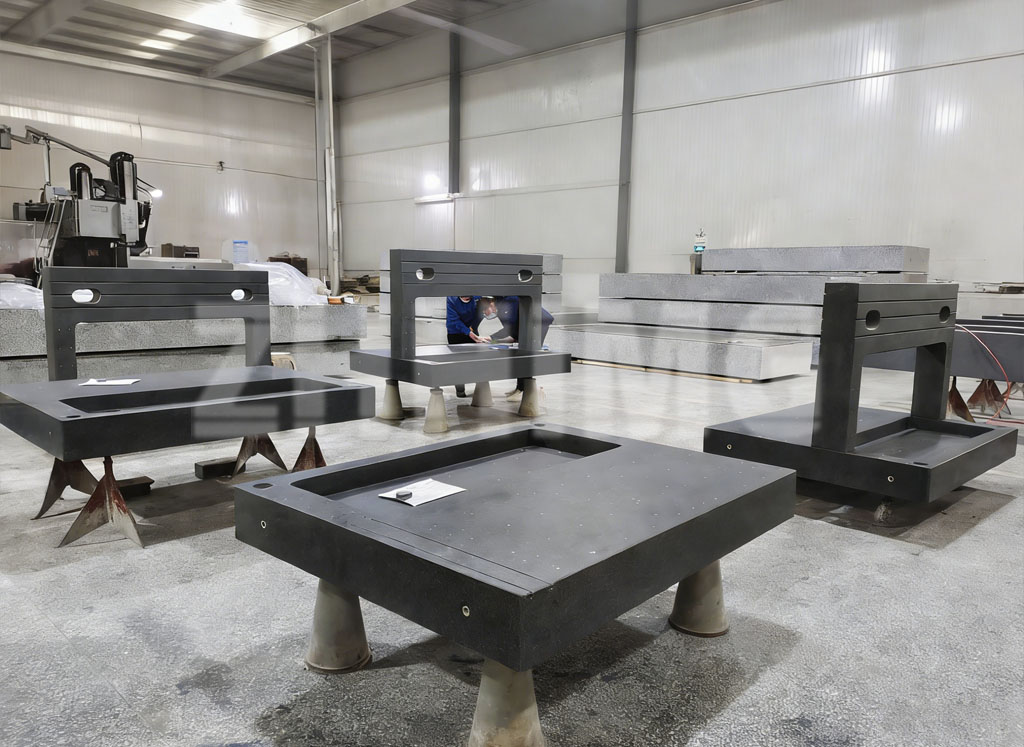
Many semiconductor equipment manufacturers worry that internal fissures in ordinary stone easily trap dirt and become pollution sources in clean workshops. ZHHIMG raw stone blanks go through sufficient aging screening, and raw materials with native fissures are eliminated. After machining, full inspection is conducted with complete imported metrology instruments to confirm no internal microcracks inside components. Fine polished surfaces reduce adhesion of tiny particles, lowering the risk of particulate contamination in cleanrooms and satisfying particle control requirements of semiconductor workshops.
Granite components still have usage limits. Although non-magnetic and rust-free, violent impact from sharp hard objects will cause chipping on the surface. Long-time immersion in highly concentrated strong corrosive chemicals will slowly damage crystal boundaries. Stable long-term operation can be achieved with proper usage.
Low-cost marble on the market has abundant pores and easily releases dust, making it unsuitable for semiconductor clean production lines. ZHHIMG consistently selects premium black granite with a density of 3100kg/m³ and rejects porous marble. Our products comply with multiple international metrology standards. In semiconductor equipment such as AOI, X-ray inspection and wafer probe testing, non-magnetic and rust-free granite structural components avoid inspection errors induced by magnetic interference and eliminate particulate pollution caused by metal rust, continuously ensuring stable operation of semiconductor inspection equipment.
Post time: Sep-10-2026