
In semiconductor manufacturing and precision inspection industries, requirements for equipment environmental purity extend to magnetic fields. Many R&D teams discover during commissioning that weak magnetism from the substrate quietly interferes with wafers, optical sensors and motion actuators, causing measurement jumps, unstable positioning and unreliable chip inspection results. Made of naturally non-magnetic minerals, ZHHIMG non-magnetic granite mechanical systems build benchmark carriers with low magnetic interference and meet stringent requirements of semiconductor and precision inspection equipment from the hardware substrate.
1. Magnetic interference: an easily overlooked hidden error source in semiconductor equipment
Processes such as semiconductor wafer inspection, optical microscopic scanning and probing tests are highly sensitive to magnetic environments. Machine beds made of ferromagnetic materials will alter surrounding magnetic field distribution. When linear motors, magnetic encoders and laser optical readheads are mounted on such bases, the substrate’s magnetic conductivity distorts magnetic circuits and introduces signal noise. Thin-film structures and tiny circuit components on wafers can also be affected by stray magnetic fields. Minor magnetic disturbance changes the local electromagnetic state of samples, triggering random drift in inspection data and leading to misjudgment of yield. Traditional metal beds require multi-layer magnetic shielding, which increases overall weight and brings new precision risks caused by mismatched thermal expansion of different materials.
2. Non-magnetic granite builds a clean benchmark platform
ZHHIMG selects non-magnetic granite raw stone without magnetizable ferromagnetic minerals. After machining, the complete mechanical system cannot be magnetized and generates no stray magnetic fields. Bases, gantries, worktables and sensor reference surfaces are processed integrally to maintain magnetic neutrality for the whole benchmark. The platform neither attracts suspended metal dust in workshops nor distorts electromagnetic fields of linear motors. The magnetic field between motor mover and stator runs fully as designed, thrust ripple is suppressed, and motion stages operate more smoothly without nanoscale jitter caused by magnetic distortion.
3. Compatible with optical inspection and sensing modules to stabilize measurement signals
Precision optical inspection equipment is equipped with optical scales, laser interferometers and high-speed optical cameras. Such sensing assemblies are sensitive to magnetic noise. Magnetic disturbance from conductive substrates causes reading jumps and lower signal-to-noise ratio, reducing consistency of repeated measurements. When optical sensors and readheads are mounted on ZHHIMG non-magnetic granite reference planes, the magnetic field around sensors will not be disturbed by the base. Collected optical signals become cleaner and more stable. It reduces pressure on post-processing software compensation algorithms, lowers false detection and false alarm rates, guarantees consistency of repeated scanning results and meets requirements of precision metrology and defect inspection.
4. Reduce metal dust adsorption and maintain clean semiconductor workstation environment
Although semiconductor workshops are equipped with cleaning systems, tiny metal chips and abrasive dust may still be generated. Ordinary ferromagnetic beds attract metal particles. Dust accumulating on guideways, optical scales and air gaps will scratch precision working surfaces and contaminate wafer inspection areas over long operation. Surfaces of ZHHIMG non-magnetic granite do not attract ferromagnetic dust. Dust settles only by gravity and can be easily removed by blowing and wiping. In cleanrooms, accumulation of metal particles on motion pairs and reference surfaces is minimized, protecting air bearing guides, optical scales and reducing risks of wafer contamination, complying with cleanroom control standards for semiconductor workstations. 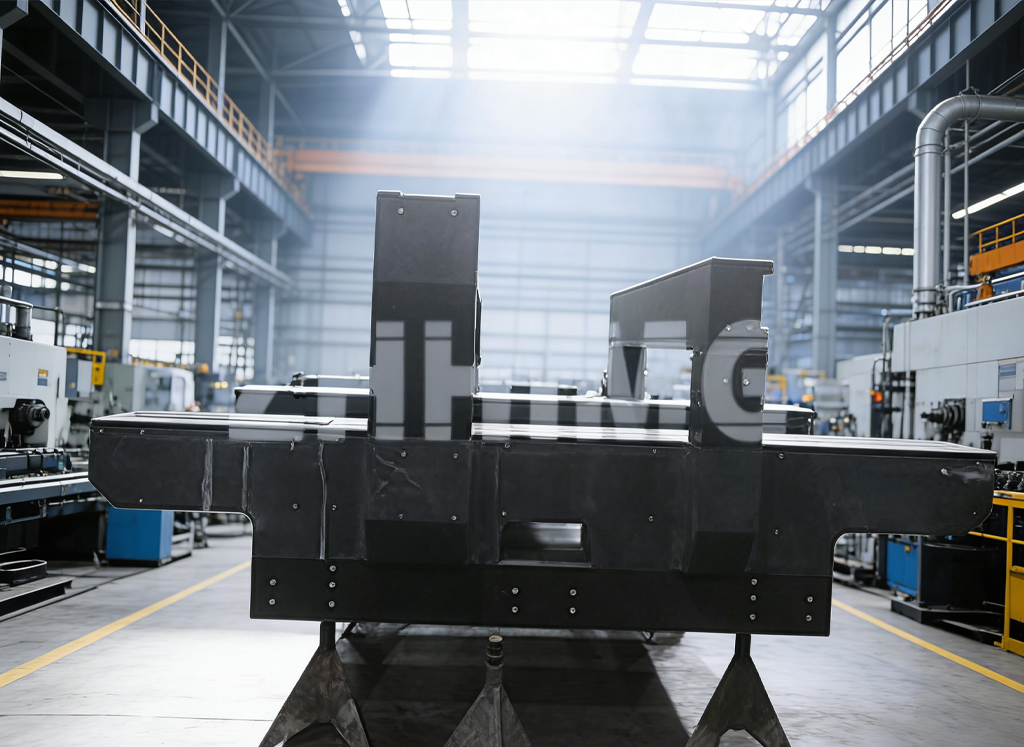
5. Simplify structural design and meet lightweight requirements of cleanroom equipment
Semiconductor equipment features compact internal space and accommodates many optical, motion and vacuum components. If the base is magnetic, designers must add magnetic shielding plates and layers, occupying valuable internal space, increasing total weight and introducing thermal mismatch of dissimilar materials. ZHHIMG non-magnetic granite requires no extra magnetic shielding. The substrate itself serves as benchmark support and basic magnetic isolation. The overall machine structure becomes simpler and more compact. Monolithic granite features high rigidity and good damping performance. Combined with low thermal expansion, it integrates magnetic stability, thermal stability and vibration suppression, matching the trend of compact and stable semiconductor equipment.
6. Applicable equipment scenarios
These non-magnetic granite mechanical systems are widely used in wafer visual inspection machines, probe stations, optical profilometers, laser scanning platforms and high-precision CMMs. Such equipment demands micron or nanometer geometric accuracy while avoiding magnetic disturbance to samples and sensors. Non-magnetic granite serves as an ideal benchmark substrate.
Conclusion
Semiconductor and precision inspection equipment have increasingly strict requirements for magnetic environments. Stray magnetic fields directly affect inspection results and motion stability. ZHHIMG non-magnetic granite mechanical systems feature natural magnetic neutrality, no stray magnetic field generation and no ferromagnetic dust adsorption. Meanwhile, they retain granite’s inherent advantages of low thermal expansion, high rigidity and high damping. Extra magnetic shielding parts are no longer needed. They provide clean and stable benchmark platforms for wafer inspection, optical scanning and precision metrology equipment, satisfying strict precision inspection requirements in the semiconductor industry.
Post time: Sep-18-2026