
1. Zoned Dust Isolation: Block Dust Contact at the Source
Workshop dust mainly comes from stone polishing, CNC cutting, material handling and environmental floating dust. Unzoned mixed operation is the leading cause of dust accumulation and surface damage on granite plates. Faced with cross-operation characteristics of production workshops, ZHHIMG adopts a strict management mode of zoned isolation and dedicated-area use to reduce dust contact fundamentally.
All granite inspection plates are placed in exclusive dust-free areas for precision inspection and assembly, physically separated from dust-generating processes such as rough machining, cutting and grinding through enclosure isolation, area marking and streamline management to avoid cross-area misuse. Plates temporarily placed in ordinary processing areas are fully covered and sealed with dust-proof covers to prevent settlement of suspended dust and cutting debris. Meanwhile, the air purification system of the constant-temperature, constant-humidity and dust-free workshop continuously filters airborne particles and reduces regional dust concentration, building a reliable environmental dust barrier and abandoning the extensive bare-placement mode adopted in ordinary workshops.
2. Standardized Regular Cleaning: Avoid Dust Deposition and Embedding
With nano-level surface accuracy, granite precision plates can suffer irreversible damage from tiny visible dust and hard debris. Conventional cleaning methods such as ordinary wiping and high-pressure air blowing easily cause secondary dust and surface scratches, which are common workshop protection mistakes. In accordance with ultra-precision metrology standards, ZHHIMG formulates exclusive standardized cleaning specifications for daily workshop application.
For daily routine cleaning, professional dust-free microfiber cloths are used for gentle wiping to eliminate scratch risks caused by hard fabrics. Stubborn dust and fine debris are removed through low-pressure dust-free air blowing matched with vacuum absorption, thoroughly cleaning residual dust on plate surfaces, T-slots and threaded holes without residue or secondary dust. After daily operation, full-range refined cleaning is carried out with professional neutral precision detergent to remove dust, oil stains and impurities, followed by natural air drying to prevent water stains from absorbing secondary dust. Adhering to the management principle of real-time cleaning and daily thorough cleaning, staff clean floating dust during operation gaps to prevent dust from embedding into stone micropores and protect the micro-flatness and benchmark accuracy of plate surfaces.
3. Graded Cover Protection: Adapt to Placement Requirements of Different Working Conditions
Granite plates are divided into three service states: high-frequency use, intermittent use and long-term idle storage. A single protection method cannot meet all-scenario demands. ZHHIMG implements a graded dust covering mechanism that balances practicality and precision protection to adapt to diverse workshop production rhythms.
High-frequency used inspection plates are covered with lightweight flexible dust covers during operation gaps to prevent dust settlement while ensuring convenient access. After daily cleaning, thickened fully enclosed dust covers are applied to isolate floating dust generated by night environment changes and equipment maintenance. Intermittently used and turnover plates are placed in constant-temperature dust-free storage areas with full sealed coverage to avoid dust interference from material handling and workshop ventilation. For long-term idle finished plates, double-layer dust-proof film and sealed box storage are adopted in line with professional stone yard dust-free maintenance standards, comprehensively resisting dust and moisture erosion and maintaining long-term surface cleanliness and precision.
4. Standardized Operation Management: Avoid Secondary Dust Pollution
Non-standard operation is the main cause of secondary dust pollution on granite plates. Debris generated by workpiece polishing, fixture disassembly and material stacking easily falls on plate surfaces and causes wear and dust accumulation. Therefore, ZHHIMG establishes strict on-site dust prevention operation specifications to standardize full-process operation details.
Before conducting inspection, assembly and commissioning on granite plates, operators must clean up dust and sundries in the working area. Dust-generating processes including grinding, cutting and drilling are strictly prohibited above the plates. Workpieces and fixtures must be thoroughly dedusted before placement and assembly to avoid dust-carrying operation. Local vacuum equipment is applied during operation to absorb real-time debris and floating dust and prevent settlement on plate surfaces. In addition, on-site staff are required to wear dust-free work clothes and clean gloves to avoid surface pollution brought by clothing dust and hand stains, eliminating secondary dust pollution at the operational source. 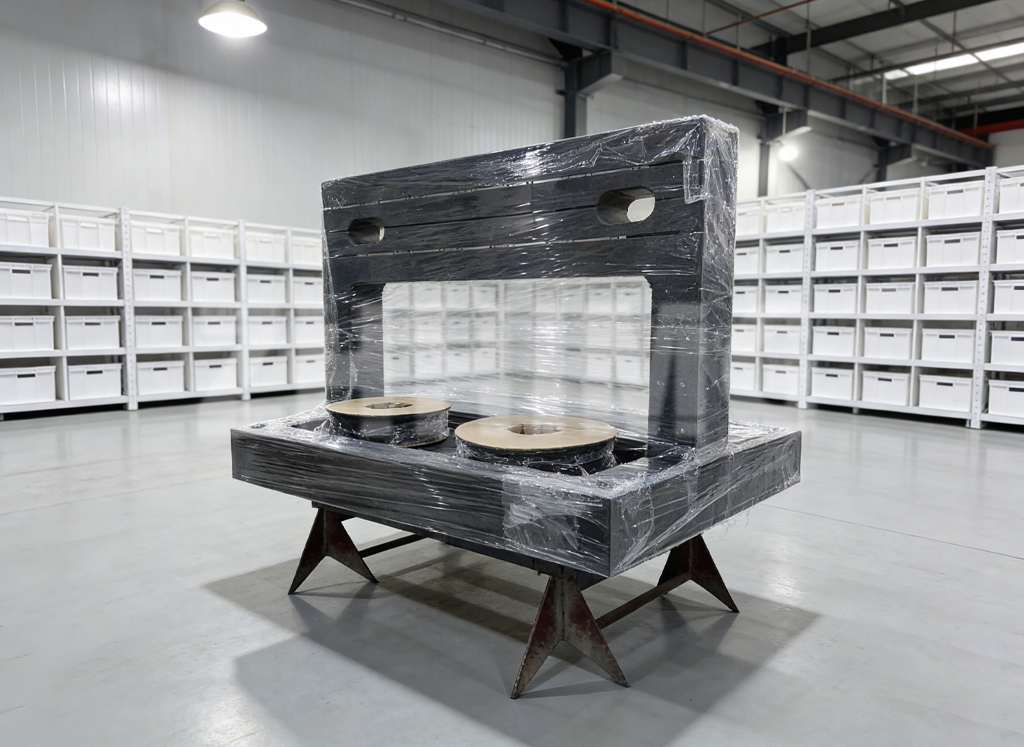
5. Regular Maintenance and Recheck: Balance Dust Prevention and Precision Stabilization
The core goal of dust prevention is to maintain long-term plate accuracy stability. ZHHIMG deeply integrates dust protection with precision maintenance to form a regular recheck mechanism. Long-term dust accumulation not only damages plate surfaces, but also slightly changes surface friction coefficient and fitting accuracy, affecting the reliability of inspection and calibration results.
Workshop maintenance personnel conduct special weekly dust maintenance to clean micropore dust and residual slot-hole debris, inspect the integrity of dust covers and isolation facilities, and replace damaged protective accessories in a timely manner. Monthly precision rechecks are performed with professional testing equipment to verify plate flatness, roughness and benchmark accuracy, eliminating micro-deviation caused by dust wear and contamination. The integrated management of dust prevention, cleaning and precision calibration strictly complies with international metrology standards including German DIN, American ASME and Chinese GB, ensuring stable and reliable plate performance for high-precision scenarios such as semiconductor inspection, laser precision machining and high-end metrology calibration.
Conclusion
The long-term high accuracy of granite inspection plates relies on superior processing technology and refined daily protection. Systematic and standardized on-site dust prevention is a key auxiliary procedure to avoid accuracy attenuation, extend service life and ensure traceable and accurate detection data. With standardized workshop operation systems and full-scenario dust prevention solutions, ZHHIMG integrates refined dust protection into the whole service cycle of granite plates. Matching the ultra-high precision performance of premium products with strict on-site protection standards, the company continuously provides stable and reliable benchmark support for ultra-precision metrology and precision assembly industries worldwide.
Post time: Aug-27-2026