
For granite inspection and measuring plates, which serve as precision metrological reference parts, material properties and lapping processes determine factory‑outlet accuracy. Meanwhile, later‑stage installation, leveling and placement directly affect practical service accuracy and service life. After purchasing high‑precision granite plates, many enterprises overlook installation‑related details, resulting in surface warpage, out‑of‑tolerance flatness and local chipping. Such problems are mistakenly attributed to product quality defects. In fact, most accuracy failures stem from human‑induced factors such as improperly selected supports, incorrect leveling operations, unfavorable placement environments and non‑standard handling procedures.
Drawing on abundant on‑site commissioning experience, ZHHIMG sorts out practical guidelines for granite surface plate installation and placement covering handling, support selection, leveling, environmental arrangement, in‑service protection, relocation and storage. These tips help end‑users give full play to the reference performance of plates and reduce unnecessary accuracy loss and component damage.
First, handling and positioning: avoid point‑load stress and violent impact. As brittle non‑metallic materials, granite components have poor impact resistance. Prying with crowbars or direct hoisting with steel ropes bound onto working surfaces are strictly prohibited. For large‑size plates, hoist via pre‑reserved lifting holes to achieve uniform force on lifting points and prevent invisible internal cracks caused by torsion during lifting. Small‑size plates shall not be dragged manually. Dragging will scratch the bottom and induce torsional stress. Do not drop plates heavily onto supports during positioning; lower them gently. Do not remove all packaging immediately upon arrival; remove cushioning materials step by step to prevent corner chipping during transportation. Internal invisible cracks may show no accuracy abnormality at first, yet trigger flatness drift after a period of service.
Second, properly select support mounts; layout of support points is critical. Simply propping up plates with random iron blocks and improperly‑arranged support points will cause self‑weight deflection even for premium‑quality plates. Matched anti‑vibration adjustable supports are preferred. Support‑point layout shall follow mechanical principles. Multi‑point support is adopted for large‑size plates. Main support points are set at around 1/5 of total plate length away from edges to bear primary loads, while auxiliary supports eliminate partial overhang. Supporting only four corners will lead to downward deflection at the plate center; single‑point central support will cause sagging corners. Contact surfaces of supports shall be clean and flat. Iron filings or granular debris trapped between plate bottom and supports will form local raised fulcrums and deform the working surface.
Third, perform step‑by‑step leveling and allow settling time for stress release. Do not put granite plates into inspection service immediately after one‑shot perfect leveling. Temporary assembly stress is generated during hoisting and relocation. Conduct rough leveling first, leave the plate to settle for several hours for stress relief, then carry out fine leveling. For heavy‑duty large‑size plates, two rounds of settling and leveling are recommended to eliminate temporary deformation caused by self‑weight. Use qualified spirit levels for leveling instead of visual judgment. The target is reasonable horizontal status rather than absolute zero‑level. Focus on eliminating twisting. Forcible over‑leveling by twisting supports will artificially exert torsional stress and impair working‑surface flatness.
Fourth, optimize placement environment to avoid indirect accuracy disturbance. Granite surface plates shall be kept away from strong vibration sources such as stamping machines and cutting equipment. Persistent floor vibration accelerates accuracy degradation and loosens supports. Avoid locations near windows, air outlets or heating devices to prevent one‑sided local heating. Uneven temperature distribution will trigger partial warpage and distorted measurement data. The foundation floor must possess sufficient rigidity. Soft ground or areas with floor settlement are unsuitable for high‑precision granite plates. Foundation settlement changes support force distribution and induces plate deformation. Foundation reinforcement is required if on‑site floor conditions are inadequate. 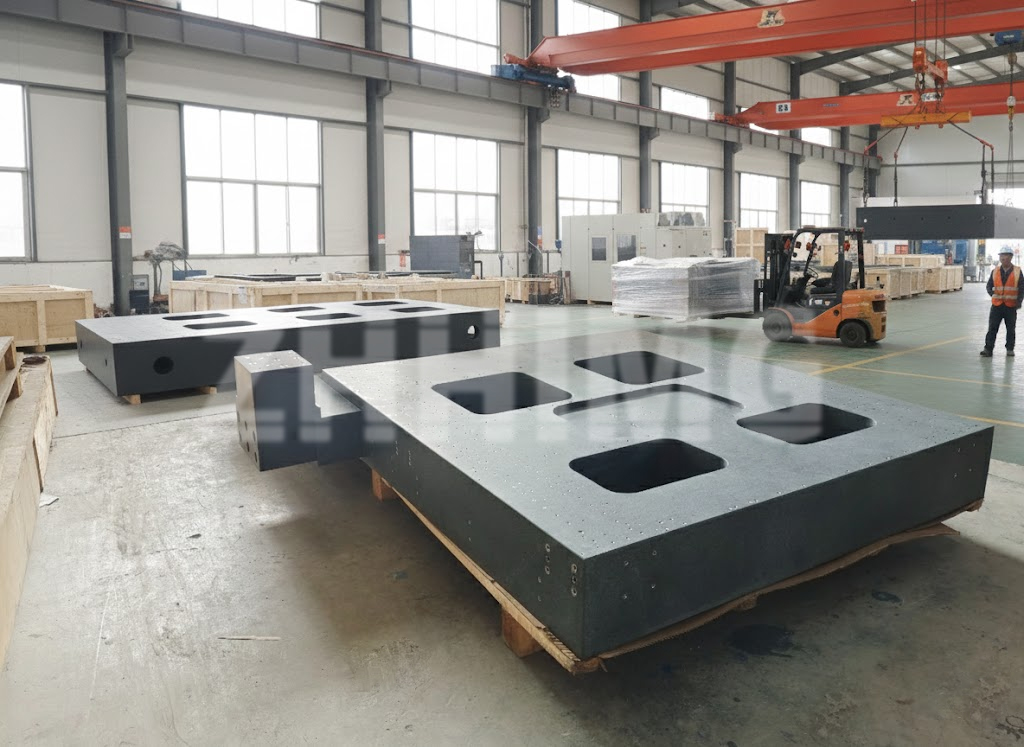
Fifth, precautions for placing workpieces on working surfaces. Never drop heavy workpieces violently onto the plate. Do not drag heavy workpieces, as dragging will scratch the lapped reference surface. Place heavy workpieces close to support points instead of overhanging edges for long‑term service; prolonged local overload will cause irreversible damage. Keep the bottoms of workpiece blocks and gauge bases clean of iron filings and burrs. Particles trapped between workpieces and plates scratch surfaces and produce wrong measurement readings. Chiseling, straightening or knocking operations on granite plates are forbidden; such impacts easily cause edge chipping and internal micro‑cracks.
Sixth, requirements for temporary relocation and long‑term storage. Cover working surfaces with dust‑proof covers after use. Soft padding is recommended for covers; hard steel plates shall not be placed directly on lapped surfaces. Follow hoisting specifications for relocation; never slide plates on supports. Retain original supports for long‑term storage instead of laying plates directly on bare ground. Uneven ground will create point‑contact stress and twisting deformation. Keep dust‑proof protection on working surfaces and regularly check supports for rust and looseness. Never store granite plates in vertical or side‑standing positions; altered force modes may lead to fracture.
Even with fully standardized installation and placement, periodic flatness re‑inspection is required. Calibration every six months to one year is advised according to service frequency to detect accuracy changes caused by loose supports or foundation displacement.
ZHHIMG granite surface plates are delivered with reference instructions for installation and supports. Supported by ISO three‑system certifications, CE and CNAS quality control, ZHHIMG provides technical guidance for installation, placement and daily maintenance besides qualified components. It helps metrology laboratories and machining quality‑inspection workshops sustain long‑term datum accuracy of granite plates and guarantee reliable inspection data.
Post time: Sep-07-2026