
1. Load-Bearing Substrate Selection: Strictly Control Stone Compactness to Avoid Inherent Structural Defects
The foundation of load-bearing structure reinforcement lies in the mechanical properties of the substrate, which is also the primary control point of reinforcement processing. The heavy-load working conditions of gantries impose far higher requirements on stone density, rigidity, compressive strength and structural integrity than ordinary decorative and conventional precision components. Therefore, special high-load black granite substrates must be strictly selected before processing, and low-grade marble and ordinary stones with loose density, disordered texture, trachoma and cracks are firmly rejected. The high-density black granite adopted by ZHHIMG has a density of up to 3100kg/m³, featuring ultra-high compressive strength, extremely low porosity and excellent structural integrity, which fundamentally guarantees the basic compression, bending and deformation resistance of load-bearing structures.
Full-size substrate flaw detection and mechanical screening shall be completed in the early stage of processing, focusing on inspecting hidden internal cracks, delamination, impurity accumulation and other defects of the stone. These defects will gradually expand under heavy load, causing hidden dangers such as structural cracking, local collapse and load offset. Meanwhile, the substrate thickness and specification shall be matched according to the rated load parameters, span size and equipment assembly weight of the gantry. Reducing the specification of load-bearing structural substrates to cut costs is strictly prohibited, so as to avoid structural sagging and elastic deformation during long-term heavy-load operation.
2. Integrated Structural Forming: Reduce Splicing Gaps to Improve Overall Load-Bearing Stiffness
Restricted by equipment conditions, most small manufacturers in the industry adopt segmented stone splicing to produce large gantry load-bearing structures. Splicing gaps greatly reduce overall rigidity, resulting in uneven load distribution, slight structural shaking during dynamic operation and loosening under long-term stress, which are core causes of load-bearing structure failure. In view of this, ZHHIMG adheres to the integrated forming principle in reinforcement processing. Relying on super-large tonnage CNC processing equipment and heavy-duty crane systems, it can realize integral processing of large-span and ultra-long gantry load-bearing structures with a single unit weight of 100 tons and a maximum processing length of 20 meters, completely eliminating segmented splicing structures.
In the process of structural reinforcement design and processing, the overall structural contour of core load-bearing parts such as beams and bases is optimized, adopting thickened base, wide force-bearing surface and arc transition design to avoid right-angle stress concentration. Compared with spliced structures, the integrated structure realizes uniform full-range load distribution without assembly gaps and stress breakpoints, greatly improving the gantry’s overall resistance to heavy load, impact and vibration. It completes core reinforcement in structural form and adapts to the long-term heavy-load dynamic working conditions of semiconductor, laser and precision testing equipment.
3. Stress Relief and Aging Treatment: Avoid Heavy-Load Deformation and Structural Rebound
A large amount of natural internal stress and mechanical processing stress will be generated during the mining and rough processing of granite blanks. If not completely released, the load-bearing structure is prone to stress rebound under long-term heavy load, reciprocating movement and temperature change, causing micro structural deformation, base warping and load offset, which directly affects equipment operation accuracy and structural safety. Therefore, stress control is an indispensable and hidden core procedure in the reinforcement processing of load-bearing structures.
ZHHIMG adopts a graded aging treatment process for large load-bearing components, which is different from the simple static placement process for ordinary precision components. Firstly, the first round of constant-temperature static aging is carried out after rough processing to release the mechanical stress generated by rough cutting, milling and grinding. Then secondary precision trimming is performed, followed by long-term natural aging in a constant-temperature workshop to completely eliminate the natural internal stress and residual processing stress of the stone. Sudden temperature changes, external extrusion and vibration interference are strictly controlled throughout the process to ensure complete stress stabilization of the load-bearing structure, prevent structural deformation in subsequent use, and maintain long-term stable load-bearing size and structural stiffness.
4. Heavy-Load Base Reinforcement Processing: Optimize Stress Layout and Strengthen Local Load-Bearing Capacity
Failure of gantry load-bearing structures mostly occurs in core stress areas such as equipment mounting bases, support points and mid-span suspended areas. Thus, reinforcement processing requires targeted local strengthening instead of uniform homogenization processing. During processing, key reinforcement and trimming shall be carried out on core stress areas according to equipment assembly drawings, gravity center distribution and load points.
A wide flat reinforcement process is adopted for the base support surface to ensure uniform full-range stress and avoid stress concentration caused by single-point suspension and local virtual support. For the suspended heavy-load area in the middle of the beam, the thickness ratio and curve transition are optimized to improve the mid-span sagging resistance. Local densified precision processing is implemented at the mounting points of modules, motors and precision components to enhance local compression and shear resistance. Meanwhile, the parallelism and overall levelness of the load-bearing base are strictly controlled to avoid partial load loss caused by equipment gravity offset after assembly, achieving the reinforcement effect of uniform overall load-bearing and strengthened key-area load-bearing performance. 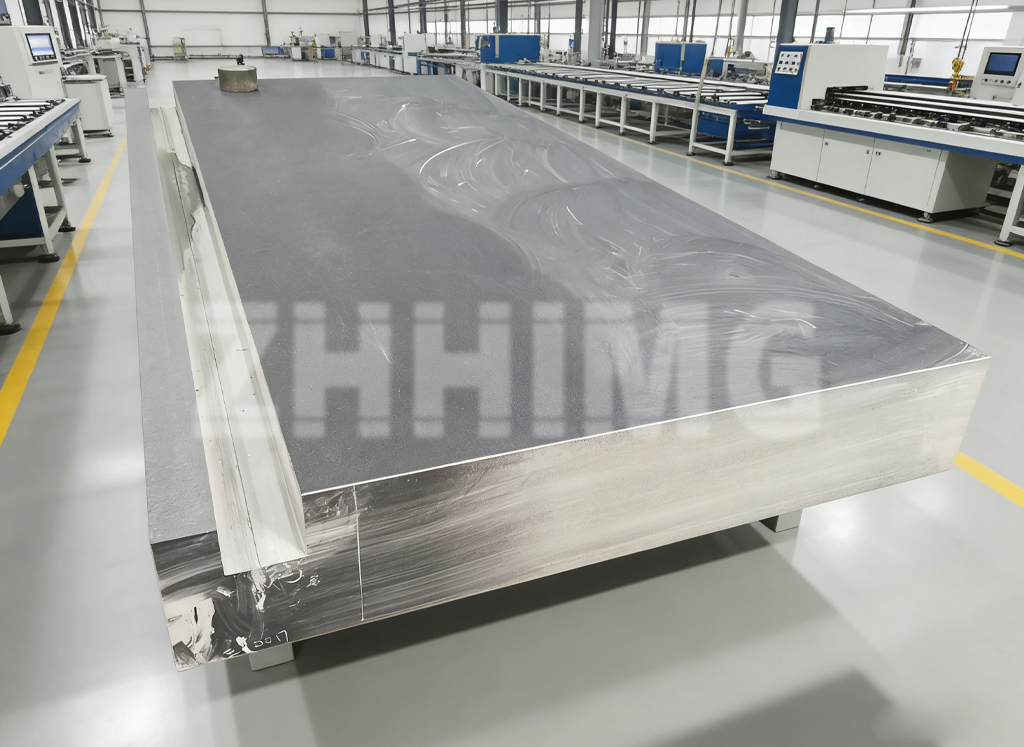
5. Constant-Temperature and Vibration-Isolated Working Condition Control: Ensure Dimensional Stability of Reinforced Structures
The reinforcement processing of load-bearing structures belongs to large-size, large-margin and high-rigidity precision processing. Environmental vibration and temperature fluctuation will cause micro deformation of stones during processing, leading to asymmetric stress and dimensional deviation of reinforced structures, which will be continuously amplified in subsequent heavy-load operation and affect overall structural stability. Therefore, the entire reinforcement processing must be completed in a dedicated constant-temperature, constant-humidity and vibration-isolated workshop.
The ultra-hard thickened concrete floor and deep vibration isolation trenches of the workshop completely isolate external vibration interference and prevent micro displacement and processing deviation of stones during production. The constant temperature and humidity environment offsets the thermal expansion and contraction characteristics of granite, ensuring stable size, shape and stress state of large-size load-bearing components throughout the processing. In addition, silent cranes are used for transportation and positioning assembly in the whole process to eliminate deformation caused by hoisting impact and extrusion, ensuring uniform mechanical properties and accurate dimensional parameters of reinforced load-bearing structures and providing a solid foundation for subsequent stable heavy-load operation.
6. Standardized Precision Testing: Verify Structural Stiffness and Load-Bearing Stability
After reinforcement processing, all-round detection of mechanical stability, dimensional accuracy and stress uniformity of load-bearing structures is required to eliminate hidden structural defects. Different from guide rail surface precision detection, the detection of load-bearing structures focuses on overall parallelism, base flatness, structural symmetry and deformation allowance to ensure uniform overall load distribution.
Equipped with world-class measuring instruments such as British Renishaw laser interferometers, Swiss WYLER electronic levels and German Mahr precision testing equipment, the company conducts full-coverage and multi-point detection on large-size load-bearing structures in accordance with DIN, ASME, JIS, GB and other international standards. It accurately troubleshoots micro structural deformation, uneven stress and local deviation. All test data can be traced to national metrology institutions, ensuring that all reinforced gantry load-bearing structures meet stiffness standards, maintain stable performance, and support long-term rated heavy-load dynamic operation without deformation, offset or fatigue loss.
7. Finished Product Protection and Standardized Warehousing: Lock Long-Term Performance of Reinforced Structures
The structural stiffness and stability of granite load-bearing structures reach the optimal state after reinforcement processing. External collision, uneven compression and environmental deformation during subsequent transportation, warehousing and assembly will damage the reinforcement effect and invalidate previous processing. Therefore, finished product protection is the final key link of load-bearing reinforcement technology.
All reinforced gantry load-bearing components are uniformly stored in a constant-temperature, constant-humidity and dust-free workshop with multi-point uniform support placement to avoid long-term static deformation caused by single-point support. The whole transportation process is protected against vibration, collision and extrusion, and violent hoisting and unilateral stress handling are prohibited. The structural levelness and stability are rechecked before assembly to ensure no attenuation of reinforced structural performance. Through full-process protection and control, the long-term effectiveness of load-bearing structure reinforcement is guaranteed, realizing long-term heavy-load, high-precision and stable operation of the entire gantry.
Post time: Aug-26-2026