
Ultra-precision automation equipment relies on stable geometric benchmarks to guarantee consistent output quality. Many system integrators select spliced granite bases to meet budget limits for large-size platforms. Most acceptance tests carried out before factory delivery are conducted under static, constant-temperature environments over a short timeframe. Such short-term inspection cannot reveal latent structural flaws. Once put into round-the-clock industrial operation, these assembled stone foundations will experience gradual precision loss, which brings unexpected challenges to long-running production lines. Understanding the underlying attenuation mechanism helps engineering teams make rational structural planning at the early design phase.
The initial trigger of precision deviation originates from mismatched physical properties among multiple stone blocks. Even raw materials mined from the same quarry display slight discrepancies in thermal expansion coefficient and internal stress distribution. After cutting, grinding and assembly, residual stress inside each granite segment tends to release slowly. Under cyclic temperature changes that exist in most workshops, individual blocks deform at different rates. Divergent deformation imposes continuous shear stress on bonding layers between splicing surfaces, creating the first source of irreversible benchmark displacement.
Adhesive ageing further accelerates precision deterioration, forming the second critical factor affecting long-term stability. The polymer binder used for joint filling maintains ideal rigidity at the beginning of service. Nevertheless, persistent micro-vibration transmitted from production equipment, combined with humidity fluctuation in the workshop, will trigger material creep of the adhesive. Tiny gaps emerge along splicing interfaces over months and years. Unlike solid monolithic granite without internal joints, these invisible clearances cannot be eliminated through secondary on-site calibration. Every vibration cycle enlarges interface displacement, leading to slow drift of flatness and perpendicularity benchmarks.
The cumulative geometric error will generate tangible operational troubles for high-tech production. In automated optical inspection stations, subtle perpendicularity deviation of the base causes inconsistent image recognition data, raising false detection rates. For continuous laser machining equipment and new energy battery testing platforms, drifting reference standards lead to dimensional deviation of finished products. Operators are forced to arrange periodic full recalibration, occupying normal production hours. In severe cases, unqualified workpieces accumulate continuously until technicians trace the root cause to the deformed splicing structure. 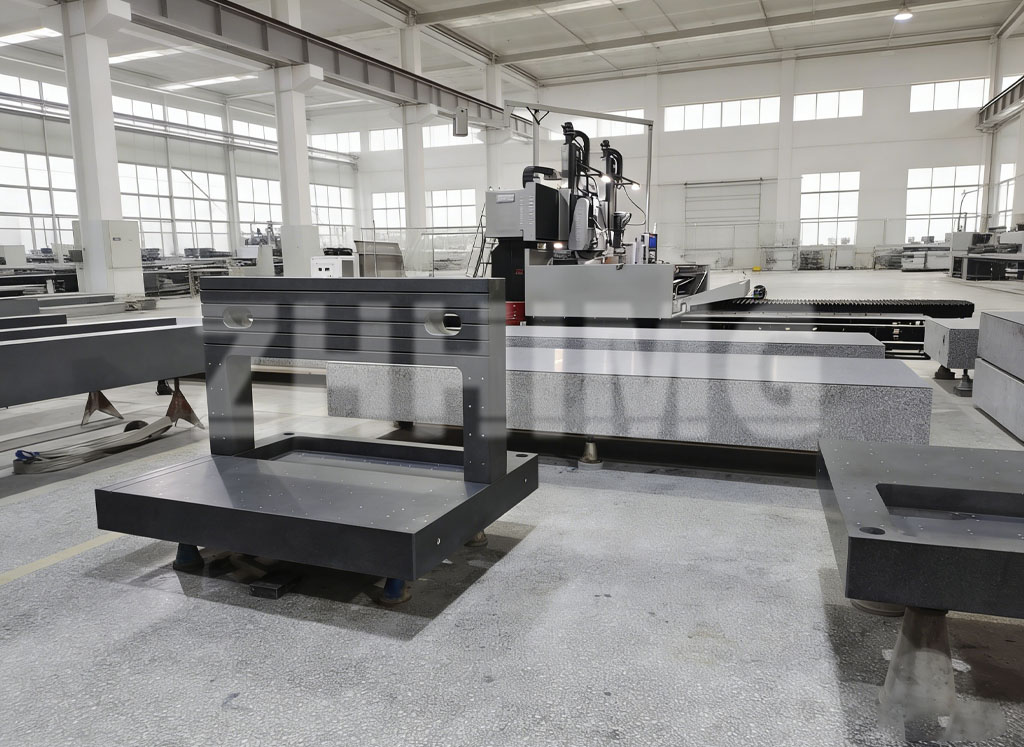
Scenarios requiring decades of uninterrupted precision output demand solutions free from joint-related risks. ZHHIMG offers customised monolithic granite bases manufactured from high-density black granite with density close to 3100kg/m³. Integrated stone structures remove bonding layers and splicing seams entirely, avoiding error accumulation caused by inter-block stress mismatch and adhesive ageing. We objectively communicate structural pros and cons to partners instead of simply pushing high-price products. Many system integrators serving semiconductor, metrology and precision CNC sectors choose our monolithic platforms for long-term operational reliability.
Consistent precision of large-size monolithic granite components relies on rigorous production management. ZHHIMG’s production complex is located in Jinan, enjoying convenient logistics access to Qingdao Port for global shipments. A professional constant temperature and humidity plant equipped with complete anti-vibration infrastructure prevents external disturbance during fine grinding procedures. Advanced heavy-duty grinding machines cooperate with skilled technicians possessing decades of polishing experience. All finished products undergo comprehensive testing using Mahr, Mitutoyo, WYLER and Renishaw inspection equipment. All measuring instruments hold valid certification from official metrology institutions to ensure test authenticity.
Equipped with ISO9001, ISO14001, ISO45001 and CE certifications, ZHHIMG keeps long-term technical exchanges with international metrology research bodies. We abide by the service principle “No cheating, No concealment, No misleading” and provide clients with data-supported structural selection advice.
When designing supporting platforms for ultra-precision equipment, engineers should assess not only initial procurement cost but also long-term precision retention performance. Recognising how splicing structures lose accuracy under continuous working conditions can avoid costly mid-term reconstruction and unplanned downtime. If you are seeking stable granite structural platforms for long-cycle precision production, reach out to ZHHIMG for technical consultation and tailored solutions.
Post time: Jul-30-2026