
For ultra-precision equipment, accuracy bottlenecks often stem not from processing algorithms or optical components themselves, but from persistent micro-vibrations. Subtle vibrations caused by high-speed reciprocation of linear motors, start-stop of transmission mechanisms and operation of surrounding workshop equipment transmit along the machine frame to the inspection surface, magnifying measurement errors and reducing repeatability of imaging, positioning and inspection results. To preserve nanometer-level benchmarks, apart from external vibration isolation tables, the material of the equipment’s base frame serves as the first line of vibration reduction defense. One core value of precision granite components is to directly mitigate vibration interference by virtue of the material’s inherent structure.
Vibration transmission is essentially the conduction and resonant amplification of energy. Metallic substrates feature a high elastic modulus; vibration waves propagate rapidly inside them. Once the excitation frequency matches the natural frequency of the frame, resonance easily occurs and tiny jitters get continuously amplified. Even if external vibration damping pads are installed, they can only isolate part of low-frequency vibrations from the ground. Internal vibrations generated by the equipment’s own movement still reflect repeatedly within the metal structure and continuously compromise the stability of the reference surface.
Industrial black granite features tightly interwoven crystals and an innate high-damping microstructure. When vibration energy enters the stone bulk, dense crystal interfaces continuously consume vibrational kinetic energy, converting vibration energy into minimal heat for dissipation, quickly attenuating amplitude and preventing continuous superposition of vibration and resonance. This material-native damping property is an inherent characteristic and will not degrade with long-term equipment service, unlike external vibration reduction materials such as rubber and foam that age and fail over time.
Vibration damping performance varies drastically among different stone types. Marble has loose crystals, abundant internal pores and uneven texture, offering limited vibration attenuation capacity and hardly suppressing high-frequency micro-vibrations. ZHHIMG adopts high-density black granite with a density of up to 3100kg/m³. It boasts uniformly arranged internal crystals. Raw blocks undergo long-term aging treatment with no hidden cracks. Integrated monolithic granite components can be directly used as equipment reference bases, gantry beams and substrates for air-bearing platforms. They absorb vibration energy at the source of vibration generation, instead of passively isolating vibrations after they spread. 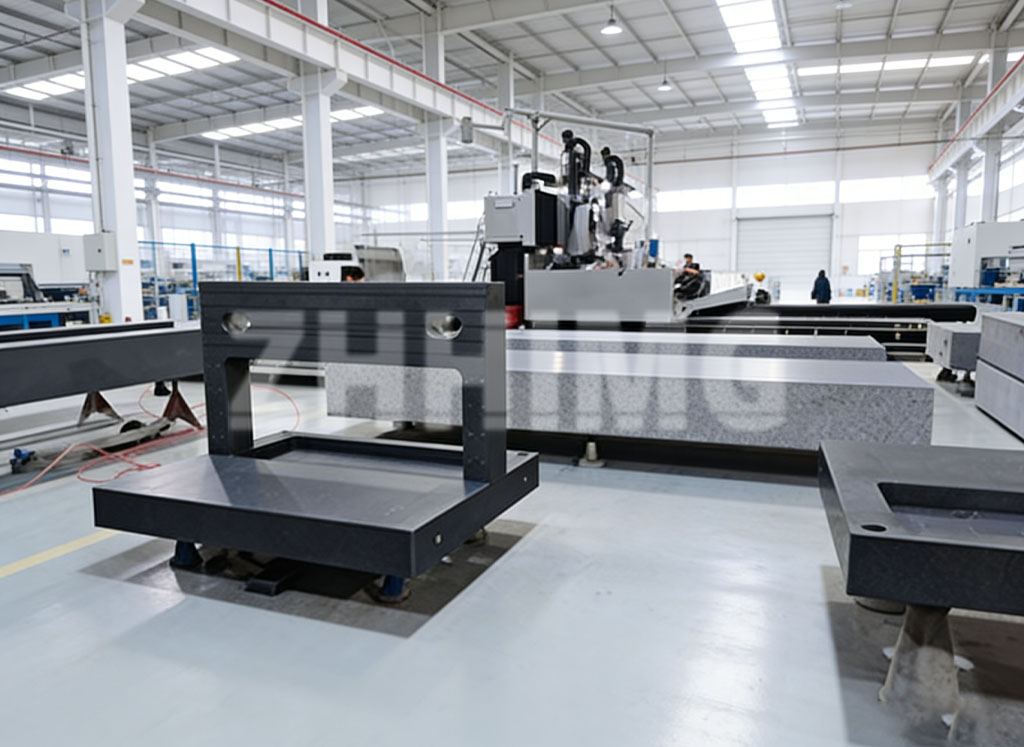
This native vibration damping advantage delivers outstanding value in high-frequency precision scenarios. Femtosecond and picosecond laser processing, AOI optical inspection, X-ray flaw detection, semiconductor wafer inspection and coordinate measuring machines are extremely sensitive to micro-vibrations. Even jitters of merely tens of nanometers will lead to blurred imaging, positioning offset and fluctuating inspection data. Equipped with granite reference components, vibrations generated by the equipment’s own motion are largely attenuated before reaching the measurement working surface. There is no need to stack numerous complex vibration reduction assemblies, simplifying the overall machine structure while improving long-term operational stability of equipment.
Objectively speaking, the vibration suppression capability of granite is not omnipotent. It excels at absorbing medium and high-frequency micro-vibrations produced inside equipment. For severe impact vibrations from external sources, it still requires coordinated protection with external structures such as professional anti-vibration trenches and shock-absorbing bases. When building constant-temperature workshops, ZHHIMG adopts independent anti-vibration trench design, forming a dual internal-and-external vibration reduction system together with the inherent damping of granite components to maximally protect benchmark precision.
In summary, precision granite components are not merely load-bearing bases but benchmark carriers with built-in vibration suppression capacity. Relying on the material’s high damping property, they weaken vibration interference generated during equipment operation from the source, reducing perturbation to measurement and positioning benchmarks, and helping ultra-precision equipment steadily maintain micron and even nanometer working accuracy. This is the key reason why they are continuously selected for high-end metrology, semiconductor and laser equipment.
Post time: Sep-14-2026